Choosing the best GCE A Level subjects is one of the most critical decisions you will make during your secondary education in Cameroon. The Advanced Level certificate administered by the Cameroon GCE Board does more than mark your completion of high school—it defines your academic trajectory, determines your eligibility for university admission, and sets the foundation for competitive entrance examinations (concours).
Many Lower Sixth and Upper Sixth candidates select subject combinations based on peer recommendations or perceived difficulty rather than strategic career planning. Choosing incompatible or non-prerequisite subjects can lock you out of premier faculties like Medicine (CUSS/FHS), Engineering (ENSP/FET), Law, and Business Administration (ESSEC), regardless of how high your overall points are.
What Makes a Subject Combination “The Best”?
The ideal subject portfolio balances three core elements:
- Faculty Prerequisite Alignment: Fulfilling the mandatory subject entry requirements for professional faculties and national entrance examinations.
- Point Maximization Potential: Selecting subjects where you can realistic achieve top grades (Grades A and B) to accumulate up to 15 points across 3 principal subjects.
- Academic Versatility: Keeping career pathways open if you decide to adjust your higher education plans after graduation.
What This Guide Covers
In this comprehensive guide, you will discover:
- High-Yield Science Tracks: The gold-standard subject combinations for Medicine, Pharmacy, Civil/Mechanical Engineering, and Computer Science.
- Top Humanities & Arts Tracks: The strongest combinations for Law (LLB), Political Science, International Relations (IRIC), and Journalism.
- High-Performing Commercial Tracks: Optimal subject pairings for Corporate Finance, Accounting, Economics, and Management degrees.
- Strategic Selection Rules: How to balance practical workloads, avoid combination traps, and utilize study packages on 237exams.com.
Let’s dive into the top science tracks for university admission.
High-Yield Science Tracks (Medicine, Engineering & IT)
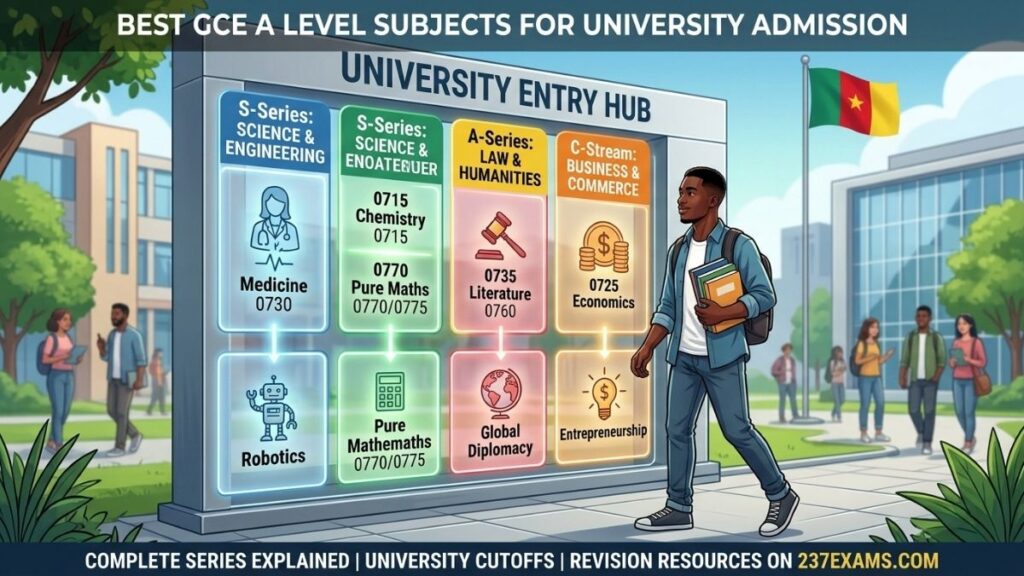
Science subject combinations within the Cameroon GCE Advanced Level framework are designated under the S-Series. Gaining entry into top science faculties and passing competitive national entrance examinations (concours) requires choosing a combination tailored to your target field.
Medical & Health Sciences Track (Series S2 & S3)
For candidates aiming for Faculty of Health Sciences (FHS) programs, CUSS (Faculty of Medicine and Biomedical Sciences), Pharmacy, or Dentistry, biological and chemical mastery is mandatory.
- Core Combination:Chemistry (
0715) + Biology (0710) + Physics (0780) or Pure Mathematics (0770/0775). - Why It Works:Chemistry (0715) and Biology (0710) form the absolute baseline prerequisite for nearly all medical concours in Cameroon. Pairing them with Physics (0780) provides the biophysics background needed for medical imaging, radiology, and biomedical engineering, while Pure Mathematics offers strong analytical grounding for epidemiology and pharmacology.
- Target Pathways: Doctor of Medicine (MD), Pharmacy, Medical Laboratory Sciences, Nursing, Public Health, and Biotechnology.
Engineering & Physical Sciences Track (Series S1)
Candidates pursuing structural, mechanical, electrical, or civil engineering must prioritize quantitative rigor and physical principles.
- Core Combination:Pure Mathematics (
0770/0771) + Physics (0780) + Chemistry (0715). - High-Power Alternative (Series S6): Add Further Mathematics (
0775) as a 4th subject for an ultra-competitive edge in polytechnic entrance exams. - Why It Works: This classic trio fulfills the mandatory requirements for the National Advanced School of Engineering (ENSP), the Faculty of Engineering and Technology (FET), and regional polytechnic institutes. Mathematics provides the calculus foundation, Physics covers mechanics and thermodynamics, and Chemistry supplies the materials science base.
- Target Pathways: Civil Engineering, Electrical Engineering, Mechanical Engineering, Petroleum Engineering, Renewable Energy, and Architecture.
Technology & Computer Science Track (Series S4/S5 Variants)
With the rapid expansion of digital tech and software infrastructure, technology-focused A Level tracks have become among the most sought-after by university applicants.
- Core Combination:Pure Mathematics (
0770/0775) + Computer Science (0795) or ICT (0796) + Physics (0780). - Why It Works: Combining pure mathematics with applied computing gives candidates immediate proficiency in algorithms, discrete structures, and hardware logic. University tech faculties (such as COT, COLTECH, and UB Computer Science) strongly prefer candidates with prior practical programming experience from A Level Computer Science (
0795). - Target Pathways: Software Engineering, Artificial Intelligence, Data Analytics, Cybersecurity, Telecommunications, and System Architecture.
Top Humanities & Arts Tracks (Law, Social Sciences & Media)
Arts and Humanities subject combinations are categorized under the A-Series (Series A1 through A5) by the Cameroon GCE Board. Candidates pursuing legal, diplomatic, linguistic, or administrative professions should choose combinations that foster critical evaluation, logical argumentation, and strong essay writing skills.
Legal & Administrative Track (Series A1 & A5)
For students intending to study Law (LLB) at public universities (e.g., University of Buea, University of Yaoundé II, University of Bamenda) or enter magistrate and administrative pathways, analytical essay subjects are vital.
- Core Combination (Series A5):Literature in English (
0735) + History (0760) + Philosophy (0790). - Alternative Option (Series A1):Literature in English (
0735) + History (0760) + French (0745). - Why It Works:Literature in English sharpens textual analysis, legal comprehension, and critical synthesis. History provides structural grounding in constitutional evolution and governance, while Philosophy delivers formal logic and ethical reasoning—core foundations for legal arguments.
- Target Pathways: Bachelor of Laws (LLB), Political Science, Public Administration, Judiciary Studies, and Human Rights Law.
Diplomacy & International Relations Track
Candidates aiming for diplomatic training, political science, or international organization careers require strong bilingualism, global awareness, and geographical context.
- Core Combination:History (
0760) + French (0745) + Literature in English (0735) or Geography (0750). - Why It Works: Combining bilingual language proficiency (French and Literature in English) with historical and geopolitical context (History and Geography) builds the mandatory profile for international development work and diplomatic entrance pathways (such as post-graduate entries into IRIC).
- Target Pathways: International Relations, Diplomacy, Foreign Policy, Translation/Interpretation (ASTI), and Development Studies.
Media, Journalism & Social Sciences Track (Series A2 & A3)
For students targeting communications, journalism, sociology, or public relations, dynamic social science subject pairings yield strong admission profiles.
- Core Combination (Series A2/A3):History (
0760) + Geography (0750) + Economics (0725) or Literature in English (0735). - Why It Works: Fulfills the entry requirements for journalism entrance examinations like ASMAC / ESSTIC (Advanced School of Mass Communication). Geography and Economics provide data-driven insights into societal trends, demographic shifts, and market structures, while History and Literature ensure clear narrative communication.
- Target Pathways: Mass Communication, Journalism, Public Relations, Sociology, Demography, and Environmental Resource Management.
High-Performing Commercial Tracks (Finance, Accounting & Business)
Commercial tracks offer direct pathways into corporate finance, banking, auditing, management consulting, and business administration. Candidates aiming for top university management faculties or professional accounting certifications (such as ACCA, CIMA, or CPA) must pair quantitative rigor with solid economic and administrative theory.
Corporate Finance & Accounting Track
For candidates targeting high-level financial careers, investment banking, or auditing, combining quantitative problem-solving with financial accounting principles yields an unbeatable admission standing.
- Core Combination:Accounting (
0705) + Economics (0725) + Pure Mathematics (0770/0775). - Why It Works:Accounting (
0705) delivers essential principles in financial reporting, corporate balance sheets, and cost management. Economics (0725) covers macroeconomic policies, market structures, and international trade. Adding Pure Mathematics provides the calculus and statistical foundation needed for quantitative financial modeling, risk analysis, and corporate valuation. - Target Pathways: Bachelor of Science in Accounting, Corporate Finance, Auditing & Control, Banking and Risk Management, and immediate exemptions in professional accounting pathways (ACCA/CIMA).
Business Management & Enterprise Track
For candidates aspiring to managerial roles, entrepreneurship, marketing, or general business administration across local and international enterprises.
- Core Combination:Economics (
0725) + Accounting (0705) + Geography (0750) or Management / Commerce (7025/7030). - Why It Works: Fulfills entry criteria for leading management schools (such as ESSEC Douala and university management faculties in Buea, Bamenda, and Dschang). Geography adds vital understanding of demographic trends, trade logistics, and environmental resource management, which complements corporate strategy and market expansion models.
- Target Pathways: Business Administration (BBA), Marketing & Brand Management, Human Resource Management, Entrepreneurship, Supply Chain & Logistics, and International Trade.
Generalist Combinations to Keep Options Open
If you are entering Lower Sixth without a finalized career choice, selecting a generalist subject combination prevents premature specialization. These strategic combinations leverage high-versatility subjects that satify prerequisite criteria across multiple distinct university faculties simultaneously.
The Power of “Bridge” Subjects
Certain GCE A Level subjects serve as academic bridges across traditionally separate streams:
- Pure Mathematics (
0770/0771): The single most versatile A Level subject. Mathematics acts as a universal bridge, granting entry into Engineering, Computer Science, Economics, Business Finance, Environmental Science, and quantitative Social Sciences. - Economics (
0725): Serves as an excellent bridge subject for both Humanities and Science candidates. Paired with Arts subjects, it enables pathways into Law and International Relations; paired with Mathematics and Sciences, it opens doors to Financial Engineering, Actuarial Science, and Econometrics. - Geography (
0750): Accepted in both Science (S3) and Arts (A2/A3) series. It provides entry into Environmental Sciences, Geology, Urban Planning, and Public Administration.
Top Versatile Combinations
| Combination | Bridge Subject | Target Faculties |
|---|---|---|
| Pure Math, Physics, Further Math, Chemistry, Biology | Pure Mathematics & Biology | Engineering, Tech, Medicine, Pharmacy, Environmental Sci, Agriculture. |
| Economics, Geography Pure Math, ICT | Pure Mathematics, Economics | Corporate Finance, Econometrics, Law, Journalism, Banking, Business, Political Science |
Strategic 3-Subject vs. 4-Subject Portfolios
- The 3-Subject Strategy (Recommended): Concentrating your preparation on 3 primary subjects allows deep syllabus coverage and higher grade targets (aiming for AAA or AAB). Professional entrance examinations (concours) and university admissions prioritize overall points scored over the sheer volume of subjects attempted.
- The 4-Subject Strategy (Safety Net): Taking 4 subjects (such as adding Further Mathematics to an S1 combination or French to an Arts track) offers a safety margin. If performance drops in one paper, your top 3 subject grades can still yield a competitive 12 to 15-point profile.
Common Subject Selection Mistakes to Avoid
Choosing your GCE A Level subjects requires careful planning. Even high-performing students can jeopardize their university placement by falling into common selection traps during registration.
Avoid these critical mistakes when finalizing your subject combination:
Critical Selection Pitfalls
- Ignoring Faculty Prerequisites (Concours Requirements): A common mistake is prioritizing high points over mandatory subject requirements. For example, earning 15 points in Literature, History, and Geography will not grant entry into Medical School (CUSS), as Chemistry and Biology are non-negotiable prerequisites. Always check specific faculty requirements before registering.
- Overloading on Practical Subjects: Taking three 3-paper practical subjects (such as Biology, Chemistry, and Computer Science) in a single examination session creates significant exam stress. Managing timed laboratory practicals alongside dense theoretical papers requires careful planning and time management.
- Selecting Weak or Incompatible Combinations: Pairing subjects with no clear academic connection (such as Literature in English, Pure Mathematics, and Accounting) dilutes your subject focus. Admissions boards prefer coherent portfolios (S-Series, A-Series, or Commercial Tracks) that demonstrate a clear academic direction.
- Neglecting Ordinary Level Foundations: Attempting quantitative or lab-heavy A Level subjects (like Physics, Chemistry, or Further Mathematics) without a strong foundational pass at Ordinary Level often leads to poor performance. Ensure your academic baseline supports your A Level ambitions.
- Failing to Check Timetable Conflicts: The Cameroon GCE Board does not adjust timetables or reschedule papers for conflicting subject choices. Always verify your subject combination against the official exam schedule prior to submission.
Summary & University Entry Hub on 237exams.com
Selecting the best GCE A Level subjects requires aligning your academic strengths with clear university entry goals. Whether you choose a specialized Science track (such as PCM or BCP), an Arts & Humanities series (such as LHP or LHF), or a Commercial track (such as EAM), your primary goal should be meeting faculty prerequisites while maximizing your point total on the 15-point scale.
Key Takeaways for Subject Selection
- Verify Entrance Requirements Early: Double-check mandatory subject prerequisites for competitive entrance examinations (concours) and professional faculties across Cameroonian and international universities before finalizing your registration file.
- Focus on Quality and Point Yield: Prioritize achieving top letter grades (Grades A and B) across 3 principal subjects over taking a 5-subject load with lower scores.
- Maintain Career Flexibility: If your university choice is undecided, include versatile bridge subjects—such as Pure Mathematics or Economics—to keep multiple professional pathways open.
Elevate Your Revision Strategy with 237exams.com
Achieving top grades at the Advanced Level demands targeted practice with official Cameroon GCE Board examination materials. Prepare for your exams with direct access to revision tools on 237exams.com:
- Download Official GCE A Level Syllabi & Subject Outlines (PDF)
- Access Past A Level Question Papers
- Explore Solved Revision Pamphlets & Professional Concours Prep Sets
Visit 237exams.com today to download your Advanced Level revision packages and secure your pathway to higher education success!