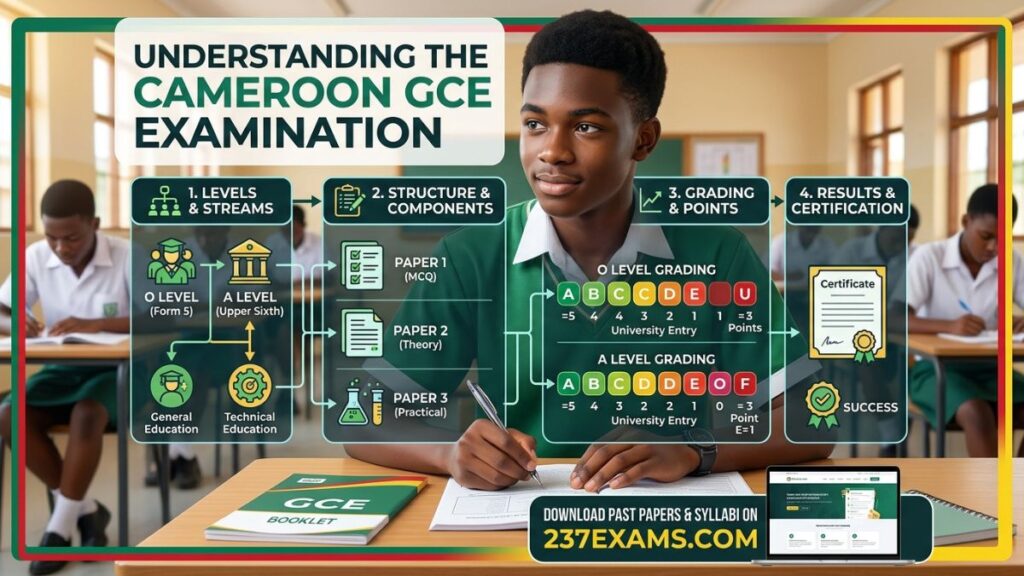
Understanding how the Cameroon GCE Examination works is essential for every secondary school student and private candidate aiming for academic success in Cameroon. Created under the Anglo-Saxon educational tradition and managed by the Cameroon GCE Board, this national examination serves as the official benchmark for academic progression and university admission.
Navigating subject choices, complex paper weightings, and grading scales can feel overwhelming without a clear roadmap.
What Makes the GCE System Unique
The Cameroon GCE Board operates a standardized assessment system designed to evaluate both theoretical comprehension and practical expertise:
- Two Main Academic Tiers: Divides secondary education assessment into Ordinary Level (O Level) and Advanced Level (A Level) qualifications.
- Dual Stream Options: Offers General Education subjects alongside Technical and Vocational Education (TVE) pathways.
- Criterion-Referenced Evaluation: Assesses student performance against fixed national performance standards rather than curved percentages.
What You Will Learn in This Guide
This operational breakdown covers the fundamental mechanics of the examination system:
- Level Breakdown: The distinct roles of Ordinary and Advanced Level certifications.
- Subject Selection Rules: Mandatory core requirements and maximum subject limits.
- Paper Anatomy: How Paper 1 (MCQs), Paper 2 (Theory), and Paper 3 (Practicals) contribute to your final score.
- The Official Grading Scale: How letter grades translate into university point calculations.
- Download Hub: Direct links to download official syllabi and past question papers on 237exams.com.
Let’s dive into the core structure of the examination levels.
Examination Levels & Target Qualifications
The Cameroon GCE Examination is divided into two distinct academic levels, each catering to specific milestones in a student’s secondary education journey. Additionally, the Board caters to technical and professional tracks through specialized streams.
Comparison of Examination Levels
| Feature | Ordinary Level | Advanced Level |
|---|---|---|
| Academic Stage | Form 5 | Upper Sixth |
| Target age | ~ 15 – 16 | ~ 17 – 18 years old |
| Prerequisite | First School Leaving Certificate | Official O-Level Pass |
| Primary purpose | Secondary School Graduation | Direct University entry qualification |
Ordinary Level (O Level)
- Target Audience: Students completing their fifth year of general secondary education (Form 5).
- Objective: Assesses foundational competence across humanities, sciences, and languages.
- Outcome: Earning an Ordinary Level certificate validates the completion of lower secondary education and grants admission into High School (Lower Sixth).
Advanced Level (A Level)
- Target Audience: High school students completing two years of post-O-Level studies (Upper Sixth).
- Objective: Assesses advanced analytical skills, critical thinking, and specialized knowledge in specific academic disciplines.
- Outcome: Serving as the gold standard for tertiary education admission, A Level results determine candidate placement into universities and professional higher institutes across Cameroon and abroad.
Technical & Vocational Education (TVE)
To support technical training, the Cameroon GCE Board offers parallel technical qualifications:
- Intermediate Technical Examination (ITC): Equivalent to Ordinary Level, assessing commercial, industrial, and vocational skills.
- Advanced Technical Examination (ATC): Equivalent to Advanced Level, providing entry into professional university programs and higher technical institutes.
How the Cameroon GCE Examination Works: Complete Guide for Candidates
Subject Selection Rules & Compulsory Requirements
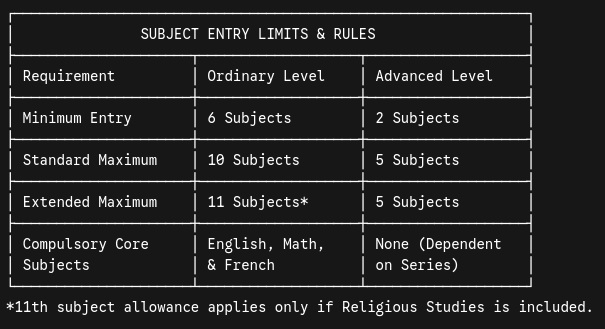
Subject selection is governed by strict rules set by the Cameroon GCE Board to ensure balanced academic foundations. First-time candidates must satisfy specific subject thresholds and core subject mandates.
Subject Selection & Limits Comparison
Ordinary Level Subject Rules
- Minimum Requirement: All first-time candidates must register for a minimum of 6 subjects.
- Compulsory Core Trio: Registration must include English Language, Mathematics, and French (or Special Bilingual Education French).
- Subject Cap: Candidates can register for up to 10 subjects under standard rules, or 11 subjects if Religious Studies is selected as the 11th paper.
Advanced Level Subject Rules
- Entry Prerequisites: Candidates must hold an official O Level certificate with passing grades (A, B, or C) in at least 4 subjects.
- Registration Limits: Candidates register for a minimum of 2 subjects and a maximum of 5 subjects.
- Stream Specialization: While there are no board-wide compulsory subjects at A Level, candidates choose subjects aligned with their intended career tracks:
- Sciences: Physics, Chemistry, Biology, Further Mathematics, Pure Mathematics with Mechanics/Statistics.
- Arts & Humanities: Literature in English, History, Geography, Philosophy, Economics, French.
- Commercials: Accounting, Economics, Management, Law.
Question Paper Structure & Examination Components
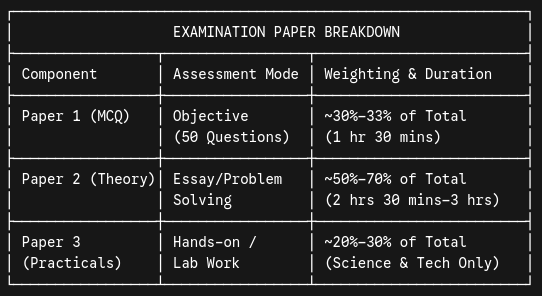
Every subject in the Cameroon GCE Examination is evaluated using a multi-paper framework. Combining objective testing, structured essay questions, and practical assessments ensures a comprehensive measure of a candidate’s overall competence.
Anatomy of GCE Assessment Components
Paper 1: Multiple Choice Questions (MCQ)
- Format: Consists of 50 compulsory multiple-choice questions covering the entire syllabus breadth.
- Duration: Typically 1 hour and 30 minutes.
- Scoring: Machine-marked using automated optical mark readers. Candidates record their answers by shading lettered bubbles (A, B, C, or D) on specialized MCQ response sheets using HB pencils.
Paper 2: Theory, Problem-Solving & Essays
- Format: Structured theoretical questions, calculations, or extended essay prompts divided into distinct sections.
- Duration: Ranges from 2 hours and 30 minutes to 3 hours depending on the subject and level.
- Scoring: Evaluates deep subject understanding, logical reasoning, and clear writing skills. Candidates select a specific number of questions (e.g., answering 4 out of 7 questions) as specified on the paper cover.
Paper 3: Practical Examinations
- Target Subjects: Compulsory for natural sciences (Physics, Chemistry, Biology), Computer Science, ICT, and specialized vocational subjects.
- Execution: Conducted in school laboratories and computer centers under strict invigilator supervision. Candidates perform real-time experiments, record data, analyze results, or build functional code/circuits.
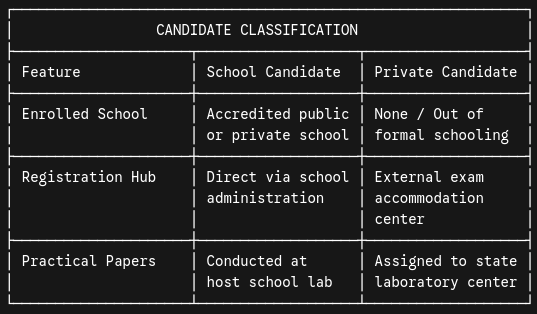
- Alternative to Practical: Private candidates taking certain science subjects may sit for a written “Alternative to Practical” paper if access to full laboratory facilities is restricted.
The Official GCE Board Grading System
Performance in the Cameroon GCE Examination is evaluated using a standardized criterion-referenced grading system. Letter grades are assigned for each subject, which are then converted into numerical grade points for certificate qualification and tertiary institution admissions.
Ordinary Level (O Level) Grading Matrix
At the Ordinary Level, candidates receive letter grades ranging from A down to U. A candidate must secure a minimum grade of C to earn a pass in any given subject.
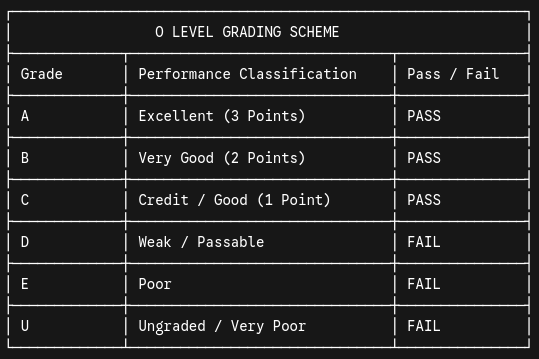
- Overall Certificate Award: To obtain an official O Level certificate, a candidate must pass in at least 4 subjects in a single sitting.
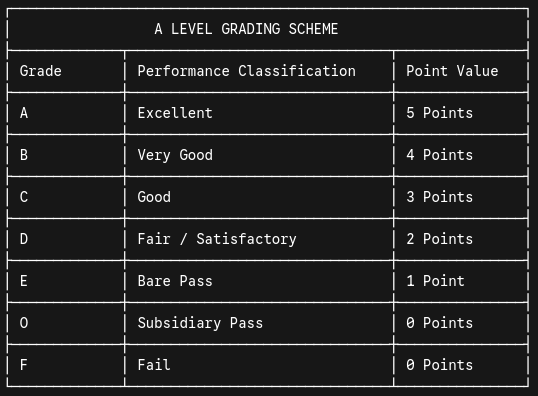
Advanced Level (A Level) Grading Matrix
At the Advanced Level, passing grades range from A to E. Grade O represents a subsidiary level pass, while F denotes an absolute failure.
Calculating University Admission Points
Higher education institutions in Cameroon and abroad calculate candidate admission scores based on their top A Level subject grades:
- Maximum Subject Value: An A grade yields 5 points, while an E grade yields 1 point.
- Three-Subject Scale: Most university faculties (such as Medicine, Engineering, or Law) evaluate candidates out of a maximum of 15 points (calculated from their 3 best principal subjects, e.g., points).
- Subsidiary Passes: Grade O indicates that a candidate failed to reach the full A Level pass standard but demonstrated sufficient performance to earn credit at the Subsidiary/Ordinary level.
Candidate Categories & Examination Workflow
Registering for and sitting the Cameroon GCE Examination involves a structured administrative cycle managed directly by the Cameroon GCE Board in partnership with regional accommodation centers.
Internal vs. External Candidates
Step-by-Step Examination Lifecycle
The journey from registration to official qualification follows six major milestones:
- 1. Candidate Registration & Fee Payment: Registrations run electronically via the GCE Board payment portal (GCEPAY). Candidates complete their subject entry forms, pay standardized registration fees, and submit biometric photos to their assigned center.
- 2. Timetable & Slip Issuance: Candidates verify their entries and receive an official Individual Timetable (IT) bearing their unique Candidate Index Number and registered subjects.
- 3. Main Examination Window: Written, oral, and practical sessions take place nationally between May and June at designated accommodation centers.
- 4. Script Marking & Result Processing: Answer scripts are masked for anonymity and evaluated at centralized marking centers by board-appointed examiners.
- 5. Result Publication: Official results are released nationally between July and August. Candidates can check their grades online or view printed pass lists at their examination centers.
- 6. Certificate Issuance: Official printed GCE certificates with security features are issued to candidates through their registration centers several months following result publication.
Summary & Study Center on 237exams.com
Navigating the Cameroon GCE Examination successfully comes down to clear planning, early subject strategy, and understanding how every paper contributes to your final grades. Whether you are aiming for an Ordinary Level foundation or calculating Advanced Level points for university entry, mastering the structure behind the exam gives you a distinct advantage on test day.
Core Takeaways for Candidates
- Understand Your Targets: Know the minimum subject requirements and specific grade boundaries needed for your chosen academic or professional stream.
- Master the Paper Weights: Balance your preparation across Paper 1 (MCQs), Paper 2 (Theory), and Paper 3 (Practicals)—every mark builds your final letter grade.
- Stay Compliant: Respect all board registration timelines, verify your Individual Timetable (IT) early, and follow exam hall conduct to protect your results.
Download Syllabi & Revision Past Papers on 237exams.com
Equip yourself with the best preparation tools available. Visit 237exams.com to access free, comprehensive revision materials tailored to the Cameroon GCE Board syllabus:
- Download Official Cameroon GCE Subject Syllabi & Regulations (PDF)
- Download GCE Ordinary Level and Advanced Level Past Questions
Combine thorough subject revision with smart exam strategy on 237exams.com, and step into your examination sessions fully prepared to excel!