Preparing for the GCE Cameroon Ordinary Level (O Level) and Advanced Level (A Level) examinations is one of the most significant academic milestones in a student’s life.
The pressure to perform well can feel overwhelming. You are faced with expansive syllabi, stringent marking schemes, and the knowledge that your final results will directly shape your future higher education options, scholarship eligibility, and career path.
Why the Cameroon GCE Demands a Targeted Approach
Administered by the Cameroon General Certificate of Education (GCE) Board in Buea, the national GCE examinations are designed to rigorously test both foundational understanding and critical analytical skills.
Unlike standard classroom term tests, board examinations demand:
- Strict adherence to official marking keys and specific subject terminologies.
- Flawless time management across multiple subjects and paper formats (MCQs, structured essays, and practical labs).
- The ability to apply theoretical concepts to novel, high-level problem scenarios.
Candidates who rely solely on general textbooks or late night cramming often fall short. Success requires training with authentic GCE Cameroon past papers and understanding precisely what examiners look for.
What You Will Learn in This Guide
Whether you are an O Level candidate building a strong academic foundation or an A Level student striving for maximum university admission points, this guide provides a complete roadmap for success.
In the following sections, we will cover:
- Board Architecture: The exact structure, entry requirements, and paper formats for both O Level and A Level.
- Stream Breakdown: Subject combination strategies for Science, Arts, and Commercial tracks.
- The Grading Matrix: How grades (A–E) are calculated and converted into university points.
- The “GCE Top-Rank Revision Strategy”: A step-by-step methodology to master marking schemes and boost Paper 1 speed.
- Free Download Hub: Direct access to PDF past questions and model solutions on 237exams.com.
Let’s begin by understanding the inner workings of the Cameroon GCE Board.
Understanding the Cameroon GCE Board & Structure
Created by Presidential Decree in 1993, the Cameroon General Certificate of Education (GCE) Board, headquartered in Buea, oversees the setup, regulation, and administration of secondary and technical education examinations for Anglophone and bilingual candidates across the national territory.
Understanding how the Board structures its examinations is the first step toward effective preparation.
1. Ordinary Level (O Level)
The GCE O Level examination marks the completion of five years of secondary education (Forms 1 through 5). It measures broad foundational knowledge across general, commercial, and technical subjects.
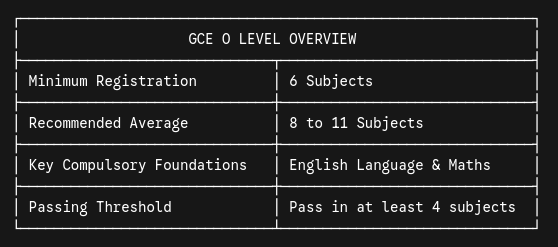
- Core Requirement: Passing English Language, French Language, and Mathematics is essential; these three subjects are required for admission into high school Advanced Level programs, professional training colleges, and tertiary institutions.
- Paper Breakdown: Most subjects consist of Paper 1 (Multiple Choice Questions) and Paper 2 (Structured/Essay Questions). Some sciences such as Computer Science and Food Science include an additional compulsory Paper 3 (Practical Laboratory Assessment).
2. Advanced Level (A Level)
The GCE A Level examination takes place after two years of high school specialization (Lower Sixth and Upper Sixth). It is a rigorous pre-university qualification designed to test deep subject mastery, analytical synthesis, and critical thinking.
- Subject Combinations: Candidates typically sit for 3 to 5 subjects aligned with their target university discipline (e.g., Science, Arts, or Commercial streams).
- The A Level Gateway: A Level results determine direct entry into public and private universities, as well as eligibility for competitive professional entrance exams (concours) such as medical schools, engineering faculties, and teacher training colleges.
3. General vs. Technical GCE
The Cameroon GCE Board conducts two main examination tracks:
- General GCE (O & A Level): Tailored for academic progression in the Arts, Humanities, Pure Sciences, and Social Sciences.
- Technical & Vocational GCE (ITC & ATC): Designed for vocational and technical specialties, focusing on practical skills alongside theoretical components in fields like Electrical Technology, Building Construction, Home Economics, and Business Trades.
GCE Cameroon O Level Guide
The Ordinary Level (O Level) examination is designed to test candidates on fundamental concepts across languages, natural sciences, human sciences, and commercial disciplines.
Succeeding at the O Level requires knowing how to navigate different paper types and practicing regularly with authentic exam questions.
Core Subject Streams at O Level
Candidates typically select 8 to 10 subjects divided across three major academic tracks:
- Sciences: Mathematics, Physics, Chemistry, Biology, Human Biology, Computer Science, and Additional Mathematics.
- Arts & Humanities: English Language, Literature in English, French, History, Geography, Citizenship Education, Logic, and Religious Studies.
- Commercials & Economics: Economics, Accounting, Commerce, and Business Mathematics.
Compulsory Rule: To qualify for a full GCE O Level certificate, candidates must register for English Language, Mathematics, and French as part of their subject selection.
Breakdown of Paper Formats
For almost all O Level subjects, the examination is split into two or three distinct papers:
- Paper 1 (Multiple Choice Questions – MCQs): Consists of 50 compulsory objective questions to be completed in 1 hour 30 minutes. This paper tests broad syllabus coverage, quick calculations, and factual recall.
- Paper 2 (Structured Theory & Essay Questions): Typically lasts 2 hours to 2 hours 30 minutes. It tests deep comprehension, problem-solving, structured proofs, and essay composition.
- Paper 3 (Practical Examinations): Required for practical subjects like Computer Science and Food & Nutrition. Candidates carry out hands-on laboratory experiments/tasks or software exercises under timed conditions.
Access O Level Past Questions on 237exams.com
Mastering time management for Paper 1 MCQs and understanding Paper 2 question phrasing is best achieved by working through previous board papers.
Download complete PDF sets of past questions, worked solutions, and revision keys on 237exams.com:
- Download GCE O Level Mathematics Past Papers
- Download GCE O Level Additional Mathematics Past Papers
- Download GCE O Level English Language Questions
- Download GCE O Level Literature Questions
- Download GCE O Level Physics Past Papers
- Download GCE O Level Chemistry Past Papers
- Download GCE O Level Biology Past Papers
- Download GCE O Level Economics Past Papers
- Download GCE O Level History Past Papers
- Download GCE O Level Geography Papers
Next, let’s explore the structure, subject combinations, and past paper hub for GCE A Level!
GCE Cameroon A Level Guide & Past Papers
The Advanced Level (A Level) examination is a high-stakes, pre-university assessment. It demands a shift from rote memorization to high-level analysis, critical evaluation, and advanced problem-solving.
Because A Level performance directly dictates entry into university faculties and professional institutions (concours), strategic subject selection is critical.
Popular A Level Subject Streams
High school students typically choose 3 to 5 subjects that form a coherent specialization stream:
1. The Science Stream
- Combinations: Physics – Chemistry – Mathematics (PCM), Biology – Chemistry – Physics (BCP), Biology – Chemistry – Pure Mathematics (BCM), or Biology – Chemistry – Geology (BCG).
- Career Pathways: Medicine, Software & Civil Engineering, Pharmacy, Chemical Technology, and Industrial Research.
2. The Arts & Humanities Stream
- Combinations: Literature in English – History – French (LHF), History – Geography – Economics (HGE), Economics – History – Literature (EHL), Philosophy – Literature – History (PLH), or Religious Studies – Literature – History (RLH).
- Career Pathways: Law, International Relations, Journalism, Diplomacy, Educational Leadership, and Public Policy.
3. The Commercial & Social Sciences Stream
- Combinations: Accounting – Economics – Management (AEM), Economics – Mathematics – Geography (EMG), or Accounting – Economics – Commerce (AEC).
- Career Pathways: Financial Auditing, Banking, Corporate Law, Business Analytics, and Global Supply Chain Management.
Paper Structure at A Level
Each A Level subject consists of multiple specialized papers designed to assess different cognitive dimensions:
- Paper 1 (MCQs): 50 complex multiple-choice items testing rapid numerical calculations, logical deduction, and fundamental theory across the entire 2-year syllabus.
- Paper 2 (Core Theory & Essay Problems): Rigorous, multi-part questions requiring detailed proofs, mathematical derivations, structured chemical mechanisms, or extended critical essays.
- Paper 3 (Advanced Practicals / Specialized Case Essays): Hands-on laboratory experiments (for Physics, Chemistry, Biology) or real-world problem sets (for subjects like Computer Science and Geography).
Access A Level Past Questions on 237exams.com
To score top grades (A, B, C) at A Level, practicing with past board questions is non-negotiable.
Download authentic A Level PDF papers, detailed marking guides, and model answers on 237exams.com:
- Download A Level Pure Mathematics Past Papers
- Download A Level Further Mathematics Exam sets
- Download A Level Physics Past Papers (PDF)
- Download A Level Chemistry Past Papers
- Download A Level Biology Past Exam Sets
- Download A Level Literature Past Papers
- Download A Level History Past Papers
- Download A Level Geography Past Papers
- Download A Level Economics Past Papers
- Download A Level Accounting Past Papers
- Download A Level Management Papers
Next up, let’s look at Section 5: The GCE Grading System & University Points Calculation!
The GCE Grading System & University Points Calculation
Understanding how your GCE performance is evaluated helps you set clear target grades for higher education. The Cameroon GCE Board uses a standardized grading letter scale for both O Level and A Level examinations.
Official Grade Scale Breakdown
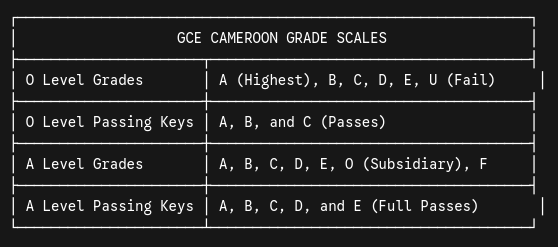
- O Level Distinction & Credit Scale: Grades A, B, and C represent official passes. Grades D and E indicate poor performance below pass standard, while U represents an Ungraded fail.
- A Level Full Pass Scale: Grades A, B, C, D, and E are full principal passes. Grade O represents a subsidiary pass (equivalent to an O Level standard pass), while F denotes a complete failure.
The A Level University Admission Points Formula
When applying to higher education faculties, professional training schools, or competitive entrance examinations (concours) across Cameroon and abroad, your letter grades are converted into a numerical points scale.
Points are calculated on a 5-point scale per paper:
Calculating Your Total A Level Points
Your total points score is the sum of points earned across your principal subjects:
- Maximum Score (3 Subjects): (Straight A’s)
- Competitive Entry Benchmark: Most professional schools (such as Medicine, Engineering faculties, or ASTI) typically require a minimum of 10 to 12 points in relevant subject combinations.
Minimum Certificate Validity Criteria
To possess a recognized, valid qualification for university enrollment and official employment:
- O Level Certificate: You must secure passes (Grade C or above) in at least 4 subjects, including English Language.
- A Level Certificate: You must obtain a minimum of 2 principal passes (Grades A through E) in a single sitting.
The “GCE Top-Rank Revision Strategy”
Scoring top grades (A and B) in the Cameroon GCE is not just a test of how many hours you spend studying—it is a test of how strategically you prepare.
Many candidates read textbooks repeatedly, yet struggle when confronted with actual exam papers. To maximize your performance on both Paper 1 (MCQs) and Paper 2/3 (Theory and Practicals), apply this proven four-step revision framework:
Step 1: Align Your Study Plan with the Official GCE Syllabus
Never study blindly using generic or outdated international textbooks. The Cameroon GCE Board publishes specific syllabi detailing exact learning objectives, key definitions, and required mathematical derivations for every subject.
- Map Out Syllabus Modules: Highlight topics you have mastered in green, topics needing review in yellow, and unstudied areas in red.
- Focus on Heavy-Weight Topics: Prioritize core modules that consistently appear in past papers (e.g., Organic Reaction Mechanisms in A Level Chemistry or Calculus in Pure Mathematics).
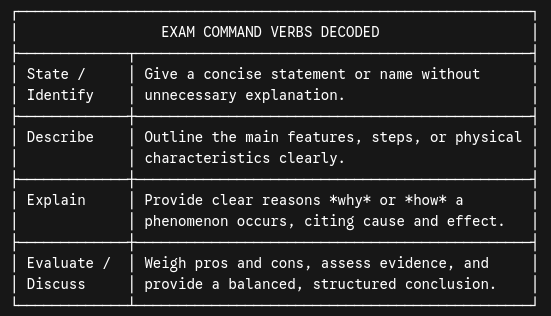
Step 2: Master the Board’s Marking Scheme Vocabulary
Examiners grade thousands of papers strictly following pre-determined marking keys. Understanding key command verbs in question prompts prevents lost marks:
Step 3: Optimize Paper 1 Speed & Elimination Tactics
Paper 1 MCQs carry significant credit weight, yet time is extremely tight (50 questions in 90 minutes—giving you roughly 1.8 minutes per question).
- Use the Two-Pass System: On your first pass, answer every question you can solve immediately in under 45 seconds. On your second pass, return to complex calculations or reasoning problems.
- Practice Process of Elimination: Cross out obviously incorrect options first to increase your guessing odds on tough questions from 25% to 50%.
Step 4: Time-Bound Practice & Mock Simulation
Knowledge without exam-room discipline leads to unfinished papers.
- Simulate Real Exam Conditions: Set a timer, clear your workspace, and complete full 2-to-3-hour past papers without looking at notes.
- Grade Yourself Against Answer Keys: Identify common mistakes, such as missing units in calculation steps, weak intro paragraphs in literature essays, or messy scientific diagrams.
Summary & Download Center on 237exams.com
Excelling in the GCE Cameroon Ordinary and Advanced Level examinations is entirely within your reach when you combine consistent study habits with smart exam tactics. By mastering the official syllabus, understanding the board’s marking schemes, and putting yourself through timed practice sessions, you can turn exam-day anxiety into complete confidence.
Your Final GCE Success Checklist
- Know Your Syllabus: Ensure you have covered all compulsory modules for both O Level and A Level subjects.
- Practice Time Management: Train with Paper 1 MCQs to build speed, and practice Paper 2 structured questions to refine your formatting and argument structure.
- Master the Points System: Target top grades in your primary A Level combination to secure the 10+ points required for competitive university entrance exams (concours).
- Leverage Authentic Past Papers: Never rely purely on class notes—study real GCE Board questions and model answer keys.
Download Your GCE Preparation Materials
Take the next step in your exam preparation. Visit 237exams.com to download organized PDF past question papers, answer keys, and mock examination sets for both O and A Levels:
- Download GCE O Level and A Level Past Papers (PDF)
- Download GCE Board Syllabi & Revision Guides
Start downloading your past papers today, put your study plan into action, and secure the grades you need for your academic future!