
The GCE broadsheet is often very difficult to understand at first glance.
You see letters: A, B, C, D, E, O, U.
Some are printed in bold. Others come attached with administrative tags like SRC or FI.
Here is the problem:
Most candidates only look at their name on the list. If their name is there, they assume they passed. If it is missing, they assume they failed.
That is a dangerous mistake.
Understanding the exact GCE grades meaning is the difference between securing a spot at top universities—like the University of Buea or University of Bamenda—and having your application quietly rejected.
The Cameroon GCE Board uses two completely different grading scales for Ordinary Level and Advanced Level. A Grade D at O-Level means something entirely different from a Grade D at A-Level.
In this guide, we break down every single letter grade, point value, and administrative code published by the Cameroon GCE Board.
No fluff. No confusion. Just the exact facts you need to read your results like an insider.
GCE O-Level Grades Meaning (Ordinary Level & TVEE Intermediate)
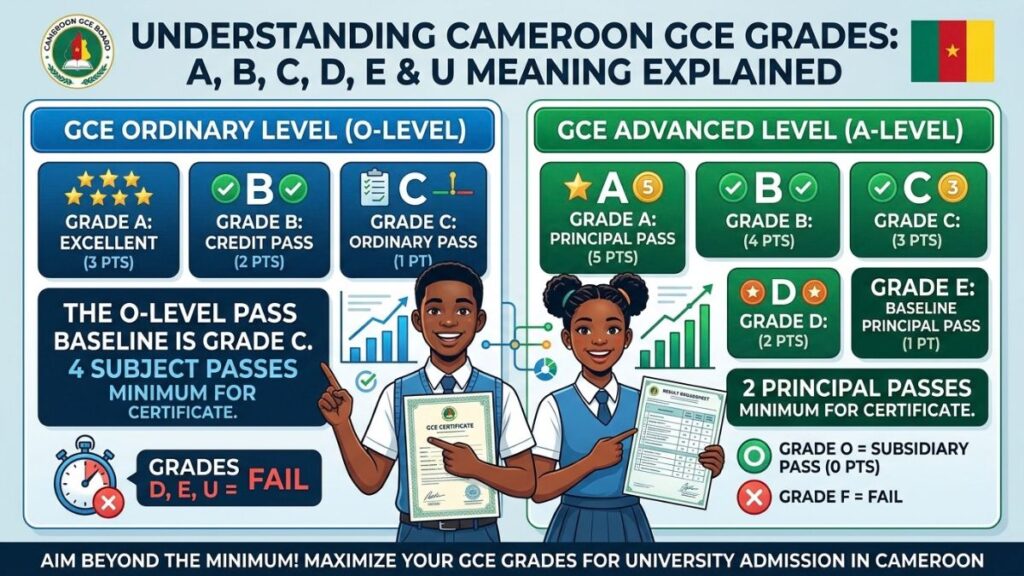
At the Ordinary Level (and TVEE Intermediate Level), the GCE Board evaluates performance across six letter grades: A, B, C, D, E, and U.
Knowing the exact GCE grades meaning at this level comes down to one clear line: the separation between passing and failing.
Here is the exact breakdown of what each letter grade means on your official transcript:
Grade A (3 Points) — Highest Distinction
- Performance: Exceptional subject mastery.
- Status: Pass.
- Point Value: .
- What it means: You scored in the top percentile for that subject. Securing Grade A passes boosts your aggregate point total toward the maximum 33-point benchmark.
Grade B (2 Points) — Credit Pass
- Performance: Strong, above-average understanding.
- Status: Pass.
- Point Value: .
- What it means: You demonstrated solid subject knowledge. Grade B passes are highly competitive for technical tracks and science combinations in High School (Lower Sixth).
Grade C (1 Point) — Ordinary Pass
- Performance: Satisfactory performance meeting baseline standards.
- Status: Pass (Minimum Baseline).
- Point Value: .
- What it means: Grade C is the absolute baseline pass mark at O-Level. It counts fully toward your minimum 4-subject requirement for a full GCE Certificate.
Grade D (0 Points) — Subsidiary Fail
- Performance: Weak / Below standard.
- Status:FAIL.
- Point Value: .
- The Reality Check: A widespread myth among candidates is that Grade D is a “subsidiary pass.” It is not. At Ordinary Level, Grade D is legally classified as a fail. It contributes and cannot be counted toward your 4-subject certificate minimum.
Grades E & U (0 Points) — Direct Fail & Ungraded
- Grade E: Serious subject deficiency (Fail).
- Grade U: Ungraded / Completely below assessment criteria (Fail).
- Point Value: .
- What it means: Neither grade appears as a passed subject on your final GCE certificate.
GCE A-Level Grades Meaning (Advanced Level & TVEE Advanced)
At the Advanced Level, the game changes completely.
The Cameroon GCE Board uses a 7-grade scale for A-Level: A, B, C, D, E, O, and F.
Understanding the GCE grades meaning at this level requires knowing the difference between a Principal Pass and a Subsidiary Pass.
Here is the precise breakdown:
Grade A (5 Points) — First-Class Principal Pass
- Status: Principal Pass.
- Point Value: .
- What it means: The highest achievable grade at A-Level. Securing an A gives you maximum leverage for ultra-competitive university programs like Medicine (CUSS), Engineering (FET/Polytechnic), and Law.
Grade B (4 Points) — Upper Division Principal Pass
- Status: Principal Pass.
- Point Value: .
- What it means: Excellent performance. It puts you well above the standard admission cut-offs for most state university faculties.
Grade C (3 Points) — Solid Principal Pass
- Status: Principal Pass.
- Point Value: .
- What it means: Strong, average performance. A string of C grades easily secures your 2-principal pass requirement for a full A-Level Certificate.
Grade D (2 Points) — Fair Principal Pass
- Status: Principal Pass.
- Point Value: .
- What it means: Unlike at O-Level (where D is a fail), Grade D is a valid pass at A-Level. It earns you toward your university aggregate score.
Grade E (1 Point) — Baseline Principal Pass
- Status: Principal Pass (Minimum Threshold).
- Point Value: .
- What it means: Grade E is the absolute minimum principal pass mark at A-Level. It counts toward your 2-subject certificate requirement and adds to your total score.
Grade O (0 Points) — Subsidiary Pass (Ordinary Level Equivalent)
- Status:Subsidiary Pass / Non-Principal.
- Point Value: .
- The Reality Check: Grade O means your performance fell below the A-Level principal standard, but matched Ordinary Level standard.
- Does it count? It proves subject knowledge at the O-Level baseline, but it does NOT count as a principal pass toward your 2-subject certificate rule or university entry points.
Grade F (0 Points) — Complete Fail
- Status:FAIL.
- Point Value: .
- What it means: Total failure to meet minimum examination standards. No points or credit awarded.
Quick Reference Matrix: Comparing O-Level & A-Level Grades
Need a fast side-by-side comparison?
Here is how the Cameroon GCE Board translates every letter grade into official status, point values, and certificate eligibility across both examination levels:
| Letter Grade | O-Level Status | O-Level Points | A-Level Status | A-Level Points | Counts for Certificate? |
| Grade A | Pass (Distinction) | 3 Points | Principal Pass | 5 Points | Yes (Both Levels) |
| Grade B | Pass (Credit) | 2 Points | Principal Pass | 4 Points | Yes (Both Levels) |
| Grade C | Pass (Ordinary) | 1 Point | Principal Pass | 3 Points | Yes (Both Levels) |
| Grade D | FAIL | 0 Points | Principal Pass | 2 Points | A-Level Only |
| Grade E | FAIL | 0 Points | Principal Pass | 1 Point | A-Level Only |
| Grade O | N/A | N/A | Subsidiary Pass | 0 Points | No (A-Level Principal) |
| Grade F | FAIL | 0 Points | FAIL | 0 Points | No |
| Grade U | FAIL (Ungraded) | 0 Points | N/A | N/A | No |
Key Takeaways from the Matrix:
- The “D” Split: Grade D is a complete fail at Ordinary Level, but a valid principal pass at Advanced Level worth .
- Maximum Points: Aggregate points are awarded starting at Grade C for O-Level (max 3 pts/subject) and Grade E for A-Level (max 5 pts/subject).
- The “O” Trap: Grade O at A-Level confirms standard baseline knowledge, but delivers zero principal points for university admission.
Special Administrative Status Codes (Beyond Letter Grades)
Sometimes, instead of a standard letter grade like A or C, you will spot an administrative code printed next to a candidate’s name or subject line on official broadsheets.
These codes are not grades. They are official status designations issued directly by the Cameroon GCE Board.
Here is what every code means and how it affects your overall result:
FI — Further Investigation
- Status: Result Withheld / Under Review.
- What it means: The Board flagged your paper for administrative or technical checks before final release. This can happen due to missing center attendance sheets, unregistered paper codes, clerical script mismatches, or suspected irregularity.
- Action Required: Do not panic. FI does not automatically mean you cheated. Report immediately to your Chief of Centre with your original Registration Slip and Individual Timetable (IT). Once the Board resolves the query, cleared results are updated on supplementary broadsheets.
SRC — Subject Result Cancelled
- Status: Sanction / Partial Cancellation.
- What it means: The GCE Board officially cancelled your performance in one specific subject due to proven examination malpractice (e.g., smuggling notes, using unauthorized electronic devices, or collusion in the hall during that paper).
- Impact: You receive a fail/cancelled status for that specific paper. However, your valid grades in other uncompromised subjects during the same session remain intact and count toward your total score.
ARC — All Results Cancelled
- Status: Severe Sanction / Full Cancellation.
- What it means: The highest administrative penalty imposed by the Board. All subject results for that session are erased completely.
- Why it happens: Issued in cases of grave, systemic, or repeated malpractice—such as impersonation, physical assault on invigilators, organized center-wide cheating, or script substitution.
- Impact: You leave the exam session with zero valid results. Candidates hit with an ARC sanction are typically banned from registering for subsequent examination sessions for a designated period (usually 1 to 3 years).
How Your Grades Impact University Admissions & Concours
Scoring passing grades is step one. Step two is understanding how higher institutions convert those letter grades into admission cut-off points.
Whether you are applying to state universities in Anglophone regions or sitting for national competitive entrance examinations (Concours), your grade profile dictates your options.
State University Baseline Point Calculations
Anglophone universities—such as the University of Buea (UB) and the University of Bamenda (UBa)—evaluate candidates using total A-Level points accumulated from principal passes:
- General Arts & Social Science Faculties: Typically require a baseline minimum of 2 Principal Passes with an aggregate of at least 2 to 4 Points (e.g., or ).
- Science & Technology Faculties: Require 2 or 3 Principal Passes in relevant science subjects, usually demanding 6 to 9 Points minimum (e.g., ).
- High-Demand Professional Programs: Fields like Computer Engineering or Medical Laboratory Sciences often require an aggregate threshold of 10+ Points (e.g., ).
Converting GCE Grades for Competitive Entrance Exams (Concours)
When applying to professional schools—such as ENS (Teacher Training), FET/Polytechnic (Engineering), or CUSS/FMSB (Medicine)—or Francophone state universities, GCE letter grades are converted onto the 20-point scale () used in the national system.
While exact conversion formulas vary slightly by faculty board, the standard conversion scale applied for point weighting is:
| GCE Letter Grade | A-Level Grade Equivalent (/20) | O-Level Grade Equivalent (/20) |
| Grade A | (Excellent) | (Very Good) |
| Grade B | (Very Good) | (Good) |
| Grade C | (Good) | (Average) |
| Grade D | (Pass) | (Below Average / Fail) |
| Grade E | (Bare Pass) | (Fail) |
| Grade O / F | (Fail / Non-Principal) | (Fail) |
The “Subject Requirement” Rule
Point totals alone will not guarantee admission if you miss core prerequisite subjects.
- Engineering Programs: Require principal passes in Pure Mathematics and Physics regardless of your total score.
- Medical Programs: Mandatory principal passes in Chemistry and Biology, with Physics or Pure Math as key supporting subjects.
- Law Programs: Mandatory O-Level pass in English Language alongside relevant A-Level humanities.
Frequently Asked Questions (FAQs)
Is Grade D a pass mark at GCE O-Level in Cameroon?
No. At the Ordinary Level, Grade D is legally classified as a subsidiary fail. It carries and cannot be counted toward the 4-subject requirement needed to earn a full GCE Ordinary Level Certificate.
How many points is an ‘E’ grade worth at A-Level?
A Grade E at the Advanced Level is worth 1 point. It represents the baseline principal pass threshold, meaning it counts as a valid principal pass toward your minimum 2-subject certificate requirement and university admission score.
Does an ‘O’ grade at A-Level count toward my 2-principal pass requirement?
No. An O grade is an Ordinary Level subsidiary pass equivalent. While it indicates that you demonstrated baseline O-Level knowledge in that subject, it carries and does not fulfill the 2-principal pass rule for an Advanced Level Certificate.
Can I get into university in Cameroon with only 1 A-Level pass?
State universities in Cameroon generally require a minimum of 2 principal passes ($E$ grade or higher) for direct degree entry. Scoring a single principal pass yields an official Result Slip, but you will typically need to sit for a supplementary paper or enter through diploma/certificate bridging programs before advancing into a full degree track.
What is the maximum number of points I can score at GCE A-Level?
It depends on how many subjects you take. Since each Grade $A$ principal pass is worth $5 \text{ points}$, the maximum aggregate score is 15 points for 3 subjects, 20 points for 4 subjects, and 25 points for 5 subjects.
Conclusion
Understanding the exact GCE grades meaning transforms your results broadsheet from a cluster of confusing letters into a clear, strategic roadmap for your future.
Whether you are calculating your total points for university admissions or checking if you met the baseline subject minimums for an official certificate, keep these key benchmarks in mind:
- At O-Level: Aim for Grade C or higher across at least 4 subjects (including English Language) to secure a valid certificate and smooth high school progression.
- At A-Level: Target Grade E or higher in at least 2 principal subjects to earn a full A-Level Certificate and qualify for higher education entry.
- For University & Concours: Remember that letter grades convert directly into point values (A=5 down to E=1 at A-Level). High points combined with the right core subjects give you maximum competitive leverage for top faculties across Cameroon.
Don’t just check if your name appeared on the broadsheet—verify your points, double-check your core subject combinations, and take the next confident step toward your academic goals.