Failing an exam feels like the end of the world.
You scroll down the results list, and your stomach completely drops. Your name isn’t even there—or worse, it’s sitting right next to a brutal row of D, E, O, or F grades.
Here is what nobody tells you in the immediate panic:
Failing an exam is a temporary setback, not a permanent administrative wall.
Every single year, thousands of candidates across Cameroon face this exact moment. And thousands of them go on to retake their papers, adjust their strategies, enter top universities like Buea or Bamenda, and build successful careers.
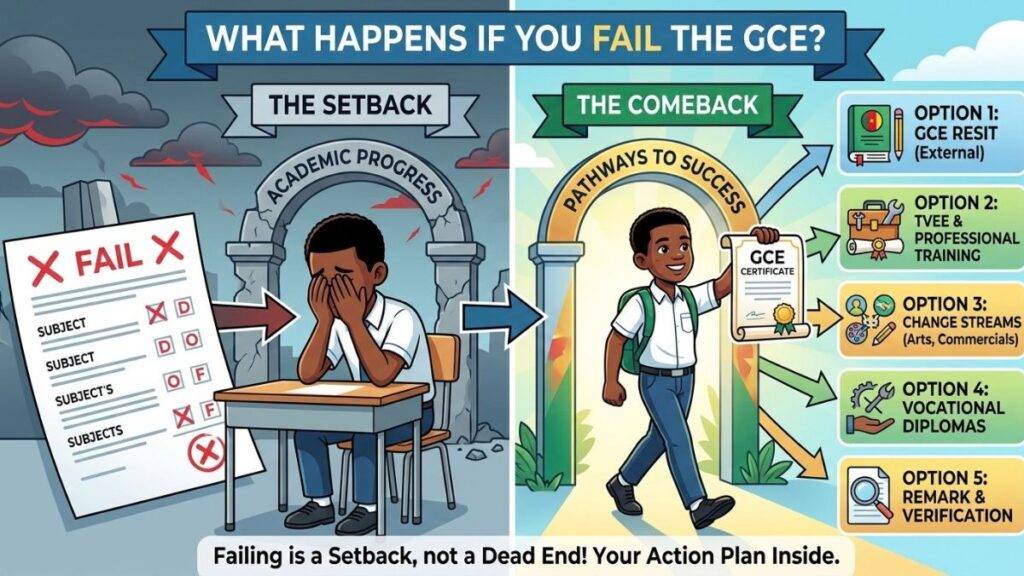
So, what happens if you fail the GCE?
First, let us get one thing straight: under Cameroon GCE Board rules, “failing” does not mean you are banned from education. It simply means you did not hit the minimum threshold for a full certificate during that specific session.
Whether you missed your O-Level 4-subject requirement or fell short of the 2 A-Level principal passes, you have clear, legal, and strategic pathways forward.
No panic. No wasted time. Let us break down your exact options step by step.
Understanding “Failure” Under GCE Board Rules
Before deciding your next move, you need to understand how the Cameroon GCE Board legally defines a pass versus a fail.
Many candidates panic unnecessarily because they see a single bad grade on their result slip. Others celebrate prematurely, assuming three passes automatically unlock high school progression or university entry.
Here is the exact criteria used by the Board:
What Counts as Failing at O-Level (Ordinary Level)?
To earn a full General Certificate of Education Ordinary Level Certificate, the GCE Board requires a minimum threshold:
- The 4-Subject Rule: You must pass at least 4 subjects with a Grade C or higher in a single sitting.
- The Grade D Trap: Passing 3 subjects with C grades and getting a D in a 4th subject does not count. At Ordinary Level, D is classified as a subsidiary fail and carries .
- The Core Subject Gap: While you can technically get a 4-subject certificate without passing English Language or Mathematics, missing English Language will block entry into Lower Sixth in most accredited institutions and prevent registration for competitive entrance exams (Concours).
What Counts as Failing at A-Level (Advanced Level)?
At the Advanced Level, the standard shifts to Principal Passes:
- The 2-Principal Pass Rule: To earn a full GCE Advanced Level Certificate and qualify for direct university admission, you must secure at least 2 Principal Passes (Grades ).
- The “Single Pass” Outcome: Getting 1 Principal Pass () means you do not qualify for a full A-Level Certificate. You will receive a Result Slip listing that single paper, but state universities will not admit you into full degree programs without bridging requirements.
- The “Grade O” Fallacy: Earning a Grade O alongside one Principal Pass does not give you 2 passes. Grade O is an Ordinary Level subsidiary equivalent—it earns and cannot fulfill the 2-subject certificate requirement.
Result Slip vs. Official Certificate
There is a huge legal difference between receiving a Result Slip and holding a GCE Certificate:
- Result Slip: Issued to every registered candidate who passes at least 1 subject. It acts as a provisional summary of performance.
- Official Certificate: Awarded only when you clear the national baseline threshold (4 O-Level passes or 2 A-Level principal passes).
If your result slip falls short of these minimums, you have not earned a full certificate—and that brings us to your recovery options.
Option 1: Try Again The Next Academic Year
If you fell short of the pass threshold, the most direct path forward is registering for a resit session the next academic year.
You do not need to re-enroll in a formal secondary school to retake your papers. The Cameroon GCE Board grants external candidates identical exam conditions, grading scales, and certificate recognition as internal school students.
Here is how the resit process works in practice and how to approach it strategically:
How External Registration Works
- Choosing an Exam Centre: You must register through an officially designated GCE Board external examination centre (typically selected public high schools or accredited regional centers).
- Required Documentation: When submitting your Form G3/T3 entry, bring certified photocopies of your Birth Certificate, National Identity Card, and your previous GCE Result Slip or Certificate.
- Registration Phasing: The Board operates a three-phase digital process: Pre-Registration at your centre, payment via approved mobile money codes (
*126*007#), and final validation by your Chief of Centre to collect your Individual Timetable (IT).
Strategic Decision: Full Retake vs. Partial Resit
The biggest mistake resit candidates make is registering for every single subject again out of anger. Smart candidates trim their load:
- At O-Level (Partial vs. Full Registration):
- If you have ZERO or 1–3 passes: You must register for a fresh full sitting of at least 6 subjects (including compulsory subjects: English, French, Math).
- If you ALREADY possess 4+ passes: You can register as a “Partial Candidate” for single papers to improve specific grades or fulfill missing prerequisites. Attach proof of your existing 4-subject result slip during registration.
- At A-Level:
- You can register for between 2 and 5 subjects.
- The Playbook: If you failed with a heavy load (e.g., 4 or 5 subjects), narrow your focus to 3 core subjects. Dropping unnecessary extras like Further Mathematics allows you to concentrate your effort and secure solid A–C principal passes.
Do Resit Certificates Look Different?
No. The certificate issued to an external candidate carries the exact same weight, security features, and administrative recognition as one issued to a regular school student.
Admissions officers at universities and Concours panels evaluate your final grades, not the candidate status printed on your entry form.
Option 2: Changing Your Academic Stream or Subject Combination
Sometimes a fail isn’t caused by a lack of effort. It’s caused by being in the wrong stream.
Forcing yourself through a subject combination that brutalized your score during your first attempt is one of the biggest traps in the GCE system.
If you struggled significantly at A-Level or couldn’t get traction at O-Level, pivoting your subject combination or academic stream is often the fastest route to a high pass mark.
Pivoting from Pure Sciences to Arts or Commercials
At A-Level, the drop-out and fail rates spike highest in the S-Series (Pure Sciences).
If you registered for a heavy science combination—such as S6 (Chemistry, Physics, Mathematics, Further Math) or S8 (Biology, Chemistry, Physics, Math, Further Math)—and walked away with F grades across the board, you need a honest evaluation.
- The Reality Check: A-Level Pure Math and Physics require deep conceptual foundations. If your O-Level Math pass was a weak Grade C, carrying complex S-Series subjects into Upper Sixth often leads to burnout.
- The Strategic Pivot: Switching to a Commercial or Humanities series—like A2 (History, Geography, Economics) or A4 (Economics, Geography, Pure Math)—can completely turn your performance around.
- The University Opening: A strong B, C, C profile in an Arts or Commercial series opens doors to competitive faculties in Law, Journalism, Economics, Public Administration, and Management across state universities—routes that remain completely closed if you hold failing science results.
Dropping “Grade Killer” Subjects
You do not always need to change streams completely. Often, dropping just one high-friction subject restores your entire score.
The most common culprits are Further Mathematics and Computer Science.
- The Math Dilemma: Many science candidates register for Further Math assuming it adds weight to their application. In reality, unless you are aiming for top-tier competitive engineering faculties (FET, Polytechnic), Further Math is purely optional.
- The Math Math: If studying Further Math consumes of your weekly study time and drags your Pure Math grade down to an E and your Physics down to an F, drop it immediately.
- Concentrating your preparation on 3 principal subjects (e.g., Pure Math, Physics, Chemistry) gives you a far higher probability of securing A–C principal passes.
Switching to the TVEE (Technical) Track
If general academic subjects keep stalling your progress, consider switching directly to the Technical and Vocational Education Examination (TVEE) stream run by the GCE Board.
- Intermediate Level (IL): The technical counterpart to Ordinary Level. It tests practical trade specialties like Civil Engineering (Building Construction), Electrical Power Systems, Accounting, and Automobile Mechanics alongside core academic subjects.
- Advanced Level (AL): The technical counterpart to A-Level. Passing TVEE Advanced Level grants direct university admission eligibility into higher technical institutes—such as ENSET (Douala/Bambili) and IUT—and often boasts higher national pass rates than general academic streams.
Option 3: TVEE, Professional Training, & Diploma Pathways
You do not always need a traditional GCE Advanced Level Certificate to step into high-paying, professional careers.
If general academic examinations keep derailing your timeline, Cameroon’s vocational and professional education system offers direct pathways to earn market-ready qualifications—often without waiting a full year to resit your GCE.
Direct Entry into SAR/SM (Vocational Training Centers)
Under the Ministry of Employment and Vocational Training (MINEFOP), publicly funded Section d’Artisanat et de Ménage (SAR/SM) centers and accredited private vocational institutes accept candidates with partial GCE results.
- Target Programs: Information Technology, Solar Energy Systems, Automobile Diagnostics, Graphic Design, Digital Marketing, and Industrial Welding.
- The Qualification: You graduate with a CQP (Certificat de Qualification Professionnelle) or BQP (Brevet de Qualification Professionnelle).
- The Advantage: These programs focus on practical execution and theory. They build tangible skill sets that immediately qualify you for job placements or self-employment while bypassing theoretical GCE essay hurdles.
University Bridging & Diploma (ND/HND) Pathways
If you fell short at A-Level—for example, scoring only —several private higher institutes and university faculties in Cameroon offer Diploma and Certificate Bridging Programs.
- National Diploma (ND) / Foundation Courses: Many private universities enroll candidates with partial A-Level results into 1-year foundation tracks.
- The HND Alternative: While official Higher National Diploma (HND) matriculation under the Ministry of Higher Education (MINESUP) technically requires a full A-Level Certificate (2 principal passes), many accredited institutes allow you to register for a 1-year preparatory diploma.
- The Dual Strategy: You can pursue a professional certificate program during the day while preparing for a targeted 1-subject or 2-subject GCE resit as an external candidate in the evening. By year-end, you hold both your professional skill certificate and your upgraded GCE result.
Administrative Options: Verification & Script Remarking
Before you completely write off a failed paper, you need to rule out administrative or marking errors.
If your official broadsheet result shows an unexpected fail—or if you suspect a clerical error—the Cameroon GCE Board provides official administrative review channels.
Here is how script reviews work, what they cost, and when you should actually apply:
Recheck vs. Remark: What is the Difference?
Candidates often confuse these two options, but they are entirely different administrative procedures:
- Recheck (Clerical Verification): A mechanical recount of your marks. The Board verifies that all pages of your answer script were graded, that no sub-questions were missed by the examiner, and that the individual paper scores were correctly added up and converted onto your final result slip.
- Remark (Script Re-assessment): A complete regrading of your written answer scripts by an independent senior examiner. The new examiner evaluates your written answers from scratch without seeing the previous examiner’s marks.
Handling Administrative Status Codes (FI, Query)
If your result line displays FI (Further Investigation) instead of a letter grade, this is not a fail.
- The Cause: The Board placed your paper under review due to a administrative query—such as a missing attendance list from your centre, a mismatched candidate number on your answer booklet, or an unregistered paper code.
- The Solution: Report to your Chief of Centre immediately with your original Registration Receipt and Individual Timetable (IT). Your principal submits a formal clearance query to the GCE Board Secretariat in Buea to release your actual grade on a supplementary broadsheet.
When Should You Request a Remark?
Remarking carries a non-refundable administrative fee per subject, so you must be strategic.
- Apply for a Remark if:
- Your mock exam results were consistently scoring A or B grades, but your official result dropped straight to an E or F.
- You need just 1 additional point or a single grade bump (e.g., moving a Grade D to a Grade C at O-Level) to clear your 4-subject certificate threshold or meet a specific Concours requirement.
- Do NOT Apply for a Remark if:
- You knew you performed poorly when you left the hall.
- You failed across multiple subjects by wide margins. Save your money and channel those funds directly into your resit registration fees instead.
Deadlines & Application Channel
- Strict Time Window: Applications for rechecks and remarks open immediately after results are officially proclaimed and usually close within 14 to 21 days.
- The Submission Path: You must channel your application through your Chief of Centre (your school principal or external registration center coordinator). Direct individual applications sent straight to the Board in Buea without center endorsement are routinely rejected.
Mindset & Action Plan: A 30-Day Recovery Blueprint
Panicking burns time. Executing a structured plan restores control.
When GCE results drop and the outcome isn’t what you planned, give yourself 48 hours to process the disappointment. After that, step directly into execution mode.
Here is a 30-day tactical recovery blueprint to rebuild your strategy and prepare for your next attempt:
Days 1–7: Perform an Honest Academic Autopsy
Before spending money on new registration forms or study materials, collect your official Result Slip from your examination centre and analyze your exact failure points.
- Breakdown by Paper: Did you fail because of Paper 1 (MCQs), Paper 2 (Theory/Essays), or Paper 3 (Practicals)?
- Identify the Structural Flaw:
- If your MCQ scores were weak, your core definitions and coverage of the syllabus were incomplete.
- If your Paper 2 scores collapsed, your problem wasn’t knowledge—it was exam technique, speed, and poor alignment with the official GCE marking guide.
- If Practical Papers dragged down your science grades, you need dedicated laboratory access or an alternative-to-practical prep center.
Days 8–14: Choose Your Single Recovery Track
Do not try to pursue three different paths at once. Select one primary track based on your diagnostic analysis:
- Track A (Direct GCE Resit): Best if you fell short by only 1–2 subjects or missed your point target.
- Track B (Stream/Combination Pivot): Best if you failed heavily across S-Series sciences or heavy math and want to switch to Arts or Commercial subjects.
- Track C (TVEE or Professional Diploma): Best if academic general exams do not match your learning style and you prefer immediate, practical skill certification.
Days 15–21: Secure Administrative & Financial Logistics
Registration windows for external candidates open in the months following result releases. Missing these windows forces a whole year of delay:
- Locate an Approved External Centre: Choose an established public high school or official GCE Board external examination centre that offers reliable administrative support.
- Budget the Registration Fees: Prepare the required fees—typically a base registration fee (9,000 FCFA), per-subject fees (2,000 FCFA), practical fees (5,000 FCFA where applicable), plus 1,000 FCFA for form G3/T3 franking.
- Complete Digital Pre-Registration: Register online through official channels and pay fees using the designated GCE mobile money code (
*126*007#) to generate your transaction ID.
Days 22–30: Rebuild Your Study System
Do not repeat the exact same preparation habits that produced your previous result.
- Acquire Official Marking Schemes: Study past GCE Chief Examiners’ Reports and marking guides. Knowing how examiners award marks is as vital as knowing the content.
- Set Up a Timed Past-Paper Drill: Solve at least 5 years of past GCE papers under strict exam conditions (no notes, strict time limits) to build pace and endurance.
- Join a Targeted Prep Center: If self-study led to poor time management, enroll in an accredited evening or repeaters’ preparation center with proven track records in your specific resit subjects.
Frequently Asked Questions (FAQs)
Can I combine two different GCE Ordinary Level result slips to qualify for High School (Lower Sixth)?
Yes, most secondary schools and high schools across Cameroon allow candidates to combine two O-Level result slips to meet entry requirements for Lower Sixth. However, both slips must collectively satisfy the minimum subject rules and prerequisites set by the school (such as possessing a pass in English Language and core stream subjects).
Do external candidates get the exact same certificate as regular school candidates?
Yes. The Cameroon GCE Board issues official General Certificates of Education that do not distinguish between internal school candidates and external private candidates. Your certificate carries the exact same legal weight, official security seals, and academic recognition for university admissions and employment.
How many times am I allowed to re-sit the Cameroon GCE?
There is no limit to the number of times you can write or resit the GCE examination. The GCE Board allows candidates to enter for examination sessions as many times as necessary until they achieve their target grades or full certificate threshold.
Can I use a single A-Level principal pass to enter a state university in Cameroon?
State universities (e.g., University of Buea, University of Bamenda, University of Yaoundé I) generally require a minimum of 2 principal passes (E grade or higher) for direct entry into degree programs. A single principal pass yields an official result slip, but you will typically need to complete a diploma/bridging program or resit to earn a second principal pass before matriculating into a full degree track.
Conclusion
A single bad GCE result slip is a temporary pause on your academic journey, not a dead end.
The worst thing you can do after a setback is to freeze, hide your results, or drift into the next year without a clear plan.
The candidates who successfully bounce back use a systematic recovery process:
- Diagnose your weak points: Analyze whether your failure came down to core subject gaps, paper weightings, or time management during written exams.
- Select your optimal pathway: Choose between a targeted external candidate resit, a strategic shift to Arts or Commercial streams, or pivoting directly into a hands-on TVEE professional diploma track.
- Execute administrative deadlines early: Pay your fees through official mobile channels, register at your designated centre on time, and build a structured past-paper study routine.
Your academic trajectory isn’t defined by whether you fall—it’s defined by how quickly you rebuild your strategy and step back into the hall.