
The release of the General Certificate of Education (GCE) examination results marks one of the most critical annual milestones in Cameroon’s academic calendar.
Managed and coordinated by the Cameroon GCE Board, these results shape higher education admissions, vocational pathways, and professional opportunities for tens of thousands of students across the nation and beyond.
The official results for the 2026 examination session were formally released via a Press Communique on August 21, 2026. The announcement was made by the Board’s Transition Management Team (TMT), led by Mrs. Ndi Bernadette Frinwie Ntemna.
This release encompasses four major examination categories administered under the Anglo-Saxon sub-system of education:
- GCE Advanced Level (General Education): A major pre-university qualification assessing specialized secondary education subjects.
- GCE Ordinary Level (General Education): The foundational certificate marking the completion of general secondary education.
- Technical and Vocational Education (TVEE) Advanced Level: Advanced certification focusing on specialized technical, commercial, and trade-based disciplines.
- Technical and Vocational Education (TVEE) Intermediate Level: Intermediate-level technical assessments designed to certify core occupational and practical skills.
Established by Presidential Decree No. 93/172 of July 1, 1993, and subsequently reorganized by Presidential Decree No. 2018/714 of November 16, 2018, the Cameroon GCE Board maintains strict standards of integrity, quality, and transparency.
This guide provides a comprehensive overview of how to access these newly released results, key statistical trends from the 2026 session, performance highlights, and guidance on administrative procedures.
How to Check and Collect Your GCE Results
Following the official release of the GCE results, candidates have several channels to access their scores and retrieve their official credentials.
Primary Verification Channels
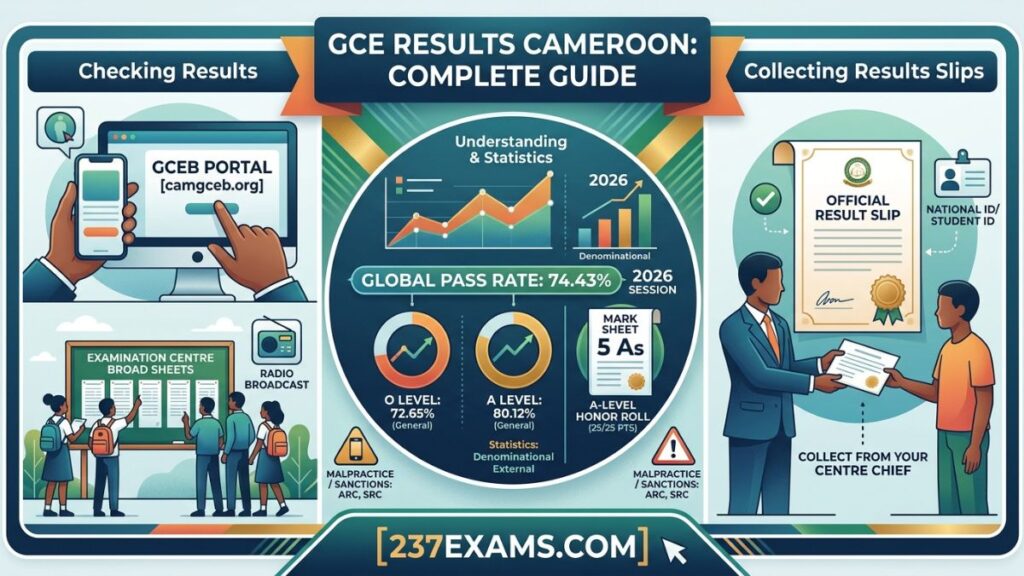
- At Registration Examination Centres: Candidates can verify their results directly at the school or accommodation centre where they registered for the examination. Detailed result broadsheets are physically posted on campus notice boards, arranged by examination centre code and candidate registration number.
- Official GCE Board Web Portal: Complete result lists organized by examination type (General Ordinary Level, General Advanced Level, TVEE Intermediate, and TVEE Advanced) are accessible via the official Cameroon GCE Board portal (
camgceb.org). - Media Broadcasts: As part of traditional public announcements, global performance figures, honor rolls, and school performance summaries are broadcast nationwide on CRTV radio stations.
Collecting Official Result Slips
While broadsheet listings and downloadable PDF files confirm successful entries, the Official Result Slip is the only authoritative personal document accepted for university registration and professional admission files.
- Location: Result slips are dispatched directly from the GCE Board Secretariat in Buea to candidate accommodation and registration centres.
- Requirements for Collection:
- Candidate National Identity Card (CNI) or school identity card.
- Original examination registration acceptance slip / candidate receipt.
- Important Notice on Fees: Result slips are issued free of charge to registered candidates at their respective accommodation centres. Candidates are advised to report any unauthorized demands for payment or unofficial “grade alteration” scams directly to school authorities or the GCE Board.
Performance Overview & Key Statistics
The 2026 examination session registered significant shifts across candidate participation, subject pass rates, and regional performance distributions.
Global Performance Overview
Across all four examination levels administered by the Cameroon GCE Board, a total of 208,741 candidates registered for the 2026 session, representing a slight contraction compared to the 213,360 registered in 2025. Out of these, 196,579 candidates actually sat for the examinations, with 133,429 successfully passing.
This yielded an overall global pass rate of 67.88%, reflecting a decrease of 7.58 percentage points from the 75.46% pass rate recorded in 2025.
| Examination Level | Registered | Sat | Passed | 2026 Pass Rate (%) | 2025 Pass Rate (%) | Trend (%) |
| GCE Advanced Level | 70,739 | 69,947 | 43,211 | 61.78 | 79.39 | -17.60 |
| GCE Ordinary Level | 98,040 | 88,053 | 65,539 | 74.43 | 78.57 | -4.13 |
| TVEE Advanced Level | 10,908 | 10,804 | 7,875 | 72.89 | 71.19 | +1.70 |
| TVEE Intermediate Level | 29,054 | 27,775 | 16,804 | 60.50 | 52.03 | +8.39 |
School Candidates vs. External Candidates
Performance metrics consistently highlight a performance gap between candidates enrolled in formal secondary institutions (school candidates) and non-formal registrants (external candidates).
- School Candidates: Maintained a higher success rate across both Ordinary and Advanced levels. Structured teaching environments, regular mock assessments, and practical laboratory exposure contributed to higher completion rates in multi-subject combinations.
- External Candidates: Registered lower pass percentages, particularly in science subjects requiring practical assessments. However, external candidates demonstrated strong isolated subject performances in humanities such as Law, Philosophy, and Religious Studies.
Subject-Wise Performance Highlights
- Advanced Level Subjects: Arts and human science disciplines continue to record the highest pass percentages. At the Advanced Level, subjects like Cinematic Art, Food Science & Nutrition, English Language, and Religious Studies recorded pass rates exceeding 85%.
- Ordinary Level Subjects: Logic and Food & Nitrition saw solid results at the Ordinary Level, while Economics and Literature in English experienced drops, with Economics recording some of the lowest individual subject pass rates (under 35%).
- Languages: English Language at the Ordinary Level recorded a strong pass rate near 78%, while French performance among Anglophone candidates maintained a steady 68.47% average.
Regional & Divisional Breakdown
Regional rankings in the 2026 session reflect high academic standards across both Anglophone home regions and metropolitan centers.
- Top Regions: The Centre Region and Littoral Region led the overall volume of successful candidates, driven by urban centers like Douala and Yaoundé. The South West Region and North West Region maintained high efficiency rates, dominating the upper percentiles for top-tier individual scores.
- Leading Administrative Divisions: Divisions such as Manyu, Koung-Khi, and Ndian posted high divisional pass rates, supported by strong performance in specialized boarding and denominational institutions within those corridors.
Understanding the Results: Performance Classification & Honor Roll
A detailed look at school categories, elite 100% pass-rate institutions, and individual top performers reveals clear trends across the 2026 session.
Performance by School Type
Denominational (missionary) institutions maintained their long-standing lead in academic excellence at both Ordinary and Advanced Levels.
- Denominational Schools: Led nationally, recording an impressive 91.25% pass rate at the Ordinary Level and 86.06% at the Advanced Level.
- Non-Denominational Private Schools: Secured an 81.22% pass rate at O Level and 67.42% at A Level.
- Government Public Schools: Posted a solid 71.91% pass rate at O Level and 68.97% at A Level.
- Special Institutions: Recorded a 73.33% pass rate at A Level and 56.25% at O Level.
- External Candidates: Registered the lowest regional averages, with 57.99% pass rates at O Level and 42.55% at A Level.
100% Success Rate Centers
In the 2026 session, 32 examination centers that registered at least 10 Advanced Level candidates achieved a flawless 100% pass rate. Prominent institutions on this honor roll include:
- Saker Baptist College, Limbe (126 candidates sat, 126 passed).
- Jesus and Marie College, Simbock-Yaoundé (94 candidates sat, 94 passed).
- Sacred Heart College, Mankon (93 candidates sat, 93 passed).
- Our Lady of Lourdes Secondary College, Mankon (87 candidates sat, 87 passed).
- Saint Anne’s High School, Limbe (64 candidates sat, 64 passed).
- Sacred Heart College, Douala (58 candidates sat, 58 passed).
- Bishop Rogan College, Small Soppo-Buea (41 candidates sat, 41 passed).
- SONARA College, Limbe (41 candidates sat, 41 passed).
- Saint Joseph’s College, Sasse-Buea (37 candidates sat, 37 passed).
At the Ordinary Level, major institutions scoring 100% pass rates were anchored by Saint Benedict College, Mvolyé (306 passed out of 306 sat), Saint Stephen’s International College, Yaoundé (175 passed out of 175 sat), and Saker Baptist College, Limbe (147 passed out of 147 sat).
Honor Roll: Most Outstanding Candidates
Despite rigorous marking schemes, top individual candidates achieved perfect scores across both levels.
Advanced Level Top Scoring Standard (25/25 Points)
At the Advanced Level, 114 candidates nationwide earned 5 Grade “A” passes in 5 principal subjects, reaching the maximum aggregate score of 25 points (). Outstanding per-candidate scores were posted by candidates across prominent centers, including:
- Quete Kamnang Grace Ornella (Saint Benedict College Mvolyé, Yaoundé)
- Boning Toko Daniel (Ladybird English Secondary School, Yaoundé)
- Nana Watchueng Herman De Ke (Saint Benedict College Mvolyé, Yaoundé)
- Njiogo Malang Carelle (Du Vaal Bilingual Comprehensive College, Douala)
- Petnga Djomo Yoan (Du Vaal Bilingual Comprehensive College, Douala)
Ordinary Level Top Scoring Standard (33/33 Points)
At the Ordinary Level, maximum scores are evaluated on 11 Grade “A” subject passes, producing a total aggregate yield of 33 points (). Leading candidate honors were claimed by candidates such as:
- Abdul-Hamid Wule Jamal (Ladybird Secondary School, Yaoundé)
- Ndi Shilton Tohsiichui (GBHS Bafoussam)
- Achaawung Godstrength Asongafac (ETA School for Bright and Gifted Children, Kumba)
- Kamdem Fidele Melvin (British College, Yaoundé)
- Nzouabet Ngann Ange-Christ Manuela (Du Vaal Bilingual Comprehensive College, Douala)
Examination Malpractices, Sanctions, and Appeals
To protect certificate credibility and maintain international sub-system standards, the Cameroon GCE Board enforces strict zero-tolerance policies regarding examination conduct. During the 2026 session, administrative disciplinary committees logged 2,792 total cases of examination irregularities across all levels.
Common Types of Malpractice Detected
- Collusion and Copy Work (1,580 cases): The most frequent infraction recorded in 2026, involving candidates sharing answers, exchanging materials, or copying work within examination halls.
- Pre-prepared Material (1,010 cases): Candidates bringing unauthorized notes, cheat sheets, textbook clippings, or summarized formulas into testing rooms.
- Cell Phones and Unauthorized Electronics (166 cases): Possession or active use of mobile phones, smartwatches, or programmable electronic devices during active sittings.
- Impersonation (23 cases): Unregistered individuals attempting to sit examinations on behalf of enrolled candidates.
- Script Substitution (4 cases): Attempting to swap official answer booklets or insert pre-written response sheets into secure collection parcels.
- Complicity by Staff & Examiners (2 cases): Isolated incidents of invigilators aiding collusion or examiners violating marking protocols.
Sanctions & Penalties Applied
Sanctions are applied based on infraction severity in accordance with GCE Board disciplinary guidelines:
| Infraction Category | Specific Malpractice | Sanction Applied | Abbreviation |
| Subject-Level Nullification | Collusion / Copy Work | Subject Result Cancelled: Awarded a grade of $X$ (Cancelled) for the specific subject. | SRC |
| Session Nullification | Caught with Pre-prepared Material | All Results Cancelled: Total cancellation of all subjects sat in the 2026 session. | ARC |
| 1-Year Suspension | Cell Phone Possession in Hall | 1-Year Ban + ARC: Nullification of current results and suspension from registering for 1 year. | 1 Ban + ARC |
| Severe 3-Year Suspension | Script Substitution, Impersonation, or Physical Violence | 3-Year Ban + ARC: Complete cancellation of results combined with a 3-year national ban from sitting GCE Board exams. | 3 Ban + ARC |
Withheld Results (“Further Investigation”)
A small subset of candidates (7 cases in 2026) have their entries marked with “FI” (Further Investigation) on official broadsheets.
- Meaning of “FI”: This status indicates that a candidate’s answer script, attendance log, or registration profile is being held for administrative review due to discrepancies (e.g., mismatched candidate numbers, missing attendance signatures, unverified transfer status, or suspected marking-center anomalies).
- Administrative Next Steps: Candidates flagged under “FI” are not automatically penalized. Affected candidates must report to their respective Accommodation Centre Chiefs or contact the GCE Board Secretariat in Buea with their original Individual Timetable (IT), registration receipts, and valid identification to clear their files before final results are released or formally sanctioned.
Frequently Asked Questions (FAQs)
Where and how can I check my Cameroon GCE Results?
You can check your results directly at the school or accommodation centre where you registered, where physical broadsheets are posted on notice boards. Official downloadable result lists organized by examination type are also published on the Cameroon GCE Board web portal (camgceb.org). Additionally, results, top performances, and honor rolls are broadcast via national and regional CRTV radio stations.
What is the difference between school candidates and external candidates?
School candidates are students currently enrolled in formal secondary institutions who complete regular coursework and practical assessments before sitting the exams. External candidates are non-formal registrants, independent learners, or repeat candidates who register independently at designated external centres.
How do I collect my official GCE Result Slip or Certificate?
Result Slips: Dispatched directly to candidate registration centres shortly after results publication. Candidates can collect them free of charge from their Chief of Centre upon presenting a valid student ID or National Identity Card (CNI).
Certificates: Issued to examination centres within six months following the release of results. Candidates must collect their original certificates from their Chief of Centre by March following the release date. Certificates not collected by this deadline are returned to the GCE Board Secretariat in Buea, after which a retrieving fee is required.
What happens if my results are withheld under “Further Investigation” (FI)?
A result marked with “FI” means the candidate’s entry is under administrative review due to discrepancies such as missing attendance logs, mismatched registration details, or suspected marking anomalies. Candidates flagged with “FI” should report to their Chief of Centre or contact the GCE Board Secretariat in Buea with their registration receipt, Individual Timetable (IT), and valid identification to clarify their file.
Can I request a remark or appeal my GCE grades?
Yes. If a candidate believes there is a clerical error or a significant discrepancy between their expected and awarded grades, they can submit an enquiry or recheck request. All enquiries must be submitted through the candidate’s Chief of Centre, who will forward the appeal and the required administrative fee to the GCE Board for review.
Conclusion
The release of the 2026 GCE examination results highlights the continued dedication of Cameroonian students, teachers, and educational administrators under the oversight of the Cameroon GCE Board. While overall performance trends reflect rigorous marking standards and strong performance across top-tier institutions, candidates are encouraged to promptly verify their results and retrieve their official result slips from their respective registration centres.
For successful candidates, these results open key pathways toward university admissions, professional training, and career progression. For candidates navigating administrative queries, withheld results, or future retakes, following official GCE Board guidelines through school heads remains the most direct route to resolution.