Receiving your Ordinary Level results is a defining milestone in your academic journey.
Crossing the O-Level threshold validates five years of secondary school work (Forms 1 through 5). However, once the initial excitement clears, every student and parent faces the exact same question: What comes next?
For decades, the standard assumption in Cameroon has been automatic progression: passing Form 5 means enrolling in High School (Lower Sixth) to prepare for the Advanced Level. While grammar Sixth Form (Lower Sixth & Upper Sixth) remains a proven route, it is far from the only path available.
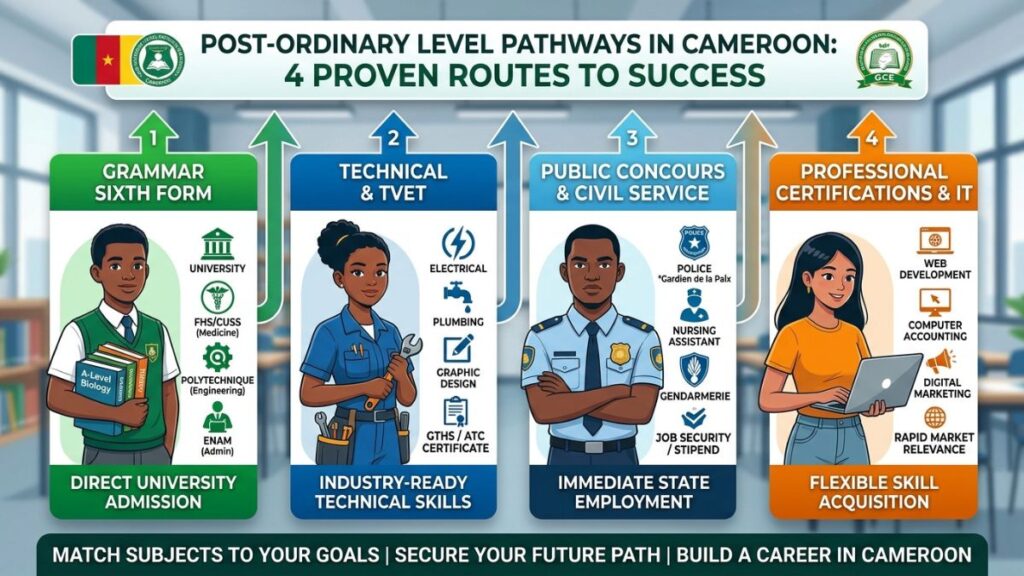
The Cameroonian education ecosystem offers four main pathways after Ordinary Level:
- Traditional Academic High School (Grammar Sixth Form)
- Professional Technical & Vocational Education and Training (TVET)
- Public Service Entrance Examinations (Concours)
- Professional IT, Business & Skill-Based Certifications
Whether your objective is to earn a university degree, enter the workforce rapidly with practical technical skills, or secure a position within public administration, understanding all available options allows you to make an informed choice aligned with your goals, learning style, and financial resources.
Pathway 1: Traditional Academic High School (Grammar Sixth Form)
The most familiar choice for GCE Ordinary Level graduates in Cameroon is advancing to Grammar High School—entering Lower Sixth (L6) and progressing through Upper Sixth (U6) to write the GCE Advanced Level (A-Level) examination.
Who It Is For
This pathway is designed for students targeting academic university degrees, professional state faculties (such as Medicine, Law, Engineering, or Journalism), or national competitive entrance examinations (Concours) that explicitly mandate a GCE Advanced Level certificate.
Key Requirements & Mechanics
- Admission Threshold: Most high schools require a candidate to hold a minimum of 4 or 5 O-Level subject passes.
- Stream Prerequisites: Progression into specific Advanced Level series requires direct passes in key foundation subjects at Ordinary Level:
- Science Series (S1–S8): Requires strong O-Level passes in Mathematics, Physics, Chemistry, and Biology.
- Arts & Commercial Series (A1–A5): Requires O-Level passes in English Language, Literature in English, History, or Economics.
- Duration: 2 academic years.
Advantages & Drawbacks
| Advantages | Drawbacks |
| Direct University Entry: Unlocks access to public state universities (UB, UBa) and international university admissions. | Purely Theoretical Focus: Prepares students for academic evaluation rather than immediate, hands-on employment. |
| Maximum Career Scope: Keeps options open for top-tier Concours (FHS, Polytechnique, ENAM, IRIC). | 2-Year Time Investment: Requires completing two full academic years before entering higher education or the labor market. |
Pathway 2: Technical & Vocational Education and Training (TVET)
For students who prefer hands-on skill development over abstract academic theory, Technical and Vocational Education and Training (TVET) provides a direct route into specialized technical trades and applied professions.
Transitioning into technical education after General O-Level allows candidates to acquire practical expertise while maintaining a clear bridge toward professional tertiary degrees.
1. Advanced Technical Certificate (ATC) in Technical High Schools
Students holding a General O-Level can transfer into the second cycle of Technical High Schools (GTHS/Lycée Technique) to complete their 2-year technical upper secondary education.
- Key Credentials: Prepares students for the Advanced Technical Certificate (ATC)—the technical equivalent of the GCE A-Level administered by the Cameroon GCE Board.
- Core Specialties: Industrial Electronics, Building Construction (Civil Engineering), Mechanical Fabrication, Automobile Technology, Home Economics, and Commercial Specialties (Accounting & Secretarial Studies).
- Next Steps: Graduates can immediately sit for higher technical university entrance exams—such as the Higher Technical Teachers’ Training College (ENSET)—or enter Higher National Diploma (HND) and Brevet de Technicien Supérieur (BTS) programs.
2. Rapid Vocational Training Centers (SAR/SM & CFM)
For graduates seeking quick skill acquisition tailored to immediate market demand, state-run Rural Craft Sections / Household Sections (SAR/SM) and Vocational Training Centers (CFM) offer targeted trade programs.
- Focus Areas: Electrical wiring, plumbing, welding, dressmaking/tailoring, woodwork, and culinary arts.
- Duration: Typically 1 to 2 years of intensive, field-based instruction.
- Goal: Direct self-employment, small business establishment, or entry-level apprenticeship in the skilled trade sector.
Advantages & Drawbacks
| Advantages | Drawbacks |
| Marketable Technical Skills: Builds immediate, practical proficiency that employers actively seek. | School Transition Adjustments: General O-Level students must adapt quickly to technical drawing, workshop practicals, and specialized trade math. |
| Entrepreneurship Potential: Enables graduates to launch independent businesses or service firms straight out of school. | Slightly Narrowed Pure Academic Track: Shifts focus away from classical general arts and pure science paths. |
Pathway 3: Professional Entrance Exams (Concours) & Public Service
For students seeking direct entry into the workforce with job security and immediate civil service integration, writing national competitive entrance examinations (Concours) directly after GCE Ordinary Level is a strategic, highly viable option.
Key O-Level Concours Categories in Cameroon
1. Security & Defense Forces
The Ministry of Defence (MINDEF) and the General Delegation for National Security (DGSN) conduct annual recruitments for candidates holding a GCE Ordinary Level (or BEPC):
- Peacekeepers (Gardien de la Paix): Entry-level police force cadre.
- Gendarmerie & Armed Forces: Non-Commissioned Officer (NCO) tracks, corporal ranks, and military technical units.
- Prisons Administration: Prison Guards (Gardiens de Prison) under the Ministry of Justice.
2. Healthcare & Paramedical Professions
The Ministry of Public Health (MINSANTE) organizes annual entrance examinations for specialized, non-degree healthcare certificates:
- Nursing Assistants (Aides-Soignants): Providing bedside patient care and clinical assistance.
- Assistant Health Technicians (ATMS): Entry-level laboratory assistants, pharmacy attendants, and community health officers.
3. Public Administration & Treasury
The Ministry of Public Service and Administrative Reform (MINFOPRA) opens Category C civil service entrance exams accessible with an O-Level diploma:
- Assistant Stores Controllers & Clerks: Administrative support personnel across state ministries.
- Typist Secretaries & Office Automation Agents: Entry-level administrative and clerical roles in public institutions.
4. Agriculture, Forestry & Animal Husbandry
State-run technical institutes under MINDER, MINFOF, and MINEPIA offer specialized 2-year diploma programs:
- Agricultural Technical Agents (ETA): Field officers assisting in rural extension services and farm management.
- Eco-Guards & Forestry Assistants: Wildlife protection, forest monitoring, and conservation enforcement.
Advantages & Drawbacks
| Advantages | Drawbacks |
| Direct Employment Security: Passing guarantees immediate admission into state training schools, followed by direct integration into the public service. | Extremely High Competition: Tens of thousands of candidates compete for a limited number of state quotas. |
| Financial Independence: Trainees often receive state stipends or immediate salaries upon completing training. | Strict Eligibility Limits: Age caps (often 18–25 years), strict medical/physical standards, and rigid application deadlines. |
Pathway 4: Professional Certifications & Skill Acquisition (IT & Business)
In today’s fast-evolving digital economy, high-school degrees are no longer the sole gatekeepers to earning a living. For Ordinary Level graduates looking to acquire actionable skills quickly—either as a gap-year strategy before Sixth Form (Lower Sixth & Upper Sixth) or as a pivot toward independent freelancing—short-term professional certifications offer a flexible, low-cost route.
1. Digital & Information Technology Certifications
Cameroon’s growing tech ecosystem in cities like Buea (“Silicon Mountain”), Douala, and Yaoundé has created strong demand for practical digital expertise:
- Web Development & Programming: HTML/CSS, JavaScript, and basic Python coding through practical bootcamps or certified computer institutes.
- Graphic Design & Branding: Mastering Adobe Photoshop, Illustrator, and Canva for corporate branding, marketing collateral, and social media management.
- Computer Networking & Maintenance: Hardware repairs, system troubleshooting, and introductory Cisco CCNA / CompTIA A+ hardware configurations.
2. Business, Financial & Office Administration Skills
Commercial institutes offer 3- to 6-month specialized programs that prepare graduates for immediate office support roles:
- Computerized Accounting: Hands-on training in accounting software like Sage, QuickBooks, and Microsoft Excel.
- Digital Marketing & Content Creation: Managing social media campaigns, SEO basics, and online customer service for local businesses.
- Bilingual Secretarial & Office Automation: Professional typing, document processing, and administrative front-desk operations.
3. Language Proficiency & Immersion Programs
In a officially bilingual country like Cameroon, language mastery opens substantial doors:
- Bilingual Immersion (French/English): Completing intensive language certification courses (such as Alliance Française or linguistic centers) to gain full professional fluency.
- International Exam Preparation: Preparing for standardized international exams (IELTS, TOEFL, DELF/DALF) if planning for international scholarships or overseas migration.
Advantages & Drawbacks
| Advantages | Drawbacks |
| Rapid Market Readiness: Skills can be acquired in 3 to 9 months, allowing for quick monetization. | No Higher Academic Equivalence: Short certificates do not replace an A-Level certificate for university admission. |
| High Flexibility: Can easily be pursued alongside evening classes or taken during a gap year. | Requires Strong Self-Drive: Long-term success depends heavily on self-learning and building a personal portfolio. |
Decision Matrix: Choosing the Right Pathway for You
Evaluating what to do after GCE Ordinary Level depends on your academic strengths, financial constraints, time horizon, and career goals. This framework compares the four primary routes across key criteria:
| Evaluation Criteria | Pathway 1: Grammar Sixth Form | Pathway 2: Technical & Vocational (TVET) | Pathway 3: Public Service (Concours) | Pathway 4: Skill Certifications & IT |
| Duration | 2 Years (L6 & U6) | 1 to 2 Years | 1 to 2 Years (Training school) | 3 to 9 Months |
| Primary Credential | GCE Advanced Level (A-Level) | Advanced Technical Certificate (ATC) / Vocational Diploma | State Civil Service Integration / Certificate | Professional Industry Certificate / Portfolio |
| Financial Investment | Moderate (Standard secondary school fees) | Moderate to High (Workshop tools, materials, school fees) | Low to Moderate (Concours application fees & prep classes) | Flexible (Low to moderate course fees) |
| Target Career Goal | University degrees, long-term professional faculties (Medicine, Law, Engineering) | Applied technical trades, HND/BTS degrees, entrepreneurship | Immediate civil service employment (Police, Nursing Assistant, Clerical) | Freelancing, digital economy jobs, rapid employment, gap-year prep |
| Academic Risk | High reliance on passing final GCE A-Level exams | Moderate (Continuous practical evaluation + written exams) | High (Extremely competitive national pass rates) | Low (Focuses on mastery and portfolio building) |
How to Make Your Choice:
- Choose Grammar Sixth Form if: You earned 5+ O-Level passes (including English and Mathematics) and plan to pursue a 3- to 7-year university degree or sit for top-tier national Concours (such as FHS or Polytechnique).
- Choose TVET if: You thrive in hands-on environments, prefer practical technical problem-solving, and want a marketable trade that enables self-employment or specialized technical diplomas.
- Choose Public Service (Concours) if: Your priority is immediate job security, civil service integration, or earning a stipend while training (e.g., Police, Health Technicians, Military).
- Choose Skill Certifications if: You need a high-impact gap-year strategy, want to enter the digital economy quickly, or wish to gain income-generating skills alongside evening/distance studies.
Frequently Asked Questions (FAQs)
1. Can I register and sit for national Concours while repeating failed O-Level papers?
Yes, but conditionally. Most national competitive entrance examinations (Concours)—such as those for the Police force, Health Assistants, or Category C Civil Service—require candidates to submit a certified true copy of the Ordinary Level Pass Slip or Certificate at the time of application submission.
If you are currently retaking specific O-Level papers (such as Mathematics or English) to upgrade your results, you cannot apply using a pending registration slip. However, if you already hold a valid O-Level pass (e.g., 4 or 5 subjects) that meets the minimum threshold for that specific Concours, you may apply while re-sitting other subjects to improve your academic profile for future studies.
2. Is it possible to switch from General O-Level to Technical A-Level (ATC/TVE)?
Yes, this is a recognized transition route in Cameroon. Candidates holding a General GCE Ordinary Level can transition directly into Lower Sixth Technical at a Technical High School (GTHS / Lycée Technique).
- How it works: You will enroll in the second cycle of technical education to prepare for the Advanced Technical Certificate (ATC) or Technical GCE A-Level.
- What to expect: You will take core technical modules alongside standard subjects. While General O-Level students usually adapt quickly to theoretical trade subjects, you will need to put in extra practical effort in workshop training and technical drawing during your first term in Lower Sixth.
3. What should I do if I passed my O-Level but failed compulsory subjects like English Language or Mathematics?
Failing Mathematics or English Language is a common roadblock because state universities, grammar Sixth Forms, and major civil service entrance exams enforce these two subjects as strict baseline requirements.
If you find yourself in this situation, you have three primary options:
- Option A (March/June Re-sit): Register as an external/private candidate with the Cameroon GCE Board solely to re-sit English or Mathematics while simultaneously taking short professional IT or language certification courses.
- Option B (TVET Skill Transition): Enroll directly in a vocational training center (SAR/SM or CFM) or private skill institute that focuses on practical competence rather than strict academic subject prerequisites.
- Option C (Targeted Concours): Check specific Ministry Concours guidelines (such as certain agriculture or trade extensions) where entry is based on your overall subject count rather than a mandatory pass in Mathematics.
Strategic Conclusion
Determining what to do after GCE O Level in Cameroon should not be reduced to a default, automatic jump into traditional High School. Navigating your post-O-Level transition successfully requires evaluating your academic strengths, financial context, personal learning style, and long-term career ambition.
To maximize your opportunities after Form 5:
- Assess Beyond Sixth Form: Recognize that Grammar High School, TVET institutions, public service Concours, and professional skill bootcamps each lead to distinct, viable career outcomes.
- Fix Missing Baseline Core Subjects: Prioritize clearing baseline prerequisites—specifically English Language and Mathematics—if you plan to transition toward university faculties or civil service frameworks.
- Align Choices with Market Demands: Match your route to real economic opportunities in Cameroon, whether through university degree prerequisites, technical trades, state civil service tracks, or practical digital skills.
By treating your GCE Ordinary Level results as a versatile launching pad rather than a single fixed track, you can choose a post-secondary pathway that positions you for long-term independence, career growth, and academic success.
This video provides additional context on navigating the Cameroonian education landscape and choosing post-secondary routes:
This video offers practical insights into how Cameroon’s dual educational structure impacts post-secondary options and career planning for students.