Earning your Advanced Level certificate is the single most decisive transition in the Cameroonian educational secondary cycle.
Crossing the A-Level threshold—achieving a minimum of two principal subject passes—officially closes the door on secondary school and opens up the complex ecosystem of tertiary education and professional specialization. However, with thousands of high school graduates competing for limited university seats and state civil service spots each year, answering the question “What can you do after GCE A Level?” requires strategic planning rather than passive decision-making.
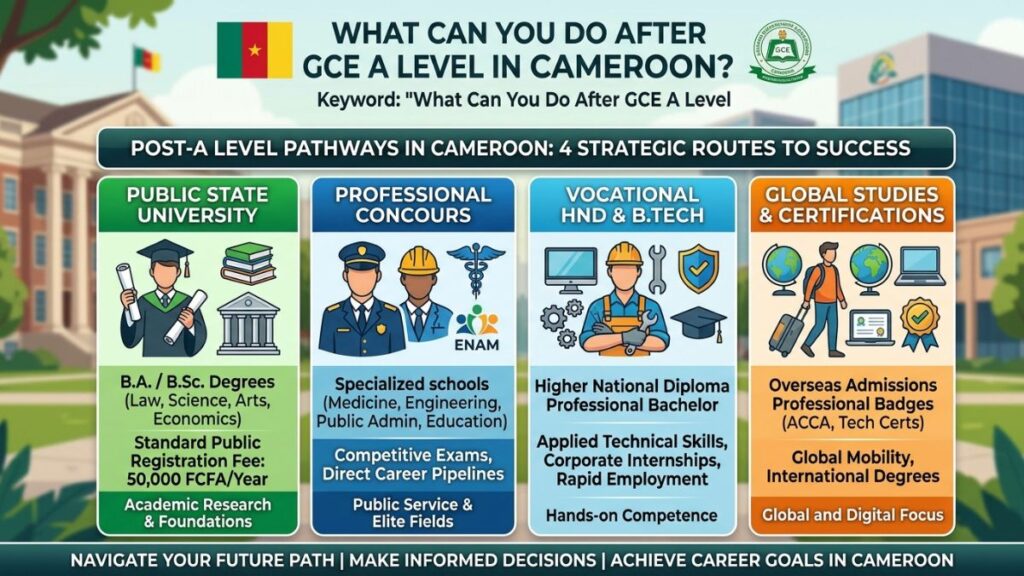
Higher education in Cameroon offers four main pathways after Advanced Level:
- Academic & Professional State University Faculties (Public Higher Education)
- National Competitive Entrance Examinations (Concours)
- Applied Vocational Higher Education (HND, BTS & Professional Bachelors)
- International Opportunities, Professional Body Certifications & Entrepreneurship
Whether your goal is entering an elite state professional school, building hands-on technical competence through an HND, securing a standard university degree, or pursuing international study, choosing the right path depends on your A-Level point score, subject triad alignment, and financial resources.
Pathway 1: Academic & Professional State University Faculties
Enrolling in one of Cameroon’s public state universities—such as the University of Buea (UB), University of Bamenda (UBa), University of Yaoundé I & II, or the Universities of Douala, Dschang, Maroua, Ngaoundéré, Ebolowa, Garoua, and Bertoua—is the primary tertiary route for A-Level graduates.
1. Open-Admission Faculties (General Bachelor’s Degrees)
Open-admission faculties accept candidates based on meeting the baseline entry criteria (a minimum of 2 GCE A-Level principal passes in relevant subjects).
- Faculty of Law and Political Science (FSJP): Offers LL.B. degree tracks in Common Law (English sub-system) and Private/Public Law (Civil Law sub-system).
- Faculty of Arts, Letters and Social Sciences (FALSH): Offers Bachelor of Arts (B.A.) programs in History, English Literature, Linguistics, Sociology, Geography, and Foreign Languages.
- Faculty of Science (FS): Delivers Bachelor of Science (B.Sc.) degrees in Biochemistry, Chemistry, Computer Science, Physics, Geology, and Plant/Animal Biology.
- Faculty of Economics and Management (FSEG): Prepares students for B.Sc. degrees in Economics, Management, Accounting, and Banking & Finance.
2. Selective Professional Faculties & Schools
Unlike general faculties, selective faculties inside state universities require candidates to write a competitive national entrance exam (Concours) or undergo strict portfolio screening.
- Health Sciences: Faculty of Health Sciences (FHS Buea, CUSS Yaoundé I, FAMS Bamenda, FMBS) for Medicine, Nursing, Medical Laboratory Sciences, and Pharmacy.
- Engineering & Technology: National Higher Polytechnic Institutes (Polytechnique Yaoundé/Douala, NAHPI Bamenda, FET Buea).
- Teacher Education: Higher Teachers’ Training Colleges (HTTC/ENS) and Higher Technical Teachers’ Training Colleges (HTTTC/ENSET) for secondary school educators.
Advantages & Drawbacks
| Advantages | Drawbacks |
| Highly Affordable Registration: State-subsidized tuition is set at a flat rate of 50,000 FCFA per academic year for Cameroonian citizens across all general public university faculties. | Large Class Sizes: Open-admission faculties frequently experience overcrowded lecture halls and high student-to-lecturer ratios. |
| Broad Academic Recognition: Standard 3-year Bachelor’s degrees (B.A. / B.Sc.) offer widely recognized academic credentials for master’s programs and global scholarships. | Theoretical Emphasis: General degree programs place greater emphasis on theoretical instruction over practical industry internships. |
Pathway 2: Professional National Entrance Examinations (Concours)
For high school graduates seeking direct entry into prestigious professional schools and elite state institutions, sitting for national competitive entrance examinations (Concours) is one of the most sought-after routes after GCE A-Level.
Passing a national Concours directly out of Upper Sixth transitions a candidate into specialized professional training, often providing automatic integration into the state civil service or a recognized professional license.
Key A-Level Concours Categories in Cameroon
1. Engineering, Technology & Agriculture
Organized by state ministries and university tech campuses, these exams select top candidates for 5-year civil, electrical, software, and agricultural engineering tracks:
- National Higher Polytechnic Institutes (Polytechnique): ENSPY (Yaoundé), NAHPI (Bamenda), FET (Buea), and ENSP (Douala).
- Faculty of Agriculture and Agricultural Sciences (FASA): Located in Dschang, training agricultural engineers, forestry specialists, and agronomists.
- National Advanced School of Public Works (NASPW / ENSTP): Training civil engineers, topographers, and urban planners.
2. Medical Sciences & Healthcare Training
Regulated directly by the Ministry of Higher Education (MINESUP) through a single centralized national exam:
- National Medical Entrance Examination: Grants access to Doctor of Medicine (M.D.), Pharmacy, and Doctor of Dental Surgery programs across FHS Buea, CUSS Yaoundé I, FAMS Bamenda, FMBS Douala, and accredited private medical faculties.
3. Administration, Defense & Security Forces
These exams recruit candidates for strategic state administration, law enforcement, and national defense:
- National School of Administration and Magistracy (ENAM – Cycle B): Recruits A-Level holders into intermediate administrative corps (Treasury, Customs, Taxation, and General Administration).
- Combined Military Academy (EMIA – Direct Recruitment): Recruits A-Level holders for officer cadet training in the Cameroonian Armed Forces.
- National Police Force (DGSN): Recruits candidates holding GCE A-Level as Inspectors of Police (Inspecteurs de Police).
4. Teacher Education (HTTC / HTTTC)
Higher Teachers’ Training Colleges prepare secondary school educators:
- HTTC / ENS (Yaoundé, Bamenda, Maroua, Bertoua): Trains general secondary school teachers (First Cycle requires GCE A-Level).
- HTTTC / ENSET (Douala, Bambili, Kumba): Trains technical high school teachers in specialized industrial and commercial fields.
Advantages & Drawbacks
| Advantages | Drawbacks |
| Direct Civil Service Job Security: Successful candidates entering institutions like ENAM, ENS, or military academies secure immediate state integration or stipends during training. | Extremely Low Acceptance Rates: Thousands of applicants compete for limited annual seat quotas set by official ministerial decree. |
| Elite Professional Prestige: Graduates hold top-tier credentials, granting immediate professional standing in engineering, law enforcement, teaching, and medicine. | Age & Physical Restrictions: Most entrance exams enforce strict age limits (typically 22 to 26 years maximum for entry-level tracks) and stringent medical fitness checks. |
Pathway 3: Vocational Higher Education (HND, BTS & Professional Bachelors)
For candidates seeking industry-aligned practical skills over classical theoretical degrees, vocational higher education provides a direct pipeline into entry-level corporate positions, technical roles, and entrepreneurial ventures.
The Ministry of Higher Education (MINESUP) structures these 2-year vocational qualifications to ensure graduates gain immediate technical proficiency while maintaining a clear bridge to higher academic degrees.
1. Key Vocational Credentials
- Higher National Diploma (HND): The flagship 2-year higher technical qualification in the Anglophone subsystem, culminating in a supervised national exam organized by MINESUP.
- Brevet de Technicien Supérieur (BTS): The Francophone equivalent 2-year national diploma, widely offered across private and public technical institutes.
- Professional Bachelor’s Degree (B.Tech / Licence Professionnelle): A 1-year top-up degree available to HND or BTS graduates, focusing on advanced specialization, management, and a mandatory corporate capstone project/thesis.
2. Core Specialty Tracks
Vocational programs operate through accredited Private Higher Education Institutions (IPES) operating under academic mentorship from state universities, as well as university technology colleges (e.g., COLTECH Bamenda, COT Buea, and various IUTs):
- Business, Finance & Management: Accountancy, Banking & Finance, Executive Secretarial Studies, Logistics & Transport Management, Human Resource Management, and Marketing.
- Computer Engineering & Information Technology: Software Engineering, Computer Networks & Systems Maintenance, E-Commerce, and Telecommunications.
- Medical & Health Sciences: Nursing, Medical Laboratory Studies, Midwifery, Ultrasonography, and Pharmacy Technology.
- Engineering, Building & Agricultural Trades: Civil Engineering Technology, Electrical Power Systems, Automobile Maintenance, Agro-Pastoral Entrepreneurship, and Water Management.
Advantages & Drawbacks
| Advantages | Drawbacks |
| High Employability & Practical Focus: Syllabuses prioritize hands-on laboratory work, mandatory corporate internships, and practical field evaluations. | Higher Tuition Fees: Private institutes (IPES) charge higher tuition rates (typically ranging from 150,000 FCFA to 500,000+ FCFA annually) compared to open state university faculties. |
| Rapid Progression: Enables students to earn a workplace-recognized national diploma in 2 years and a full Professional Bachelor’s degree in 3 years. | Varied Accreditation Quality: Requires careful verification to ensure the chosen private institute is fully accredited by MINESUP for national HND exams. |
Pathway 4: International Study, Professional Certifications & Entrepreneurship
Beyond traditional higher education inside Cameroon, a GCE Advanced Level certificate serves as an internationally recognized secondary credential. Graduates looking to build early global mobility, specialized finance credentials, or independent ventures can pursue alternative pathways tailored to the global digital and corporate landscape.
1. International University Admissions & Overseas Study
A GCE A-Level certificate with strong principal passes satisfies direct entry criteria for Bachelor’s degree programs across the United Kingdom, Canada, the United States, Europe, and Asia.
- Document Authentication: Applications require certified transcripts, GCE Board result slips, and verification through the Ministry of Secondary Education (MINESEC) and Ministry of External Relations (MINREX).
- Language Proficiency: While A-Level English literature or general paper passes demonstrate English command, foreign universities or visa boards may require standardized language testing (IELTS or TOEFL for English-speaking destinations; DELF/DALF or Campus France processing for Francophone destinations like France or Belgium).
- Scholarship Pathways: Candidates targeting fully funded international scholarships (e.g., Commonwealth, MasterCard Foundation, or government bilateral awards) rely heavily on high A-Level point counts (12 to 15 points) and active extracurricular leadership.
2. Professional Body Qualifications (Chartered Status)
High school graduates can bypass general academic university degrees and enroll directly into international chartered bodies:
- Accounting & Finance (ACCA / CIMA): The Association of Chartered Certified Accountants (ACCA) allows direct registration for candidates holding 2 A-Level passes and 3 O-Level passes (including English and Mathematics). Completing the Applied Knowledge and Applied Skills papers leads directly to professional accounting credentials.
- Information Technology & Cloud Architecture: Enrolling in industry-standard certification tracks—such as Cisco Certified Network Associate (CCNA), Amazon Web Services (AWS) Certified Cloud Practitioner, or CompTIA Security+—prepares candidates for remote technical roles and global IT contracting.
3. Innovation Hubs & Tech Entrepreneurship
For tech-oriented school leavers, joining innovation ecosystems—such as those centered in Buea (“Silicon Mountain”), Douala, and Yaoundé—provides an immersive environment to build software, launch digital startups, or acquire practical product design skills:
- Incubation Bootcamps: Accelerator programs offer practical mentorship in full-stack development, mobile app construction, and digital marketing.
- Freelance & Remote Work: Establishing a practical portfolio enables self-employment and international contract work without waiting for a tertiary university degree.
Advantages & Drawbacks
| Advantages | Drawbacks |
| Global Recognition: International degree programs and global professional body certifications (e.g., ACCA) offer high earning potential and portable career mobility. | High Financial Capital Requirements: Tuition fees, international visa proof-of-funds requirements, and exam registration fees in foreign currencies (GBP/USD) demand substantial financial resources. |
| Bypasses Academic Redundancy: Enables direct specialization in finance or technology straight out of high school without general faculty electives. | Visa & Admission Competition: International student visas face strict embassy documentation requirements and competitive selection thresholds. |
Decision Matrix: Comparing Post-A Level Pathways
Choosing what to do after GCE Advanced Level requires balancing your academic score (A-Level points), financial budget, desired career speed, and overall risk tolerance. This matrix evaluates the four core post-A Level routes across key decision criteria:
| Evaluation Criteria | Pathway 1: State University Faculties | Pathway 2: Professional Concours | Pathway 3: Vocational (HND / BTS / B.Tech) | Pathway 4: International & Certifications |
| Duration | 3 Years (Bachelor’s B.A. / B.Sc.) | 2 to 7 Years (Depending on institution & specialization) | 2 Years (HND/BTS) + 1 Year (Professional Bachelor) | 3 to 4 Years (Degrees) / 1 to 2 Years (Certifications) |
| Average Cost | Very Low: Standard public fee of 50,000 FCFA/year | Low to Moderate: Publicly subsidized; application and prep class costs | Moderate to High: Private institutes (150,000–500,000+ FCFA/year) | High to Very High: Requires foreign currency, international tuition, or exam fees |
| Entry Barrier | Low: Minimum 2 A-Level principal passes for general faculties | Very High: Strict national competitive exams, age caps, and quotas | Low to Moderate: Open admission based on A-Level pass in relevant series | High: Dependent on international visa approval, proof of funds, or global entrance criteria |
| Job Security & Speed | Moderate: Theoretical foundation; often requires further specialization or Master’s | Maximum: Direct integration into government civil service or licensed elite fields | High: Immediate industry-ready practical skills and internship exposure | Variable: Dependent on global job markets, remote skills portfolio, or visa work rights |
| Ideal Candidate | Academic research, future post-graduate studies, budget-conscious students | High academic achievers targeting public administration, medicine, teaching, or military | Practical learners wanting rapid market employment or technical entrepreneurship | Students with international mobility support, global tech ambitions, or finance career focus |
How to Make Your Strategic Decision:
- Choose State University Faculties if: You want an affordable 3-year foundational degree (B.A. or B.Sc.), plan to write postgraduate entrance exams later, or intend to pursue academic research.
- Choose Professional Concours if: You scored top points in your A-Level subject triad, meet the strict age limits, and want job security in civil service, public health, engineering, or education.
- Choose Vocational Higher Education (HND/BTS) if: You prefer practical technical training, hands-on field experience, and want a marketable diploma in 2 years to enter the corporate workforce or launch a business.
- Choose International & Professional Certifications if: You have the financial backing for overseas study, want specialized credentials like ACCA/Cisco, or wish to enter the digital remote economy immediately.
Frequently Asked Questions (FAQs)
1. How are GCE Advanced Level points calculated for university admission and Concours in Cameroon?
In the Cameroonian sub-system of education, A-Level letter grades obtained in principal subjects are converted into a standardized numerical point system to determine admission eligibility and merit ranking:
- Maximum Score: Sitting for 3 principal subjects and achieving three “A” grades yields a maximum of 15 points.
- Minimum Threshold: State university open-admission faculties generally require a minimum of 2 principal passes (e.g., two E grades = 2 points) at the same sitting.
- Competitive Thresholds: Highly selective faculties and professional entrance examinations (Concours)—such as the Faculty of Health Sciences (FHS) or Polytechnique—typically require competitive cut-off points, often ranging from 10 to 15 points alongside high written exam scores.
2. Can I study Engineering or Medicine if I passed GCE A-Level with an Arts combination?
No. State regulations set by MINESUP and public state university Senates strictly enforce subject prerequisite alignment.
- Medical & Health Sciences: Entry into Doctor of Medicine, Pharmacy, or Nursing programs requires a background in the biological and physical sciences—specifically principal passes in Biology and Chemistry, with Physics or Pure Mathematics as a supporting subject.
- Engineering & Technology: Enrolling in polytechnics or technology institutes requires core physical science combinations—specifically Pure Mathematics and Physics, with Chemistry or Computer Science.
- Option for Arts Graduates: If you hold an Arts combination (e.g., History, Literature, Religious Studies) and wish to pivot to science or tech fields, you must either retake the GCE A-Level as an external candidate in a Science series or enroll in specialized IT/vocational certificate tracks that accept broad educational backgrounds.
3. What happens if I passed my GCE A-Level but failed GCE O-Level Mathematics or English Language?
Holding a valid GCE Advanced Level certificate with 2 or more principal passes satisfies the baseline criteria for general university matriculation. However, specific faculties and national Concours enforce mandatory O-Level requirements:
- Faculty-Specific Blockers: Faculties of Science, Economics, and Technology enforce a mandatory GCE Ordinary Level pass in Mathematics. Faculties of Law and Arts require a pass in English Language.
- Public Service Concours: Most competitive entrance exams organized by MINFOPRA, MINSANTE, or MINDEF require complete, verified background documentation, including both valid O-Level and A-Level result slips.
- Solution: Candidates can register for the June GCE Ordinary Level session solely as a single-subject re-sit candidate to clear English or Mathematics while simultaneously taking higher education courses.
Strategic Conclusion
Answering what to do after GCE A Level in Cameroon comes down to honest self-assessment, clear career objectives, and strategic alignment with available resources. Passing the Advanced Level exam is a major academic milestone, but the path you choose next determines how effectively you turn those subject passes into sustainable employment or higher qualifications.
To navigate your post-A Level transition effectively:
- Identify Your Core Priority: Decide early whether your immediate goal is civil service job security (Concours), hands-on technical skills (HND/BTS), a broad foundational academic degree (State University), or global exposure.
- Verify Subject Series Alignment: Ensure your A-Level triad directly matches university faculty prerequisites or professional entrance exam requirements before committing funds to registration.
- Build a Safety Net: Prepare for competitive Concours while simultaneously securing open university or vocational program applications to keep your academic progress on track.
By treating your GCE Advanced Level certificate as a versatile foundation rather than a single fixed track, you can choose a route that aligns with your strengths, fits your budget, and sets you up for long-term career success.
This video offers practical guidance on choosing post-secondary pathways and evaluating tertiary options in Cameroon:
Understanding Tertiary Options and Career Pathways After High School in Cameroon
This resource provides additional perspective on how students navigate university admissions, professional entrance examinations (Concours), and career planning in Cameroon’s dual educational structure.