You just wrote your last A Level paper.
Now what?
For many Cameroonian students, the weeks after the GCE are a mix of relief and confusion. Which universities accept your results? What grades do you actually need? When do you apply? And why does your cousin who studied Medicine say the process is “not what you think”?
I get it. GCE A Level university admission in Cameroon isn’t explained clearly anywhere. Information is scattered across WhatsApp groups, outdated school notice boards, and conflicting advice from relatives.
That’s why I put this guide together. By the end, you’ll know exactly how to move from the GCE A Level to a university seat, and how to avoid the mistakes that cost students a year.
Here’s what we’ll cover:
- How the GCE A Level fits into Cameroon’s higher education system
- The grades and subject combinations that matter
- Public universities vs. professional schools vs. private institutions
- The step-by-step admission process
- Documents you need
- Costs and funding
- Studying abroad with your GCE A Level
- Seven mistakes that sink applications
- A timeline you can follow
Let’s dive in.
How the GCE A Level Fits Into Cameroon’s Higher Education System
First, the basics.
In Cameroon’s Anglophone sub-system, secondary education runs through the GCE Ordinary Level (after Form 5) and then the GCE Advanced Level (after two years of Lower Sixth and Upper Sixth). The GCE Board in Buea sets and marks both exams.
The A Level is your university entrance qualification. It’s the Anglophone equivalent of the Francophone Baccalauréat, and the Ministry of Higher Education (MINESUP) recognizes the two as equivalent for admission purposes.
That equivalence matters. It means you can apply to:
- State universities, including bilingual ones where lectures run in both English and French
- Professional and technical schools that recruit by competitive entrance exam (concours)
- Private universities and institutes accredited by MINESUP
- Universities abroad that recognize the GCE
So the question is no longer “Can I go to university?” It’s “Which route fits my grades, my goals, and my budget?”
The Grades and Subjects That Matter
Not all A Level results open the same doors.
How A Level grading works
Each subject is graded A to E, with U meaning ungraded or fail. Most students sit three principal subjects plus General Paper, and sometimes a subsidiary like ICT.
Universities typically want to see passes in at least two principal subjects, usually including relevant ones for your intended program. Highly competitive programs ask for far more.
Subject combinations decide your options
Your A Level subjects are not just a grade. They’re a filter.
| Intended Field | Subjects Usually Expected |
|---|---|
| Medicine / Health Sciences | Biology, Chemistry (Physics or Maths often helps) |
| Engineering / Computer Science | Mathematics, Physics (Further Maths or Chemistry helps) |
| Law | Literature, History, Government, Economics, or similar |
| Economics / Management | Economics, Mathematics, Business subjects |
| Education / Languages | Literature, French, History, Geography |
| Agriculture / Environmental Science | Biology, Chemistry, Geography |
Here’s the catch: a program’s exact requirements change by faculty and by year. Always check the official admission notice for the institution you’re targeting. Treat this table as a guide, not a rule.
Pro tip: Match your subjects to your plan before Lower Sixth
If you’re reading this before choosing A Level subjects, you’re in a great position. Pick subjects based on the degree you want, not what your friends choose.
If you’ve already written your exams, you can still adapt. Many universities offer programs where your combination qualifies you. The key is to research early.
Your Three Main Pathways After A Level
Most students think the only option is “go to university.” In reality, there are three main routes.
Pathway 1: Public (State) Universities
Cameroon has several state universities, including:
- University of Buea (UB), the oldest Anglo-Saxon style university in the country
- University of Bamenda (UBa)
- University of Yaoundé I and II
- University of Douala
- University of Dschang
- University of Ngaoundéré, Maroua, and Bertoua
Why students choose them: low tuition compared to private options, a wide range of faculties, and strong national recognition.
The trade-off: large class sizes in some faculties, and competition for places in popular programs.
If you’re an Anglophone student, UB and UBa are the most natural fits. But Yaoundé I, Douala, and Dschang all accept GCE holders, and bilingual ability is a real advantage there.
Pathway 2: Professional and Technical Schools (Grandes Écoles)
These institutions train students for specific careers, often with direct pathways into public service or industry. Examples include:
- Faculty of Medicine and Biomedical Sciences (Yaoundé I) and other health science faculties
- National Advanced School of Engineering (Polytechnic) in Yaoundé
- Higher Teacher Training Colleges (HTTC / ENS) for future teachers
- National School of Administration and Magistracy (ENAM)
- International Relations Institute of Cameroon (IRIC)
- Advanced School of Mass Communication (ASMAC)
- Higher Institutes of Management and various technical institutes
Why students choose them: focused training, strong career outcomes, and in some cases guaranteed professional pathways.
The trade-off: admission usually happens through a competitive entrance exam. A handful of seats, thousands of candidates. Strong A Level grades get you to the exam room, but the concours decides the rest.
Pathway 3: Private Universities and Institutes
Cameroon has a growing number of private higher education institutions, some faith-based and some secular, with accredited programs in business, IT, health sciences, and more.
Why students choose them: smaller classes, flexible schedules, and often easier entry requirements.
The trade-off: tuition is considerably higher than state universities. And accreditation varies. Before you pay anything, confirm the institution and the specific program are officially recognized by MINESUP.
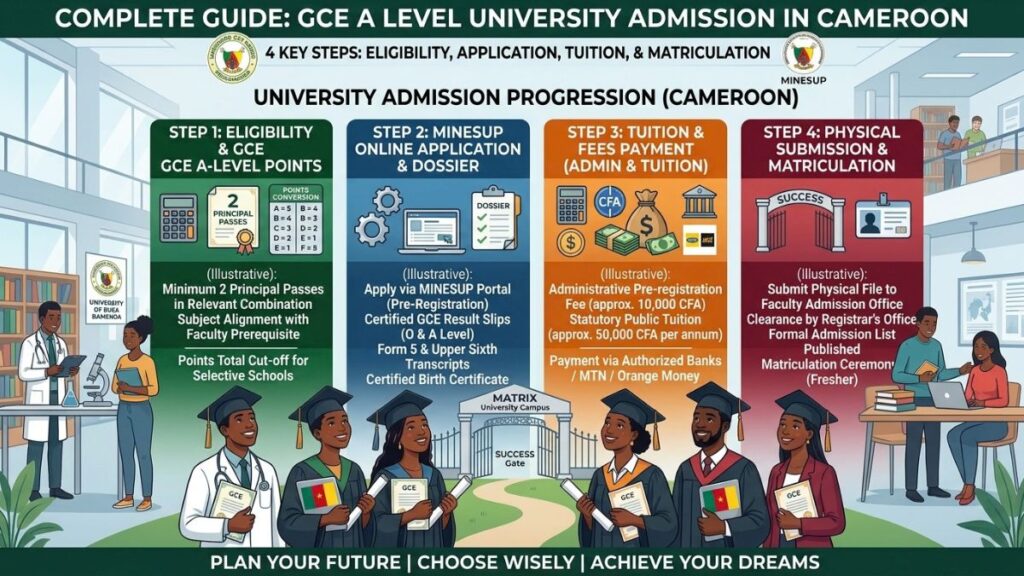
The Step-by-Step GCE A Level University Admission Process
Now to the part you came for.
Admission rules and platforms change from year to year, so confirm every detail with the official source. But the general process follows the same shape.
Step 1: Wait for (and verify) your results
Your official GCE results are released by the GCE Board. Check them through official channels only. Avoid “result checkers” that ask for payment.
You’ll need your statement of results and, later, your certificate, which usually takes longer to be issued.
Step 2: Decide your target program and backup options
Before you apply anywhere, make a shortlist of three tiers:
- Dream: the competitive program you’d love (Medicine, Polytechnic, ENAM)
- Realistic: a program where your grades comfortably qualify
- Safe: a program you’re guaranteed to meet requirements for
This is a classic strategy for a reason. It protects you if your top choice falls through.
Step 3: Watch for official admission announcements
Each institution publishes its own admission notice, with:
- Available programs and number of places
- Required grades and subjects
- Required documents
- Application deadlines
- Fees and payment method
- Entrance exam dates (for competitive programs)
Check university websites, official social media pages, and the MINESUP website. Do not rely on screenshots from WhatsApp groups. Fake notices circulate every year.
Step 4: Complete pre-registration or online application
Most state universities now use online pre-registration. You’ll create a profile, enter your personal details and exam results, upload documents, and select your program.
Double-check every spelling. A wrong name or exam number can cause serious problems when your results are verified against GCE Board records.
Step 5: Pay application or registration fees
Pay only through the official channels listed in the admission notice, whether that’s a designated bank, mobile money, or the university’s payment platform. Always keep your receipt.
Step 6: Submit your physical file (when required)
Some institutions still require a hard-copy file delivered to the admissions office. Submit before the deadline and ask for acknowledgment of receipt.
Step 7: Sit the entrance exam (for competitive programs)
If you applied to a professional school, you’ll be called to write a concours. Prepare early. Past papers, study groups, and tutoring all help, and I’ll give you preparation tips in a moment.
Step 8: Check the admission list
Admission lists are published by the institution. Confirm your name, program, and next steps, usually final registration and fee payment.
Step 9: Complete final registration
Admission isn’t final until you register. Miss the registration window and your place can go to someone else. Don’t let that happen after all your hard work.
Documents You’ll Probably Need
Requirements vary, but you should expect to prepare:
- GCE A Level statement of results (and certificate when available)
- GCE O Level certificate or statement of results
- Birth certificate (usually a recent copy)
- National ID card or proof of identity, depending on the institution
- Passport photographs
- Medical certificate, often required for registration
- Receipts for application and registration fees
- Photocopies certified as true copies, because many institutions ask for them
Pro tip: make multiple photocopies and keep digital scans on your phone and email. When a deadline is tight, having everything ready can save you.
Costs and Funding: What to Expect
One reason students pick state universities is cost.
Registration fees at public universities are generally far lower than private tuition. But “lower” doesn’t mean “free,” and amounts differ by institution, so check the current fee schedule on the official notice.
Beyond fees, plan for:
- Accommodation, either university housing or private rooms, which is often the biggest expense
- Books, printing, and course materials
- Transport and daily living costs
- Technology, especially for Computer Science or Engineering programs
Ways to fund your studies
- Family support and savings plans started early
- Scholarships from the government, NGOs, churches, foundations, and international programs
- Part-time work or tutoring once you’re settled
- Excellence awards and bursaries, which some institutions offer for top performers
Search for scholarships before you need them. Many have deadlines that fall months before admission results are released.
Studying Abroad With Your GCE A Level
Good news: the GCE A Level is a recognized qualification internationally, since it follows the Cambridge/London-style model.
That opens doors in countries like the UK, Canada, and others that recognize A Level results. Requirements often include:
- Strong A Level grades in relevant subjects
- Proof of English proficiency (some institutions waive this for Anglophone applicants, but many don’t)
- Passport, financial proof, and visa documentation
- Personal statement and references
Be careful with agents. Some charge heavy fees and make promises they can’t keep. Apply directly to institutions when possible, and verify any agency independently.
Also remember that international study often comes with high costs. Scholarships, early planning, and a strong academic profile make a big difference.
Seven Mistakes That Sink GCE A Level University Applications
I’ve seen these again and again.
Mistake #1: Waiting for results to start researching
By the time results are out, deadlines may be only weeks away. Start research during Upper Sixth.
Mistake #2: Applying to only one program
If you only apply to Medicine and miss the cutoff, you’ve lost a year. Apply across your dream, realistic, and safe tiers.
Mistake #3: Ignoring subject requirements
Great grades in the wrong subjects won’t get you into the right program. Read the requirements carefully.
Mistake #4: Trusting unofficial sources
Fake admission notices and “guaranteed admission” offers are common. Verify everything on official websites and at the institution itself.
Mistake #5: Paying to unofficial accounts
Never send fees to a personal mobile money number unless the institution officially confirms it. Keep every receipt.
Mistake #6: Submitting incomplete or inconsistent documents
A mismatch between your name on your birth certificate and your results can delay or derail your file. Fix errors early.
Mistake #7: Missing final registration
Being on the admission list isn’t the finish line. Register on time and pay what’s required.
A Simple Timeline You Can Follow
Here’s a realistic roadmap. Adjust it based on official dates.
During Upper Sixth (before exams)
- Research programs and subject requirements
- Shortlist universities and schools
- Start preparing for entrance exams if aiming for competitive programs
- Gather and organize your documents
Right after writing the GCE
- Prepare for concours with past papers
- Keep checking official admission announcements
- Research scholarships
When results are released
- Verify your results
- Finalize your three-tier shortlist
- Complete online pre-registration
- Pay fees through official channels
After applying
- Sit entrance exams
- Monitor admission lists
- Finish final registration promptly
Once admitted
- Sort out accommodation
- Attend orientation
- Plan your budget and study habits
Bonus: How to Prepare for Competitive Entrance Exams
If you’re aiming for a professional school, your A Level grades only get you through the door. The concours decides the rest. Here’s what works:
- Get past papers. Patterns repeat more than students expect.
- Study in groups. Explaining concepts out loud exposes gaps fast.
- Practice under timed conditions. Speed matters as much as knowledge.
- Strengthen your French (or English). In a bilingual system, language skills can set you apart.
- Keep General Paper skills sharp. Writing and reasoning show up everywhere.
- Protect your health. Sleep and food affect performance more than extra cramming hours.
Frequently Asked Questions
Can I go to university with just two A Level passes?
Often yes, for some programs. But competitive faculties usually expect more. Always check the specific admission notice.
Can GCE holders study in French-language universities?
Yes. Several state universities are bilingual, and GCE holders are admitted. Strong French helps a lot with lectures and exams
What if I didn’t get the grades I wanted?
You have options: apply to programs with lower requirements, consider a private institution, retake the exam, or explore professional and vocational training. One result doesn’t define your future.
Is a private university degree valid?
It can be, as long as the institution and program are accredited by MINESUP. Verify before enrolling.
How early should I start planning?
During Upper Sixth at the latest. The earlier, the better.
Final Thoughts
GCE A Level university admission in Cameroon can feel overwhelming. But now you have a clear map:
- Know your pathway options: state university, professional school, private institution, or study abroad
- Match your A Level subjects to your target program
- Build a three-tier shortlist
- Follow the step-by-step process and rely only on official sources
- Avoid the seven common mistakes
- Start early
The students who succeed aren’t always the ones with the best grades. They’re the ones who plan ahead, verify information, and stay organized.
So here’s your next step: write down three programs you’d consider (one dream, one realistic, one safe) and look up their official requirements today.
Then come back to this guide and work through the timeline.
You’ve already done the hard part by finishing your A Levels. Now go get that university seat.
Note: Admission requirements, fees, platforms, and deadlines change regularly. Always confirm current details with the official website or admissions office of each institution and with MINESUP before applying or paying.