
“Is A Level just O Level but harder?”
I hear this question more than almost any other from students, parents, and even teachers.
And the honest answer is: sort of, but that’s only a tiny part of the story.
The GCE O Level vs A Level comparison matters because these two qualifications do completely different jobs. One builds your foundation. The other qualifies you for higher education. Confuse them, and you risk choosing the wrong subjects, misunderstanding admission requirements, or wasting a year.
This guide breaks down every important difference in plain language: what each exam is, how long it takes, how it’s graded, how hard it really is, and what each one unlocks for your future.
Here’s what we’ll cover:
- What GCE O Level and A Level actually are
- The big picture: a side-by-side comparison
- Purpose: what each qualification is for
- Duration and entry requirements
- Subjects and how choices differ
- Depth of study and difficulty
- Grading systems
- What each qualification lets you do
- Common questions and misconceptions
- How to plan the journey from O Level to A Level and beyond
- Mistakes students make
Let’s start with the basics.
1. What Are GCE O Level and A Level?
GCE stands for General Certificate of Education. In Cameroon’s Anglophone sub-system, GCE examinations are organized by the GCE Board, which sets, administers, and marks the exams.
There are two main levels:
- GCE Ordinary Level (O Level): Taken after completing the first cycle of secondary education
- GCE Advanced Level (A Level): Taken after completing the second cycle, usually two years after O Level
Think of them as two floors of the same building. O Level is the ground floor: broad, foundational, and necessary. A Level is the upper floor: narrower, deeper, and the one that gets you to the roof, which in this case is university.
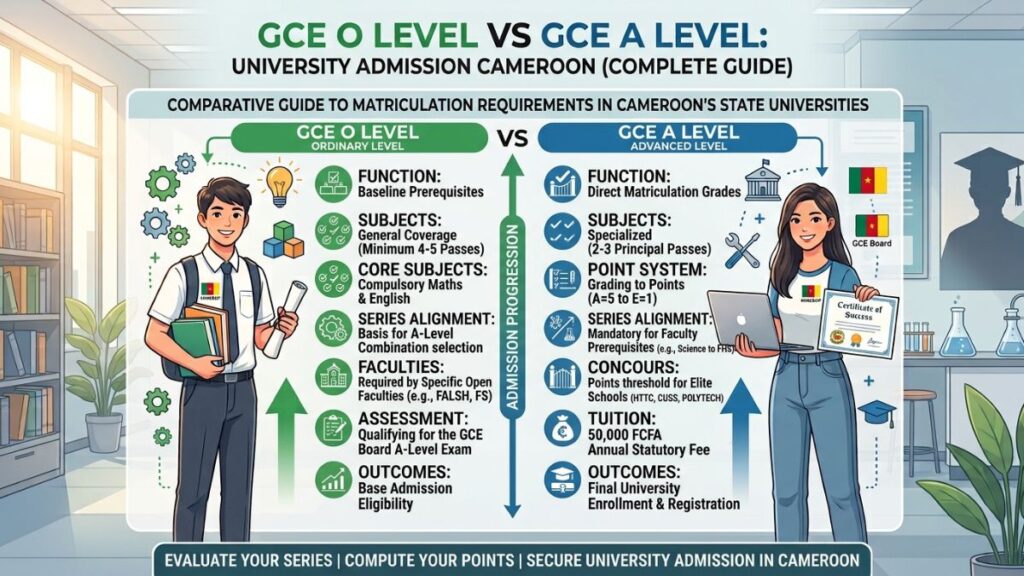
2. GCE O Level vs A Level: Side-by-Side Comparison
Here’s the quick view before we dig into the details.
| Feature | GCE O Level | GCE A Level |
|---|---|---|
| Stage | End of first cycle of secondary school | End of second cycle (high school) |
| Typical classes | Forms 1 to 5 | Lower Sixth and Upper Sixth |
| Duration | Five years of secondary education | Two additional years |
| Number of subjects | Many (commonly around 6 to 10 or more) | Few (typically 3 principal subjects plus General Paper and sometimes a subsidiary) |
| Breadth | Broad coverage across many fields | Narrow, specialized study |
| Depth | Foundational | Advanced and in-depth |
| Main purpose | Build general knowledge; qualify for A Level or technical training | Qualify for university and professional training |
| Grading | Graded A to E (with U for fail) | Graded A to E (with U for fail), by principal subject |
| Equivalent to | Completion of lower secondary/general education | University entrance qualification |
A quick note: exact subject numbers, grading details, and policies can change, so always verify the latest rules with the GCE Board.
Now let’s go deeper into each difference.
3. Purpose: What Each Qualification Is Really For
This is the most important difference, and the one most students overlook.
O Level: The foundation
The O Level proves you’ve completed a broad base of secondary education. It shows you can read, write, calculate, reason, and understand basic science, humanities, and languages.
Its job is to:
- Give you a general education across many areas
- Qualify you to enter Lower Sixth for A Level studies
- Open doors to some technical, vocational, and professional training programs
- Serve as a basic credential for certain jobs and further training
A Level: The gateway
The A Level proves you’ve mastered a few subjects deeply enough to handle university-level work.
Its job is to:
- Qualify you for university admission
- Prepare you for specialized study in your chosen field
- Serve as the basis for entry into professional schools, subject to their entrance exams
In short, O Level says “I have a solid education.” A Level says “I’m ready for higher education.”
4. Duration and Entry Requirements
Duration
- O Level: The result of five years of secondary schooling (Forms 1 to 5), with the exam taken at the end.
- A Level: An additional two years (Lower Sixth and Upper Sixth), with the exam taken at the end of Upper Sixth.
So from the start of secondary school to finishing A Level, the path typically spans seven years.
Entry requirements
- For O Level: You need to complete the secondary school program leading up to Form 5.
- For A Level: You generally need O Level passes in the subjects the school or program requires. Many schools set minimum standards for entering particular A Level subjects. For example, you may need a strong O Level result in Mathematics to do Mathematics or Physics at A Level.
This is why O Level performance matters beyond the certificate itself. It determines which A Level door you can open.
5. Subjects: Breadth vs Specialization
O Level subjects
At O Level, you study a wide range of subjects. Typically these include:
- English Language and French
- Mathematics
- Sciences such as Biology, Chemistry, and Physics
- Humanities such as History, Geography, and Literature
- Practical or technical subjects, including ICT, Economics, and others depending on your school
The idea is breadth. You sample many fields before specializing.
A Level subjects
At A Level, you specialize. Instead of many subjects, you typically take three principal subjects, plus General Paper and sometimes a subsidiary subject.
Common combinations include:
- Sciences: Biology, Chemistry, Physics, Mathematics
- Arts: Literature, History, Geography, Government, French
- Economics and business-oriented: Economics, Mathematics, Geography, and similar
The choice matters enormously because your A Level subjects determine which university programs you qualify for. Studying Arts subjects, for example, will usually not qualify you for Medicine or Engineering.
6. Depth of Study: Is A Level Really Harder?
Let’s answer the question directly.
Yes, A Level is generally more demanding. But not simply because it’s “harder content.” It’s demanding in different ways.
Depth
At O Level, you learn the essentials of a subject. At A Level, you explore the same subject at greater depth, with more complexity and detail. Take Biology: O Level introduces cells, organs, and basic processes. A Level examines mechanisms, biochemical pathways, and more advanced reasoning.
Independence
O Level often involves structured learning with teachers guiding each step. A Level expects more independent study, including reading beyond class notes, practicing past questions, and managing your own revision.
Analytical thinking
A Level questions tend to require more analysis, evaluation, and application, not just recall. You’re asked to explain why, compare ideas, and solve unfamiliar problems.
Workload
Fewer subjects doesn’t mean less work. Each A Level subject carries a heavy load, and the content is dense. Many students find that three A Level subjects demand more intense effort than eight O Level subjects.
The fair verdict
If O Level is learning to swim, A Level is swimming long distances in rougher water. Not impossible, but it requires better habits, stronger discipline, and a clear plan.
7. Grading Systems
Both levels use similar grading scales, though how results are used differs.
O Level grading
Results are typically reported by grade for each subject, with A the highest, E the lowest passing grade, and U for ungraded or fail. Employers and schools often look at the number of subjects passed and which ones, especially English and Mathematics.
A Level grading
A Level subjects are also graded A to E, with U for fail. But here’s the key difference in how it’s read: universities usually focus on principal subject passes and grades, and whether your subjects match the program you want.
Why this matters
At O Level, a broad set of passes shows general competence. At A Level, a few strong grades in the right subjects matter most. For competitive programs, the specific grades in specific subjects can decide your admission.
(Grading rules and grade boundaries can be updated, so check the GCE Board for current details.)
8. What Each Qualification Lets You Do
Here’s what you can do with each one.
With an O Level
- Proceed to Lower Sixth and study for the A Level
- Enter some technical and vocational training programs
- Apply for certain entry-level jobs or training schemes that require basic secondary qualifications
- Enroll in professional or technical courses that accept O Level holders
With an A Level
- Apply to state universities across Cameroon
- Sit entrance exams for professional schools (teacher training colleges, engineering schools, administration institutions, and others)
- Apply to accredited private universities and institutes
- Apply to universities abroad that recognize the GCE
- Pursue more advanced professional pathways that require university-level entry
The key difference
O Level keeps your options open and prepares you for the next stage. A Level is the qualification that directly unlocks university. If your goal is a degree, the A Level is the step you can’t skip.
For a complete walkthrough of how to turn your results into a university seat, read our guide on GCE A Level to University: Complete Guide for Students, and if you’re unsure what to study afterwards, see Best Courses to Study After GCE A Level.
9. Common Questions and Misconceptions
Can I go to university with just O Level?
Generally no. University admission normally requires the A Level (or an accepted equivalent). O Level can lead to Lower Sixth or to certain technical and vocational training, but not direct entry into a degree program.
Is O Level useless once I get A Level?
Not at all. Many institutions still ask for your O Level results when you apply. Strong O Level passes in subjects like English and Mathematics can matter for specific programs.
Are O Level and A Level graded the same way?
They use similar grade labels, but the standards and expectations are different. An A at A Level reflects mastery of more advanced content than an A at O Level.
Is A Level three times harder?
There’s no exact multiple. It’s more advanced and requires more independence and depth, but with consistent preparation, many students manage it well.
Do I need to take all O Level subjects seriously?
Yes, though some matter more depending on your goals. Core subjects such as English and Mathematics often matter for admission, and your O Level subject choices can influence what you’re allowed to study at A Level.
Can I retake either exam?
Generally, yes, as private or repeat candidates. Check current rules with the GCE Board and your school regarding registration, timing, and eligibility.
10. How to Plan the Journey From O Level to A Level and Beyond
The smartest students think ahead. Here’s a simple roadmap.
Stage 1: Before and during O Level
- Build strong foundations in English, Mathematics, and the Sciences or core Arts subjects
- Notice which subjects you enjoy and do well in
- Start thinking (loosely) about your career interests
Stage 2: After O Level, before choosing A Level subjects
- Research what university programs require which A Level subjects
- Match your subjects to your goals: Biology and Chemistry for health, Mathematics and Physics for engineering, Arts subjects for law and languages, and so on
- Talk to teachers, counselors, and older students
- Check whether your O Level grades meet the school’s entry requirements for your preferred subjects
Stage 3: During Lower and Upper Sixth
- Build strong study habits early: summaries, past papers, study groups
- Keep your General Paper skills sharp
- Start researching universities and entrance exams
- Organize your documents
Stage 4: After A Level
- Verify results through official channels
- Apply using a three-tier strategy: dream, realistic, and safe
- Prepare for entrance exams for competitive schools
- Follow official admission announcements
Planning backward from your goal saves you from the painful mistake of discovering, too late, that your subjects don’t match your dream program.
11. Seven Mistakes Students Make
Mistake #1: Treating O Level as unimportant
Weak O Level results can limit your A Level subject choices and affect some university applications. Take it seriously.
Mistake #2: Choosing A Level subjects without researching careers
Subject combinations determine program eligibility. Choose with your goals in mind, not just your friends’ choices.
Mistake #3: Assuming A Level studying works like O Level studying
Memorizing notes the night before isn’t enough. A Level rewards understanding, practice, and consistency.
Mistake #4: Ignoring General Paper
It may look like an add-on, but it develops writing and reasoning skills useful across university programs.
Mistake #5: Not keeping documents safe
Lost certificates and statements of results create delays later. Keep originals secure and store scanned copies.
Mistake #6: Relying on rumors
Admission rules, grading policies, and requirements change. Verify with official sources.
Mistake #7: Starting university planning too late
The best time to research is during Lower or Upper Sixth, not after results are released.
Frequently Asked Questions
What is the main difference between GCE O Level and A Level?
O Level is a broad, foundational qualification taken at the end of the first secondary cycle. A Level is a specialized, advanced qualification taken at the end of the second cycle, and it’s the one that qualifies you for university.
How many years separate O Level and A Level?
Typically two years, covering Lower Sixth and Upper Sixth.
Which is harder, O Level or A Level?
A Level is generally more demanding because of greater depth, independence, and analytical thinking.
How many subjects do you take at each level?
O Level involves many subjects. A Level involves a few, usually three principal subjects plus General Paper and possibly a subsidiary.
Do universities look at O Level results?
Often, yes. Many institutions request them as part of your application, and some programs have O Level requirements.
Can I skip O Level and go straight to A Level?
Generally, no. O Level (or an accepted equivalent) is typically required for A Level entry.
Final Thoughts
The GCE O Level vs A Level comparison comes down to this:
- O Level is broad, foundational, and prepares you for the next stage
- A Level is specialized, advanced, and qualifies you for university
- A Level demands more depth, more independence, and sharper thinking
- Your O Level results influence your A Level options, and your A Level subjects decide your university options
- Planning ahead saves you from costly mistakes
If you’re still in O Level, now is the time to build strong foundations and explore your interests. If you’re choosing A Level subjects, work backward from the career or degree you want. And if you’ve already finished A Level, start researching programs and building your application strategy.
Here’s your next step: write down the program you’d love to study, then check which A Level subjects it requires. If you’re not already on track, adjust your plan now.
Every successful journey starts with understanding the map. You’ve just read it. Now start walking.
Note: Examination structures, grading rules, subject offerings, and admission requirements can change. Always verify current details with the GCE Board, your school, and the official websites or admissions offices of the institutions you’re targeting.