You’ve finished your A Levels.
Everyone around you has an opinion. Your uncle says Medicine. Your neighbor says Engineering. Your friend says “just do Law, you argue a lot.”
But nobody has asked the one question that actually matters: what’s the right course for you?
Choosing from the courses to study after GCE A Level is one of the biggest decisions you’ll make. It shapes your career, your income, and honestly, your daily happiness for years.
The problem? Most advice is based on prestige, not fit. Students pick courses they hate, drop out, or graduate into fields with no jobs.
This guide fixes that. I’ll walk you through the best course options, who each one suits, the A Level subjects you need, what careers they lead to, and a simple framework to choose with confidence.
Here’s what’s inside:
- How to think about “best” courses
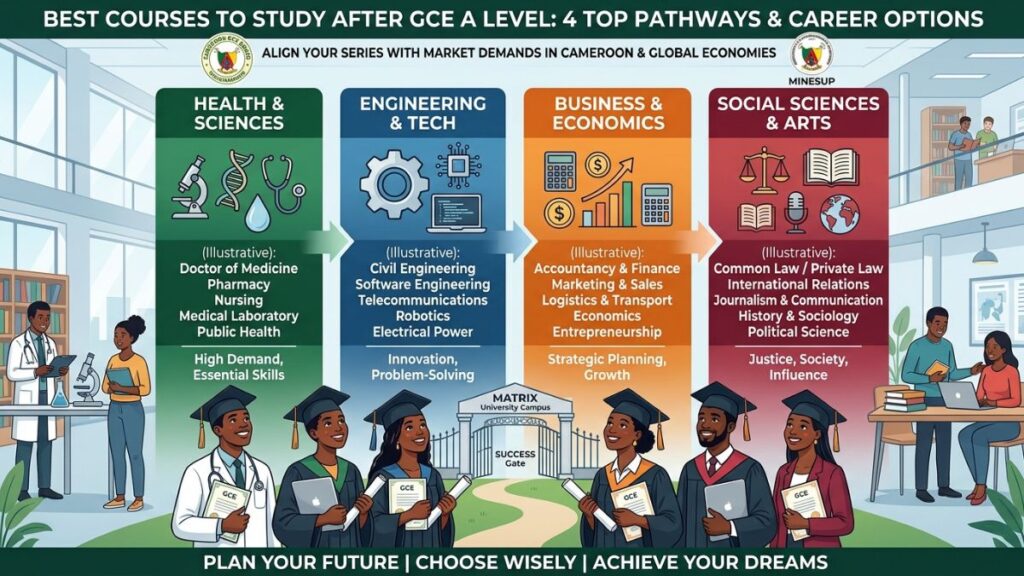
- Health and medical sciences
- Engineering and technology
- Business, economics, and management
- Law and political science
- Education and languages
- Agriculture and environmental sciences
- Media, arts, and creative fields
- Vocational and professional alternatives
- A 5-step framework for choosing
- Mistakes to avoid
Let’s get into it.
1. What Does “Best Course” Actually Mean?
Here’s something nobody tells you: there is no single best course.
The right course sits at the intersection of four things:
- Your strengths: What you’re genuinely good at, based on your A Level performance
- Your interests: What you can stand studying for 3 to 6 years
- Job demand: Whether employers or clients actually need these skills
- Your resources: Tuition, location, and family support
A course that looks perfect on paper but ignores two of these will give you trouble. A student who loves Biology but faints at blood shouldn’t force Medicine. A student who’s brilliant at Maths but bored by it may be happier in Economics.
Keep these four filters in mind as you read. We’ll come back to them in the framework later.
2. Health and Medical Sciences
Health courses are the most popular choice among Cameroonian students, and for good reason. Healthcare demand is constant, and professionals are respected in every community.
Top courses in this field
- Medicine and Surgery (MD): The most competitive course. Long training, high prestige.
- Pharmacy: Combines chemistry and patient care. Strong demand in hospitals, pharmacies, and industry.
- Nursing and Midwifery: Always in demand, locally and internationally.
- Medical Laboratory Science: Behind-the-scenes diagnosis, crucial to every hospital.
- Public Health: Focuses on communities, prevention, and health policy.
- Dentistry, Physiotherapy, and Nutrition: Specialized paths with growing demand.
Subjects you’ll typically need
Biology and Chemistry are the foundation. Physics or Mathematics often adds strength, especially for Medicine.
Who it suits
Students who are patient, resilient, and comfortable with long study hours. If you hate memorizing large volumes of information, think carefully.
The reality check
Medicine and Pharmacy admissions are highly competitive and often involve entrance exams. That doesn’t mean you shouldn’t try. It means you should always have a backup course in the health family, such as Laboratory Science, Nursing, or Public Health. These keep you in your field if your first choice doesn’t work out.
3. Engineering and Technology
If you love solving problems and building things, this is your zone. And in a world powered by technology, skills here travel well across borders.
Top courses in this field
- Computer Science and Software Engineering: The most flexible. You can work for companies, freelance, or build products.
- Civil Engineering: Roads, bridges, buildings. Infrastructure growth keeps demand steady.
- Electrical and Electronics Engineering: Power, telecommunications, and automation.
- Mechanical Engineering: Machines, manufacturing, and energy systems.
- Information Technology and Cybersecurity: Fast-growing as businesses and banks move online.
- Telecommunications and Network Engineering: Essential as connectivity expands.
Subjects you’ll typically need
Mathematics and Physics are the core. Further Mathematics or Chemistry helps for some programs.
Who it suits
Logical thinkers who enjoy math and don’t mind difficult technical problems. Computer Science, in particular, rewards self-learners.
Pro tip
In tech, skills often matter as much as the degree. While you study, build projects, learn to code, and create a portfolio. Students who graduate with real work to show beat those who graduate with only a certificate.
4. Business, Economics, and Management
Business courses are among the most versatile. Every organization, from a small shop to a multinational, needs people who understand money, markets, and management.
Top courses in this field
- Accounting and Finance: Always employable. Opens doors to auditing, banking, and professional certifications.
- Banking and Finance: Careers in commercial banks, microfinance, and insurance.
- Economics: Analytical and flexible. Leads to policy, research, banking, and consulting.
- Business Administration and Management: Broad training for leadership and entrepreneurship.
- Marketing and Communication: Increasingly digital, including social media and brand strategy.
- Human Resource Management: Hiring, training, and workforce planning.
- Entrepreneurship: For students who’d rather create jobs than find one.
Subjects you’ll typically need
Economics, Mathematics, or Business-related subjects help, though many programs accept a wide range of combinations.
Who it suits
People who like numbers, planning, negotiation, and understanding how organizations work.
The reality check
Because business degrees are common, what you add on top makes the difference: professional certifications (like accounting qualifications), internships, languages, and practical experience.
5. Law and Political Science
Law is respected, intellectually demanding, and leads to a clear set of careers. Cameroon’s bilingual legal system also creates unique opportunities for students who handle both English and French.
Top courses in this field
- Law (LLB): Leads to practice as a lawyer, magistrate, notary, or legal adviser.
- Political Science: Politics, governance, and public policy.
- International Relations and Diplomacy: Diplomatic service, NGOs, and international organizations.
- Public Administration: Management in government institutions.
Subjects you’ll typically need
Literature, History, Government, Economics, or other essay-based subjects usually prepare you well. Strong English and French writing skills are a big advantage.
Who it suits
Students who read widely, argue clearly, and care about justice and public affairs.
Pro tip
Law rewards communication skills. Join debate clubs, practice writing, and learn French if you haven’t. Bilingual legal professionals have a real edge.
6. Education and Languages
Teaching rarely gets the glamour it deserves, but it’s one of the most stable and meaningful paths available.
Top courses in this field
- Education (various subject specializations): Mathematics, Sciences, English, French, History, Geography, and more.
- Bilingual Studies and Translation: Language mediation for government, companies, and international bodies.
- Linguistics and Modern Languages: Teaching, research, and communication.
- Guidance and Counselling: Supporting students and communities.
- Educational Administration: School leadership and management.
Subjects you’ll typically need
Your A Level subjects usually match the subject you want to teach. Strong language skills help across the board.
Who it suits
Patient communicators who enjoy explaining things and helping others grow.
Why it deserves a second look
Teacher training programs, including Higher Teacher Training Colleges, often lead to clear career pathways. That’s rare in a competitive job market. If stability matters to you, don’t dismiss education because it’s not trendy.
7. Agriculture and Environmental Sciences
Cameroon is an agricultural country, and food security is becoming a global priority. This sector is growing, yet fewer students choose it.
Top courses in this field
- Agricultural Science and Agronomy: Crop production, soil management, and farm planning.
- Animal Science and Veterinary Medicine: Livestock, animal health, and food production.
- Food Science and Technology: Processing, preservation, and quality control.
- Environmental Science and Forestry: Conservation, climate, and resource management.
- Agribusiness: Combining farming and business, from production to export.
Subjects you’ll typically need
Biology and Chemistry, sometimes Geography or Mathematics.
Who it suits
Practical, outdoor-minded students who see opportunity where others see farmland.
The opportunity most students miss
Agribusiness and food processing are areas where young graduates can start ventures with relatively modest capital, especially when combining technical knowledge with business skills.
8. Media, Arts, and Creative Fields
Creative careers used to be dismissed. Not anymore. Digital platforms have made content creation, design, and communication valuable skills.
Top courses in this field
- Journalism and Mass Communication: Reporting, broadcasting, and digital media.
- Public Relations and Corporate Communication: Managing how organizations are perceived.
- Graphic Design and Multimedia: Visual communication, branding, and animation.
- Film, Theatre, and Performing Arts: Storytelling and production.
- Creative Writing and Literature: Writing, editing, and publishing.
Subjects you’ll typically need
Literature, English, French, History, or Art-related subjects help. Portfolio work often matters as much as grades.
Who it suits
Imaginative students who communicate well and aren’t afraid to build a personal brand.
Pro tip
In creative fields, your portfolio is your CV. Start building one now, whether that’s writing samples, designs, videos, or a blog.
9. Vocational and Professional Alternatives
Not every successful path goes through a traditional degree. Technical and professional training can lead to strong careers, sometimes faster.
Options worth considering
- Higher National Diploma (HND) programs: Practical, career-focused training in fields such as accounting, marketing, and engineering technology.
- Professional certifications: Accountancy, project management, IT certifications, and similar qualifications.
- Technical and vocational institutes: Electronics, plumbing, hospitality, construction, and mechanics.
- Hospitality and Tourism Management: Hotels, travel, and event management.
- Digital skills training: Web development, data analysis, digital marketing, and graphic design.
Who it suits
Students who prefer hands-on learning, want to start earning sooner, or need a more affordable pathway.
The truth
A skilled professional with a certification and real experience often outperforms a graduate with a degree and no practical skills. Don’t treat vocational routes as “second choice.” For many students, they’re the smarter choice.
10. A 5-Step Framework for Choosing Your Course
Now for the most important part. Here’s the process I recommend.
Step 1: Audit your A Level results and subjects
List your subjects and grades. Where did you perform best? Where did you struggle? Your results aren’t your destiny, but they’re useful evidence.
Step 2: Identify your top 3 interests
Ask yourself:
- What do I read, watch, or research when nobody forces me?
- What problems do I enjoy solving?
- What kind of work environment sounds exciting: hospital, office, lab, classroom, field?
Write down three fields. Not twenty.
Step 3: Research the job market
For each field, ask:
- What jobs does this course lead to?
- Who hires graduates, locally and internationally?
- What do professionals in this field actually do day to day?
Talk to real people in these careers. One 20-minute conversation with a working engineer or nurse teaches you more than ten blog posts, including this one.
Step 4: Check requirements and costs
For each course, verify:
- Required A Level subjects and grades
- Which institutions offer it
- Whether admission is competitive or entrance exam based
- Tuition, living costs, and duration
Always confirm details on official admission notices.
Step 5: Build a three-tier shortlist
Choose:
- One dream course: Competitive, ambitious.
- One realistic course: Your grades comfortably qualify.
- One safe course: You’re almost certain to meet requirements.
This protects you from losing a year if your first choice doesn’t work out.
Quick Comparison: Courses by Student Type
Not sure where you fit? Here’s a quick guide.
| If you are… | Consider |
|---|---|
| Strong in Biology and Chemistry | Medicine, Pharmacy, Nursing, Lab Science |
| Strong in Math and Physics | Engineering, Computer Science, IT |
| Strong in Economics and Math | Accounting, Banking, Economics |
| A strong reader and writer | Law, Journalism, Languages, Political Science |
| A natural explainer | Education, Counselling |
| Practical and outdoorsy | Agriculture, Environmental Science |
| Creative and expressive | Media, Design, Communication |
| Hands-on and career-driven | Vocational and professional training |
Use this as a starting point, not a final answer.
7 Mistakes Students Make When Choosing a Course
Mistake #1: Choosing based on prestige alone
A prestigious course you dislike becomes a miserable decade. Choose fit over fame.
Mistake #2: Following friends or family pressure
Your parents may mean well, but you’re the one attending lectures. Listen to advice, then decide for yourself.
Mistake #3: Ignoring subject requirements
Loving a course doesn’t help if your A Level subjects don’t qualify you. Check requirements early.
Mistake #4: Chasing “money courses” without understanding the work
Every high-paying career comes with real demands. Understand the daily reality before committing.
Mistake #5: Not having a backup plan
Competitive courses reject strong candidates every year. Always apply to a realistic and a safe option.
Mistake #6: Ignoring practical skills
Degrees open doors, but skills walk you through them. Build experience through internships, projects, and volunteering.
Mistake #7: Making the decision too late
Research early. Rushed choices lead to regret, and sometimes to expensive course changes.
Frequently Asked Questions
What are the best courses to study after GCE A Level in Cameroon?
It depends on your strengths and subjects. Popular, in-demand fields include health sciences, engineering and computer science, accounting and finance, law, education, and agriculture. The best course is the one that matches your abilities, interests, and resources.
Can I study Medicine with Arts subjects?
Generally no. Medicine requires Science subjects, especially Biology and Chemistry. If you’re in Arts and love health, look into Public Health, Health Administration, or Health Communication, where requirements may differ.
Which course has the best job opportunities?
Fields like technology, health, accounting, and engineering generally have strong demand. But demand varies, and success depends heavily on your skills and experience, not only your degree.
Can I change my course later?
Sometimes, depending on the institution’s rules. It’s usually easier early on, but it can cost time and money. Choose carefully the first time.
Is vocational training worth it?
Yes, especially if you want practical skills and faster entry into work. Many technical careers pay well and offer opportunities to start your own business.
What if my grades are low?
You still have options. Look at programs with lower entry requirements, professional certificates, HND programs, or resitting the exam. One result doesn’t define your future.
Final Thoughts
Choosing among the courses to study after GCE A Level doesn’t have to be stressful. Here’s what to remember:
- There’s no “best” course, only the best fit for you
- Match your strengths, interests, job demand, and resources
- Explore every pathway: health, engineering, business, law, education, agriculture, creative fields, and vocational training
- Use the 5-step framework to decide
- Build a three-tier shortlist so one rejection doesn’t cost you a year
- Develop real skills alongside your degree
Here’s your next step: grab a pen and write down your top three course ideas. Then spend one hour this week researching the requirements, careers, and costs of each.
Better still, find one person working in each field and ask them what a normal day looks like.
That single conversation might save you years of wrong turns.
You’ve already earned your A Levels. Now choose the path that makes the next chapter worth it.
Note: Admission requirements, course availability, fees, and deadlines change regularly. Always verify details with the official admissions office or website of each institution before applying.