When parents and students sit down to plan secondary education in English-speaking Cameroon, one big choice quickly moves to the center of the table:
Should you choose General Education or Technical Education?
For decades, the standard path seemed clear: go through general secondary school, pass your GCE O-Levels, move into Sixth Form (Lower Sixth & Upper Sixth) for A-Levels, and head off to a traditional university.
Today, that single-track mindset is completely outdated.
As Cameroon’s economy shifts toward technical skills, engineering, infrastructure development, and digital technology, the division between these two educational tracks has become one of the most critical decisions a student will ever make.
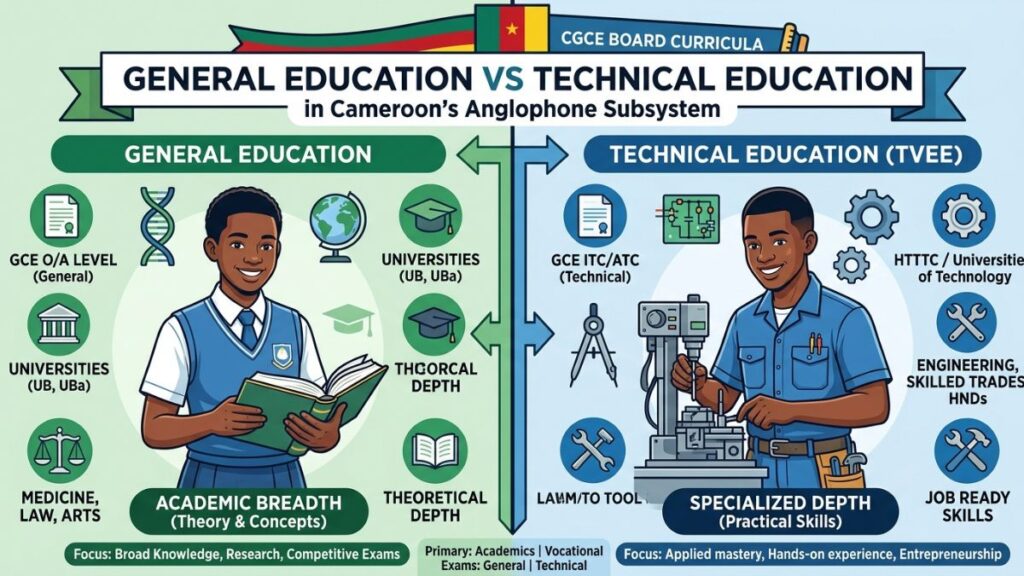
Both pathways operate side-by-side under the Cameroon General Certificate of Education (GCE) Board within the Anglophone subsystem, but they are built for entirely different outcomes:
- General Education is engineered for theoretical depth and academic breadth. It focuses on conceptual analysis, scientific principles, humanities, and abstract problem-solving across general disciplines.
- Technical Education (TVEE) is engineered for applied mastery and practical execution. It pairs core academic theory directly with hands-on workshop experience, specialized drafting, and trade-specific technical skills.
Choosing between General Education vs Technical Education isn’t about deciding which track is “better”—it’s about matching a student’s natural learning style, career ambitions, and long-term goals to the right learning environment.
In this comprehensive, step-by-step breakdown, we’ll analyze how both subsystems work, compare their curriculum structures and examination frameworks, and map out the exact higher education and career pathways each track unlocks.
System Structures & Milestones
To understand how both systems function, you need to look at how a student moves through each track from the moment they complete primary school.
While both paths cover seven years of secondary education, their structural milestones and official qualifications diverge significantly.
1. The General Education Track (5 + 2 Years)
The General Education track follows the classic academic timeline designed around pure theory and conceptual development:
- First Cycle (Forms 1 to 5): A 5-year general program. Students study a broad mix of natural sciences, social sciences, languages, and humanities.
- Major Milestone: GCE Ordinary Level (O-Level) written at the end of Form 5.
- Second Cycle (Lower & Upper Sixth): A 2-year specialized pre-university program where students focus strictly on 3 to 4 principal subjects within a Science, Arts, or Commercial stream.
- Terminal Qualification: GCE Advanced Level (A-Level) written at the end of Upper Sixth.
2. The Technical Education Track (5 + 2 Years)
The Technical and Vocational Education and Training (TVEE) track matches the same 7-year duration, but structures its learning around technical trades and practical competencies:
- First Cycle (Years 1 to 5 / Technical College): A 5-year program where students split their time between theoretical classroom work and practical workshop training in a chosen specialty (e.g., Electrical Technology, Building Construction, Home Economics, Automobile Mechanics).
- Major Milestone: GCE Intermediate Technical Examination (ITC)—formerly known as CAP in some technical frameworks—written at the end of Year 5.
- Second Cycle (High School Technical / Technical Sixth Form): A 2-year advanced technical program designed to deepen practical expertise, engineering calculations, and technical design.
- Terminal Qualification: GCE Advanced Technical Examination (ATC) written at the end of Upper Sixth Technical.
3. Key Structural Differences
| Metric | General Education Track | Technical Education Track |
| First Cycle Certificate | GCE Ordinary Level (General) | GCE Intermediate Technical (ITC) |
| Second Cycle Certificate | GCE Advanced Level (General) | GCE Advanced Technical (ATC) |
| Specialization Point | Begins broadly in Lower Sixth | Begins immediately in Year 1 of Technical School |
| Learning Environment | Classrooms & Science Laboratories | Classrooms, Drafting Rooms, & Technical Workshops |
Curriculum Focus & Learning Methodologies
The real divide between General Education vs Technical Education lies in how students learn and what they are trained to do every day in the classroom.
While General Education trains the mind to analyze abstract concepts, Technical Education trains both the mind and the hands to solve practical, real-world problems.
1. General Education: Theory, Analysis, and Conceptual Frameworks
The General Education curriculum is built around academic literacy, scientific principles, and analytical thinking.
- Core Focus: Understanding the why behind phenomena. Students master formulas, historical contexts, literary criticism, and mathematical proofs.
- Learning Environment: Traditional lecture-based classrooms, computer labs, and standard science laboratories (Physics, Chemistry, Biology).
- Workload Breakdown:
- 80–90% Theoretical Instruction: Lectures, textbook study, essay writing, and analytical problem-solving.
- 10–20% Practical Application: Standard laboratory experiments and basic scientific measurements.
2. Technical Education: Applied Theory, Workshops, and Trade Competencies
The Technical Education curriculum blends classroom theory with intensive, practical workshop execution. Students don’t just learn how a machine or system works on paper—they build, install, repair, and maintain it.
- Core Focus: Mastering the how-to of specific industrial, commercial, and technical trades.
- Learning Environment: Classrooms, technical drawing studios, auto workshops, electrical testing labs, construction bays, and industrial kitchens.
- Workload Breakdown:
- 40–50% Classroom Theory & Related Sciences: Applied Mathematics, Applied Physics, Strength of Materials, and Technical Drawing/CAD.
- 50–60% Hands-On Workshop Practice: Direct engagement with industrial equipment, wiring panels, engine blocks, building structures, or commercial software.
3. Specialized Technical Specialties (Trades)
In the Technical track, candidates enroll directly into specific departments under two broad umbrellas:
- Industrial Technology (STT/TI): Electrical Technology, Mechanical Fabrication, Automobile Mechanics, Civil Engineering/Building Construction, Carpentry & Woodwork, Electronics, and Refrigeration & Air Conditioning.
- Commercial & Home Economics Technology (STEG): Accountancy, Secretarial Administration, Action and Commercial Communication, Clothing & Textiles, and Home Economics/Hotel Management.
Examination Bodies & Qualifications (CGCEB TVE Division)
One of the biggest misconceptions about technical education in Cameroon is that it operates under a completely different board or lacks standardization.
In reality, both tracks are examined and certified by the Cameroon General Certificate of Education (GCE) Board.
However, to cater to the practical nature of technical trades, the Board operates a specialized Technical and Vocational Education (TVE) Division alongside its General Division.
1. General GCE Board Examinations
For General Education candidates, assessment focuses primarily on written examination papers and standard laboratory practicals:
- GCE Ordinary Level (General): Assesses candidates across 6 to 11 general subjects using multiple-choice (Paper 1) and essay/problem-solving formats (Paper 2 & 3).
- GCE Advanced Level (General): Evaluates deep conceptual mastery across 3 to 4 principal subjects through rigorous essay papers, complex mathematical derivations, and advanced science laboratory tests.
2. Technical GCE Board Examinations (TVE Division)
For Technical Education candidates, assessment is split between written theoretical papers, applied calculations, and intensive, timed workshop evaluations:
- GCE Intermediate Technical Examination (ITC): Written at the end of Year 5 (equivalent to Form 5 O-Level). It tests foundational technical theory, trade math, technical drawing, and practical execution.
- GCE Advanced Technical Examination (ATC): Written at the end of Technical Upper Sixth (equivalent to General A-Level). It evaluates advanced engineering design, industrial calculations, management principles, and complex practical projects.
3. The “Epreuve Pratique” (Practical Workshop Exam)
The defining feature of Technical GCE examinations is the heavy weight placed on the Practical Workshop Examination (Epreuve Pratique).
Unlike General GCE science practicals—which typically last 2 to 3 hours in a biology or chemistry lab—Technical GCE practical exams can run for 6 to 12 hours over one or two days.
Candidates are given actual blueprints, raw materials, wiring panels, or engine components and must manufacture, assemble, wire, or troubleshoot a fully functional system under the strict supervision of external examiners. Failing the practical component often means failing the entire subject, regardless of written theory scores.
University & Career Progression Options
Choosing between General and Technical Education doesn’t just shape your high school experience—it directly defines where you go next.
Both tracks open doors to higher education and professional employment, but they follow distinctly different career trajectories.
1. General Education Progression: Academic & Professional Faculties
General Education graduates (holding GCE A-Levels) are built for traditional university degree paths, competitive national entrance examinations (Concours), and theoretical research:
- State University Faculties: Direct admission into Bachelor of Science (B.Sc.), Bachelor of Arts (B.A.), or Bachelor of Laws (LL.B.) programs at institutions like the University of Buea (UB) and University of Bamenda (UBa).
- Professional Faculties (Concours): Direct entry to elite professional schools such as:
- Faculty of Health Sciences (FHS): Medicine, Nursing, Pharmacy.
- National Advanced School of Engineering (Polytechnique): Civil, Mechanical, and Computer Engineering.
- Higher Teacher Training Colleges (HTTC / ENS): Preparing secondary school teachers in general disciplines.
- Overseas Degree Programs: Direct admission into undergraduate programs across Europe, North America, and Asia.
2. Technical Education Progression: Specialized Engineering, HTTTC, and HNDs
Technical Education graduates (holding GCE Advanced Technical / ATC) possess a major advantage: they already have practical job skills alongside pre-engineering theory. Their progression routes reflect this specialized training:
- Higher Technical Teacher Training Colleges (HTTTC / ENSET): Specialized faculties (e.g., HTTTC Kumba or ENSET Douala) that train technical instructors and industrial engineers.
- Universities of Technology & Institutes of Technology: Higher institutes offering specialized Bachelor of Technology (B.Tech) degrees in fields like Electrical Engineering, Computer Networking, Automobile Design, and Civil Construction.
- HND & BTS Programs: Higher National Diploma (HND) and Brevet de Technicien Supérieur (BTS) programs in professional fields like Accountancy, Marketing, Logistics, and Industrial Automation.
- Direct Labor Market Entry & Entrepreneurship: Unlike general graduates who often must pursue further university education to gain employable skills, ATC holders can directly enter the workforce as qualified technicians, site supervisors, or start their own specialized businesses (e.g., electrical contracting, automotive workshops, civil drafting).
Summary Comparison Table
Here is a side-by-side comparison of General Education vs Technical Education in Cameroon’s Anglophone subsystem at a glance:
| Feature / Metric | General Education Track | Technical Education Track (TVEE) |
| First Cycle Exam (Year 5) | GCE Ordinary Level (General) | GCE Intermediate Technical (ITC) |
| Second Cycle Exam (Year 7) | GCE Advanced Level (General) | GCE Advanced Technical (ATC) |
| Primary Curriculum Focus | Theoretical principles, academic literacy, abstract problem-solving | Applied theory, workshop execution, trade-specific skills |
| Learning Environment | Classrooms & Science Laboratories | Classrooms, Technical Drawing Studios & Industrial Workshops |
| Practical Exam Weight | Moderate (Standard science lab tests, 2–3 hours) | Heavy (Intensive Epreuve Pratique workshop tests, 6–12 hours) |
| Core Specialization Point | High school level (Lower Sixth) | Immediately upon entry (Year 1 of Technical College) |
| Higher Education Focus | Academic Degrees (B.Sc., B.A., LL.B.) & Professional Schools (FHS, ENS) | Higher Technical Degrees (B.Tech), HTTTC/ENSET, HND/BTS |
| Immediate Workforce Readiness | Low to Moderate (Requires further university specialization) | High (Equipped with practical trade skills for direct employment/entrepreneurship) |
Frequently Asked Questions (FAQs)
Can a student with a GCE Advanced Technical (ATC) certificate enter a general university degree program?
Yes. Graduates holding the GCE ATC certificate are fully eligible for direct admission to state universities (such as the University of Buea or the University of Bamenda) and private university faculties. While their qualifications naturally align with STEM, technology, and engineering faculties, their GCE Board certificates satisfy national higher education entry requirements across standard degree programs.
Is a GCE Technical qualification recognized equally for public civil service jobs in Cameroon?
Yes. Qualifications issued by the Cameroon GCE Board—both General (O-Level/A-Level) and Technical (ITC/ATC)—are fully recognized by the Ministry of Public Service and Administrative Reform (MINFOPRA). In fact, candidates holding technical credentials often have a distinct advantage in civil service concours for specialized technical ministries, including Public Works, Energy and Water Resources, and Agriculture.
Which track offers faster entry into direct employment or self-employment?
Technical Education. Because the TVEE curriculum incorporates hands-on workshop training, industrial drafting, and practical execution alongside academic theory, ATC and ITC holders leave high school with usable, marketable trade skills. This enables them to immediately work as certified technicians or launch independent businesses (such as electrical installation, auto maintenance, or construction management) without requiring a university degree first.
Strategic Conclusion
Navigating the choice between General Education vs Technical Education in Cameroon’s Anglophone subsystem comes down to one fundamental principle: aligning a student’s learning style with their long-term vision.
Here are the key strategic takeaways to guide your decision:
- General Education Is Built for Pre-Professional Breadth: If your goal is to pursue traditional academic disciplines—such as Medicine, Law, Pure Sciences, or General Humanities—the 5+2 General GCE track provides the theoretical depth and competitive platform required for university entry and classical professional faculties (Concours).
- Technical Education (TVEE) Delivers Immediate Practical Mastery: If you thrive on hands-on creation, engineering execution, or commercial design, the TVEE track provides specialized trade skills without sacrificing core academic rigor. Graduates leave Technical Sixth Form holding the GCE Advanced Technical Certificate (ATC), ready for pre-engineering degrees, specialized technical institutes (HTTTC/ENSET), or immediate industrial self-employment.
- Both Pathways Carry Equal Legal and Educational Standing: Evaluated and awarded by the Cameroon General Certificate of Education (GCE) Board, both sets of qualifications are nationally recognized by the government and higher learning institutions.
Instead of viewing Technical Education as a secondary option, modern students and parents should treat both tracks as specialized pathways to success. Choose the track that plays to your strengths, targets your career goals early, and builds a sustainable future in Cameroon’s evolving economy.