If you want to understand academic success in English-speaking Cameroon, you need to master two critical credentials:
The GCE Ordinary Level (O-Level) and the GCE Advanced Level (A-Level).
Together, these two national examinations form the backbone of the Anglophone subsystem of education.
They dictate which high school stream a student enters, which university degree program accepts them, and ultimately, what career opportunities open up down the line.
Yet, many parents and students make a fundamental mistake:
They treat the O-Level and A-Level as if they are simply two versions of the same test—just taken two years apart.
That assumption is completely wrong.
While both exams are designed and administered by the Cameroon General Certificate of Education (GCE) Board, they serve two entirely different purposes in a student’s academic lifecycle:
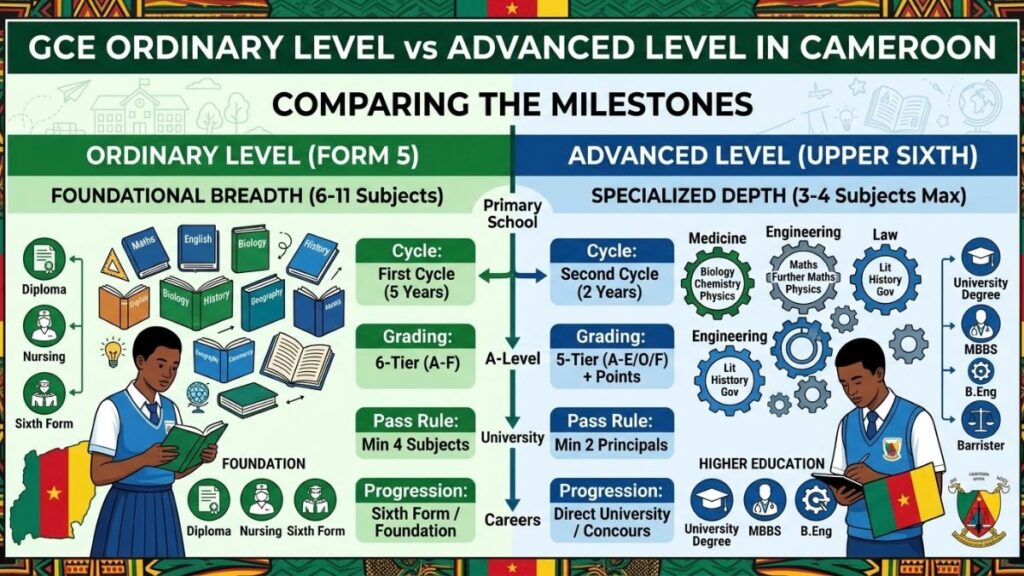
- Ordinary Level is built for breadth. It tests broad foundational knowledge across a wide spectrum of humanities, sciences, and commercial subjects.
- Advanced Level is built for depth. It demands deep subject mastery, rigorous critical analysis, and specialized problem-solving in a tight cluster of chosen disciplines.
Understanding the distinction between Ordinary Level vs Advanced Level in Cameroon isn’t just an academic exercise—it’s the key to building a high-converting strategy for university admissions and long-term career planning.
In this detailed, side-by-side guide, we’ll break down the exact differences in subject loads, grading scales, examination structures, and higher education pathways so you know precisely what to expect at every step.
Overview & Target Audience (Form 5 vs Upper Sixth)
To understand how these two examinations differ, you first need to look at where they sit within the Anglophone secondary education timeline.
The Cameroon GCE Board structures secondary school into two distinct cycles, placing one major exam at the tail end of each cycle.
1. GCE Ordinary Level: The First Cycle Milestone
The GCE Ordinary Level is written at the end of Form 5, marking the completion of the 5-year First Cycle of secondary education.
- Target Age Group: Typically taken by students aged 15 to 16.
- Primary Objective: To evaluate whether a candidate has acquired a strong, general foundation in foundational academic and technical subjects.
- Student Focus: At this stage, students are still generalists. They are testing their aptitudes across arts, natural sciences, social sciences, and commercial disciplines to discover where their core strengths lie.
- The Benchmark: Earning a strong O-Level profile serves as the official prerequisite to cross over from the First Cycle into High School (Sixth Form).
2. GCE Advanced Level: The Second Cycle Milestone
The GCE Advanced Level is written at the end of Upper Sixth, representing the culmination of the 2-year Second Cycle (Sixth Form).
- Target Age Group: Typically taken by students aged 17 to 18.
- Primary Objective: To test high-level, pre-university competence, critical thinking, and specialized knowledge in a narrow academic stream.
- Student Focus: At this stage, general exploration is over. Students function as specialists, preparing directly for university faculties, professional entrance exams (Concours), or specialized technical careers.
- The Benchmark: The GCE A-Level is the official terminal secondary school qualification in the Anglophone subsystem, serving as the direct gateway to degree programs worldwide.
Subject Breadth vs. Specialization Depth
The single biggest difference between Ordinary Level vs Advanced Level in Cameroon comes down to one word: Focus.
At Ordinary Level, the goal is exposure. At Advanced Level, the goal is expertise.
Here is how the subject structure shifts dramatically between the two levels.
1. Ordinary Level: High Subject Breadth
During Form 5, students cast a wide net. The system forces broad exposure across multiple disciplines so candidates don’t lock themselves into a single career track too early.
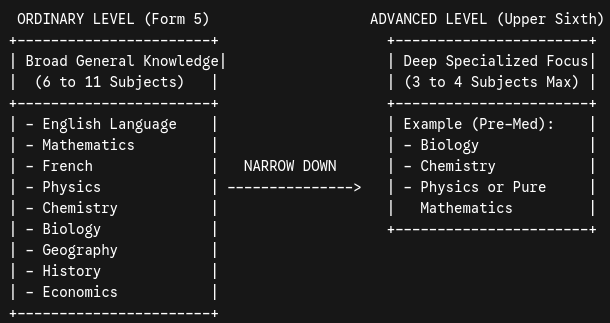
- Subject Volume: Candidates typically register for 6 to 11 subjects in a single examination session.
- Core Requirements: While students pick their elective subjects, core disciplines like English Language and Mathematics are universally emphasized to ensure baseline literacy and numerical competency.
- Typical Subject Spread: A balanced O-Level student often takes:
- Languages: English Language, French.
- Sciences: Biology, Chemistry, Physics, Human Biology.
- Arts & Humanities: English Literature, Geography, History, Economics.
- Commercial & Technical: Food and Nutrition, Accounting, Commerce, Computer Science.
2. Advanced Level: Deep Subject Specialization
Once a student enters Sixth Form (Lower and Upper Sixth), broad exploration stops. The curriculum narrows radically.
- Subject Volume: Candidates focus on 3 to 4 principal subjects maximum, alongside subsidiary subjects (such as ICT or General Paper).
- Stream Alignment: Subjects are grouped into strict, specialized academic streams aligned with university faculties:
- Science Stream (S1, S2, S3): Combinations like Physics + Chemistry + Pure Mathematics (Engineers) or Biology + Chemistry + Physics/Maths (Medical & Life Sciences).
- Arts Stream (A1, A2, A3): Combinations like Literature in English + History + French or Geography + Economics + History.
- Commercial Stream: Combinations like Accounting + Economics + Business Executive / Further Maths.
3. Examination & Question Design
This structural shift directly changes how students are evaluated:
- O-Level Exams: Rely heavily on multiple-choice questions (Paper 1), direct essay responses, and practical identification tests (Paper 2 & 3). Questions test factual recall, basic calculations, and fundamental understanding.
- A-Level Exams: Demand advanced critical evaluation, complex multi-step mathematical proofs, extended essay arguments, and independent laboratory investigations. Questions require synthesizing complex theories rather than simple memorization.
Grading Systems and Scoring Frameworks
Understanding how the Cameroon GCE Board scores these two examinations is critical.
While both use letter grades, the way results are calculated, aggregated, and interpreted for admissions varies significantly between Ordinary Level vs Advanced Level in Cameroon.
Here is the exact scoring architecture for both levels.
1. Ordinary Level Grading System
At Ordinary Level, candidate performance is evaluated subject-by-subject using a 6-tier letter grade system.
- Passing Grades:
- Grade A: Excellent (4 points)
- Grade B: Very Good (3 points)
- Grade C: Credit / Good Pass (2 points)
- Failing Grades:
- Grade D: Subsidiary Pass / Weak (0 points)
- Grade E: Poor / Fail (0 points)
- Grade F: Fail (0 points)
Key Rule: Only grades A, B, and C constitute official passes at Ordinary Level.
Total O-Level performance is expressed by the number of subject passes achieved (e.g., “Passed in 8 subjects including English and Mathematics”).
2. Advanced Level Grading System
At Advanced Level, the grading scale shifts to a 5-tier principal system, and overall performance is evaluated using a point system (up to a maximum of 15 principal points across 3 subjects).
- Principal Passing Grades & Point Values:
- Grade A: 5 Points (Highest)
- Grade B: 4 Points
- Grade C: 3 Points
- Grade D: 2 Points
- Grade E: 1 Point (Principal Pass)
- Subsidiary / Failing Grades:
- Grade O / S: Ordinary / Subsidiary Pass (0 principal points, but counts as a pass at O-Level standard)
- Grade F: Fail (0 points)
Total A-Level scores are typically calculated by summing the points of a student’s top 3 principal subjects:
- Maximum Possible Score: 15 Points (A + A + A)
- Competitive Benchmark: points represents an elite profile for high-demand university programs (such as Medicine, Engineering, or Law).
3. Minimum Pass Requirements
To secure an official GCE certificate from the Board, candidates must hit minimum thresholds:
- O-Level Certificate Requirement: A candidate must pass in a minimum of 4 subjects at Grade C or higher in a single sitting.
- A-Level Certificate Requirement: A candidate must pass in a minimum of 2 principal subjects (Grade E or higher) in a single sitting.
Progression and University Career Opportunities
Knowing how to score is one thing. Knowing what those scores actually buy you is where strategy comes in.
The qualifications you hold at both levels dictate entirely different stages of your academic and professional mobility.
Here is how Ordinary Level vs Advanced Level in Cameroon opens doors across domestic and international pathways.
1. Progression from Ordinary Level
The GCE Ordinary Level is a foundational bridge. It is not designed to yield direct entry into traditional university degree programs, but it serves several vital functions:
- Entry into Sixth Form (High School): To enroll in Lower Sixth and prepare for the Advanced Level, schools generally require a candidate to have passed at least 5 O-Level subjects in a single sitting (with core requirements like English Language and relevant stream subjects).
- Technical & Vocational Training (TVET): A strong O-Level certificate grants direct admission to 2-year professional training programs, technical institutes, and nursing assistant schools.
- Professional & Civil Service Exams (Concours): Certain entry-level public administration, military, police, and vocational civil service recruitment exams set the GCE O-Level as their baseline minimum entry qualification.
- Foundation Programs Abroad: International universities in the UK, Canada, and Australia accept high O-Level results for admission into 1-year University Foundation Courses, bypassing local high school years.
2. Progression from Advanced Level
The GCE Advanced Level is the primary key to university education and specialized professional training.
- Direct Admission to State Universities: Universities like the University of Buea (UB), University of Bamenda (UBa), and other state institutions require a minimum of 2 Principal A-Level Passes for direct admission into undergraduate degree programs (B.A., B.Sc., LL.B.).
- Competitive Professional Faculties (Concours): High-stakes entrance examinations for elite professional schools require strong A-Level profiles:
- Faculty of Health Sciences (FHS / Medicine): Requires top grades (typically points) in Biology + Chemistry + Physics/Pure Mathematics.
- National Advanced School of Engineering (Polytechnique): Demands top scores in Pure Mathematics + Further Mathematics + Physics.
- Higher Teacher Training Colleges (HTTC / ENS): Requires principal passes in the specific teaching subject discipline.
- Direct Overseas University Entry: Strong A-Level results (e.g., A, B, C grade profiles) qualify Cameroonian graduates for direct entry into 3-year or 4-year bachelor’s degree programs across North America, Europe, Asia, and the Commonwealth without needing a foundation year.
3. The Crucial Interdependence Between Both Levels
Here is a critical detail many students overlook:
Having a great GCE A-Level profile does NOT render your O-Level useless.
Most top universities, professional faculties (Concours), and credential evaluation agencies (like WES) evaluate your entire academic transcript.
For example, a student with $15$ points at A-Level in Sciences can still be disqualified from medical school or foreign university admission if they failed English Language or Mathematics at Ordinary Level. Both certificates work together as a complete credential package.
Summary Comparison Table
Here’s a side-by-side comparison of Ordinary Level vs Advanced Level in Cameroon at a glance:
| Feature / Metric | GCE Ordinary Level (O-Level) | GCE Advanced Level (A-Level) |
| Academic Cycle | First Cycle (Form 5) | Second Cycle (Upper Sixth) |
| Typical Student Age | 15–16 years old | 17–18 years old |
| Primary Objective | Test broad foundational knowledge across general disciplines | Test deep subject mastery and critical pre-university competence |
| Subject Load | 6 to 11 subjects | 3 to 4 principal subjects (+ subsidiary subjects) |
| Core / Compulsory Subjects | English Language & Mathematics strongly emphasized | Specialized by stream (Sciences, Arts, or Commercial) |
| Grading Scale | 6-tier letter scale (A, B, C, D, E, F) | 5-tier principal letter scale (A, B, C, D, E) + Subsidiary (O/S) |
| Official Passing Grades | Grades only | Grades (Principal Passes) |
| Scoring Benchmark | Measured by number of subject passes (e.g., 8 Passes) | Measured by points (1 to 15 principal points max) |
| Minimum Certificate Rule | Minimum 4 subject passes (C grade or higher) | Minimum 2 principal passes (E grade or higher) |
| Primary Progression Route | Sixth Form (High School), TVET colleges, Foundation years | Direct university entry, professional Concours, degree programs |
Frequently Asked Questions (FAQs)
Can you enter university in Cameroon with only GCE O-Level passes?
No, traditional state universities (such as UB or UBa) do not accept candidates for direct undergraduate degree programs with only GCE Ordinary Level passes. Direct entry into bachelor’s degree tracks requires a minimum of 2 GCE A-Level principal passes. However, O-Level holders can enroll in professional diploma programs, technical institutes, or 1-year university foundation courses abroad.
How many A-Level points do I need to study Medicine or Engineering in Cameroon?
For high-demand, competitive faculties accessed via national entrance exams (Concours)—such as the Faculty of Health Sciences (FHS) or the National Advanced School of Engineering (Polytechnique)—candidates typically need an elite profile of 12 to 15 points ($A, B, C$ grade combinations) across relevant principal science subjects (Biology, Chemistry, Physics, Pure Mathematics).
What happens if you pass A-Level subjects but fail English Language at O-Level?
Failing English Language at Ordinary Level is a major red flag for both university admissions and foreign credential verification (such as WES). While you may technically hold A-Level principal passes, almost all state faculties, professional schools, and international universities require a minimum grade of C in O-Level English Language as proof of basic language proficiency. Candidates in this position often re-sit O-Level English Language as an external candidate to complete their credential package.
Is a Subsidiary Pass (Grade O/S) at A-Level counted as a principal pass?
No. A Grade O (also recorded as S for Subsidiary) indicates that a candidate did not reach the standard required for a principal pass (A through E). While an O/S grade earns 0 principal points on the 15-point scale, it is officially recognized as an Ordinary Level pass equivalent for that subject.
Strategic Conclusion
Mastering the transition from Ordinary Level vs Advanced Level in Cameroon isn’t about working harder—it’s about adjusting your strategy at the right time.
Here are the primary takeaways to remember as you build your academic roadmap:
- Treat O-Level as Your Multi-Subject Foundation: Build strong study habits across a wide breadth of 6 to 11 subjects. Focus heavily on compulsory anchors like English Language and Mathematics to keep future options open.
- Pivot to High Specialization at A-Level: When entering Sixth Form, shift your mindset immediately. You are no longer memorizing broad general facts; you are building deep analytical mastery across 3 or 4 principal subjects geared toward your specific career track.
- Protect Your Transcript Package: Remember that competitive local university admissions (Concours) and foreign credential evaluation agencies evaluate both certificates together. A stellar A-Level point score requires a clean, solid O-Level baseline to back it up.
Whether you are preparing for Form 5 or Upper Sixth, understanding the structural differences between these two landmark CGCEB examination levels gives you a distinct edge. Execute your preparation with clarity, target your stream goals early, and leverage both qualifications to unlock your higher education potential.