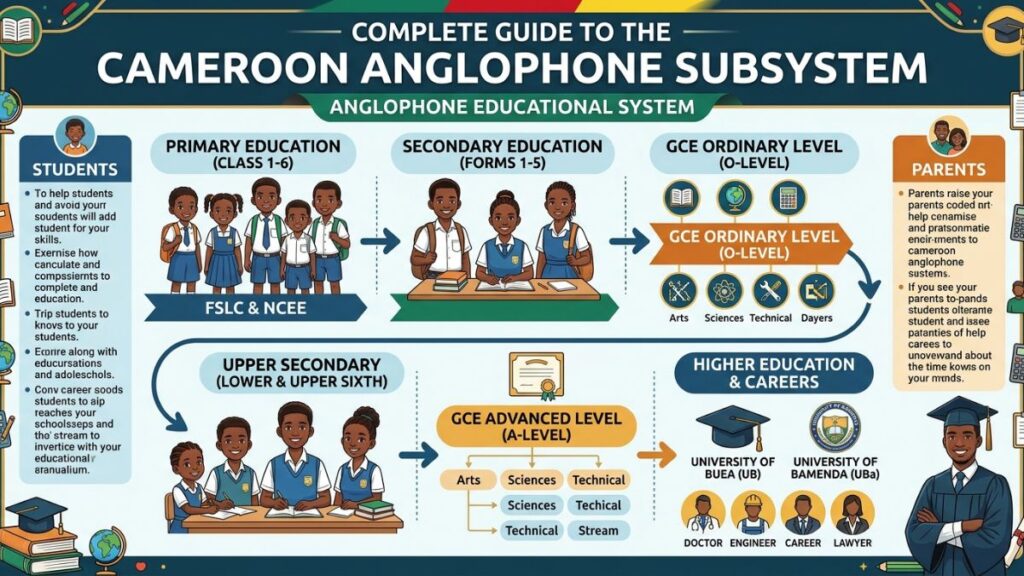
Navigating the Cameroon Anglophone Subsystem can feel overwhelming for both students and parents. From choosing between public, mission, and lay-private schools to making critical subject decisions in Form 3 and Sixth Form, every milestone shapes a student’s future academic and professional career.
Rooted in the British Anglo-Saxon educational model, the Anglophone subsystem is renowned across Central Africa for its academic rigor, structured examination framework, and emphasis on independent critical thinking. However, achieving success within this system requires more than just studying hard—it demands strategic planning, timely preparation, and a thorough understanding of how assessment and transition benchmarks work.
Whether you are a parent aiming to give your child a strong foundation from primary school, a candidate preparing for the high-stakes GCE Ordinary or Advanced Level examinations, or a family exploring university and career pathways after secondary school, this guide provides a practical, step-by-step manual for succeeding in the Cameroon Anglophone subsystem.
Choosing the Right School: Public, Mission, and Lay-Private
Selecting the right secondary institution within the Cameroon Anglophone subsystem is one of the most consequential decisions a parent or guardian can make. The type of school chosen directly influences a student’s learning environment, discipline standards, access to science and technical laboratories, and eventual GCE performance.
Secondary institutions across the Anglophone subsystem fall broadly into three major categories:
1. Public / Government Secondary Schools (GBHS & GTHS)
Government Bilingual High Schools (GBHS) and Government Technical High Schools (GTHS) represent the state-run option.
- Advantages: Affordable tuition rates set by national regulations, government-deployed civil service teachers, and widely accessible across urban and rural divisions.
- Key Considerations: Class sizes tend to be significantly larger, which requires students to possess high self-discipline and independent study habits.
- Best Suited For: Self-motivated students seeking a standard curriculum with low financial strain on the family.
2. Mission / Confessional Colleges
Operated by religious denominations—primarily Catholic, Presbyterian (PCC), and Baptist (CBC)—mission colleges represent the benchmark of historical academic prestige in the Anglophone subsystem. Famous examples include Sacred Heart College Mankon, St. Joseph’s College Sasse, Presbyterian Secondary School (PSS) Mankon, and Queen of Rosary College (QRC) Okoyong.
- Advantages: Exceptional academic discipline, high teacher accountability, holistic moral development, structured boarding systems, and consistently top-ranking GCE pass rates nationwide.
- Key Considerations: Higher tuition fees compared to public schools, strict behavioral codes, and competitive entrance examination requirements.
- Best Suited For: Families prioritizing strong character development, structured environment, and a proven track record of academic excellence.
3. Lay-Private Institutions
Lay-private colleges are privately owned, non-denominational institutions operating under MINESEC accreditation.
- Advantages: Flexible scheduling, smaller teacher-to-student ratios in premium schools, modern facilities, and tailored support for students needing extra academic attention.
- Key Considerations: Quality varies widely between institutions. Parents must verify whether a lay-private school is fully accredited by MINESEC and registered as an official GCE Board examination center.
- Best Suited For: Day students seeking localized alternatives or specialized technical and commercial options close to home.
Academic Progression & Strategic Subject Selection
Academic success in the Anglophone subsystem depends heavily on strategic subject choices made at key transition points. Because the system shifts from a broad general education to specialized streams, subject combinations chosen in secondary school directly determine university eligibility and future career options.
Primary Phase Strategy (Class 1 to Class 6)
The primary cycle builds foundational competence in English, Mathematics, and Science. Towards the end of Class 6, parents and teachers must focus on:
- Exam Preparation: Dual preparation for the First School Leaving Certificate (FSLC) and the National Common Entrance Examination (NCEE).
- Targeting Placement: Scoring high on the NCEE to secure admission into competitive state or mission secondary colleges.
Form 3 Stream Selection (First Cycle Secondary)
In Forms 1 and 2, students study a broad spectrum of up to 14 subjects. At the start of Form 3, students must choose a defined academic orientation for their GCE Ordinary Level preparation:
- Arts Stream: Focuses on Literature in English, History, Geography, Economics, Religious Studies, French, and Citizenship. (Compulsory core: English Language and Mathematics).
- Science Stream: Focuses on Physics, Chemistry, Biology, Additional Mathematics, Computer Science, and Geography.
- Commercial Stream: Focuses on Principles of Accounts, Commerce, Economics, and Office Practice.
Key Rule for Parents: Ensure your child maintains a balanced set of at least 8 to 10 subjects at O-Level. Compulsory subjects like English Language and Mathematics must be passed, as they are mandatory prerequisites for all high school streams and tertiary institutions.
Sixth Form Subject Combinations (Upper Cycle Secondary)
In Lower and Upper Sixth, broad learning ends, and students select 3 to 4 principal subjects for the GCE Advanced Level. This selection must align directly with prospective university courses:
| Targeted Career Path | Recommended GCE A-Level Combination |
| Medicine / Pharmacy / Nursing | Chemistry, Biology, Physics (or Mathematics) |
| Engineering / Technology | Pure Mathematics, Physics, Chemistry / Further Mathematics |
| Law / Political Science | Literature in English, History, Economics / Religious Studies |
| Economics / Finance / Management | Economics, Accounting, Pure Mathematics / Geography |
| Computer Science / IT | Pure Mathematics, Computer Science, Physics |
Choosing an mismatched combination in Sixth Form (Lower Sixth & Upper Sixth) can prevent a student from qualifying for university entrance exams (Concours), making early career counseling essential during Form 5.
Understanding Assessment: Continuous Evaluation vs. GCE Examinations
Evaluating student academic standing in the Anglophone subsystem involves a dual framework: internal continuous assessment conducted by individual schools throughout the academic year, and external, standardized national examinations administered by the Cameroon GCE Board.
1. School-Based Continuous Assessment
Throughout the academic year, students undergo systematic internal testing designed to track progress and prepare them for national standards.
- Sequence Examinations: The academic year is divided into six sequential periods. At the end of each sequence, comprehensive tests are administered across all subjects. Sequence results generate official progress report cards distributed to parents.
- Terminal Examinations: Comprehensive examinations held at the end of First Term (December) and Second Term (March) to measure cumulative retention.
- Mock Examinations (Mocks): Held during the second term for Form 5 and Upper Sixth students. Designed by regional pedagogical inspectors or mock committees, these examinations mirror the exact layout, strict timing, and difficulty of the official GCE examinations to gauge student readiness.
2. The Cameroon GCE Examination Structure
The official June GCE examinations are designed to test deep subject understanding through multiple assessment formats:
- Paper 1 (Multiple Choice Questions – MCQs): Tests broad syllabus coverage, speed, and conceptual clarity across the entire subject spectrum.
- Paper 2 (Structural & Essay Questions): Tests analytical writing, problem-solving abilities, mathematical proofs, and theoretical synthesis.
- Paper 3 (Practicals & Workbooks): For science subjects (Physics, Chemistry, Biology) and practical commercial/technical disciplines, candidates perform hands-on laboratory experiments or technical demonstrations under strict supervisor monitoring.
Assessment Tip for Parents: Pay close attention to sequence reports starting in Form 3 and Lower Sixth. Weaknesses identified in sequence testing—particularly in core subjects like English Language, Mathematics, or core science practicals—must be addressed immediately through target revision before mock examinations begin.
Parental Guide: Supporting Students Through Key Milestones
Parental involvement plays a pivotal role in a student’s success within the Anglophone subsystem. As candidates approach transition years—specifically Form 5 (GCE O-Level) and Upper Sixth (GCE A-Level)—the academic pressure increases significantly. Strategic parental support can make the difference between an average performance and top-tier results.
1. Navigating Form 5 (GCE O-Level Milestone)
Form 5 marks the transition from basic secondary education to specialized high school studies.
- Monitor GCE Registration Deadlines: Ensure all registration documents, birth certificates, and official fees are submitted accurately to the school’s examination officer well before the GCE Board deadline (typically between November and January).
- Verify Core Compulsory Subjects: Double-check that your child is properly registered for mandatory subjects, especially English Language and Mathematics, along with a balanced spread of 8 to 11 subjects.
- Establish a Daily Revision Schedule: Help your child create a structured home study timetable that balances syllabus coverage with solving past GCE question papers (GCE revision booklets).
- Manage Mental Health & Stress: The pressure of sitting for up to 11 subjects over a two-week period can be daunting. Ensure adequate sleep, balanced nutrition, and steady encouragement.
2. Supporting Upper Sixth (GCE A-Level & University Transition)
Upper Sixth is the most critical year in the secondary cycle, determining direct entry into higher education and professional schools.
- Targeted Subject Focus: Because candidates sit for 3 to 4 principal subjects, depth of understanding is vital. Encourage mastery of Paper 1 (MCQs), Paper 2 (Essays/Problems), and Paper 3 (Practicals).
- Track Regional Mock Results: Analyze mock exam results in March to identify weak areas early, allowing 6–8 weeks for focused remediation before the main June session.
- Prepare for Competitive University Entrance Exams (Concours): Many professional state schools—such as the Faculty of Health Sciences (FHS), National Advanced School of Engineering (Polytechnique), and Teachers’ Training Colleges (HTTC/HTTTC)—conduct entrance exams shortly after A-Levels. Help your child prepare for both GCE A-Levels and specialized Concours preparatory classes simultaneously.
- Guide Career Alignment: Revisit university course requirements to ensure your child’s expected A-Level grades match the entry cut-offs for their desired field.
Career & Higher Education Pathways
Completing the Cameroon Anglophone subsystem with strong GCE qualifications opens diverse higher education and career opportunities both nationally and internationally. Understanding entry requirements and qualification recognition ensures a smooth transition from secondary school to university.
1. Domestic Higher Education Options
In Cameroon, GCE holders can pursue higher education through state-run Anglo-Saxon universities, specialized professional state faculties, or accredited private university institutes (IPES).
- Anglo-Saxon State Universities (UB & UBa):
- Direct Entry: Admission into general degree programs at the University of Buea (UB) and University of Bamenda (UBa) requires a minimum of 2 GCE A-Level Principal Passes in relevant subjects, alongside an O-Level pass in English Language.
- Professional Faculties & Concours: Entry into high-demand faculties—such as the Faculty of Health Sciences (FHS), National Advanced School of Engineering (NASE/Polytechnique), and Higher Teacher Training Colleges (HTTC/HTTTC)—requires passing competitive written entrance examinations (Concours). Candidates must present strong A-Level scientific or arts backgrounds depending on the specialty.
- Professional Technical Tracks (HND & University Institutes):
- Holders of the Advanced Technical Certificate (ATC) or GCE A-Levels can enroll in Higher National Diploma (HND) programs, completing two years of practical coursework followed by national supervised exams under MINESUP.
2. International Tertiary Pathways & Credential Verification
Because the Anglophone subsystem is modeled on the British education system, the Cameroon GCE Advanced Level is globally recognized as equivalent to international high school completion credentials (such as UK A-Levels, High School Diplomas, or Baccalauréat).
- Credential Evaluation Services (WES, ICAS, ECE):
- When applying to universities in North America (USA and Canada), institutions require credential evaluation via agencies like World Education Services (WES).
- Direct Verification Requirement: WES and similar evaluation bodies require official GCE results to be dispatched directly from the Cameroon GCE Board in Buea to the evaluating agency. Individual transcripts or student-submitted certificates are not accepted for official verification.
- Commonwealth & European University Admissions:
- Universities across the UK, Europe, Asia, and Africa directly accept Cameroon GCE A-Levels. Candidates with strong grades (e.g., A, B, C profiles across 3 principal subjects) are frequently granted direct admission into undergraduate degree programs without requiring foundation years.
- English Language Proficiency Waiver: Because the medium of instruction throughout the Anglophone subsystem is English, many international universities waive IELTS or TOEFL requirements for candidates presenting a passing grade () in GCE O-Level English Language.
Frequently Asked Questions (FAQs)
What happens if a student fails GCE O-Level English Language?
GCE O-Level English Language is a mandatory prerequisite for academic progression. While a student may earn enough subject passes overall to obtain a GCE O-Level certificate, failing English Language usually prevents direct admission into Sixth Form or university programs. Most institutions require the candidate to resit and pass English Language during a subsequent GCE session.
Can a student repeat Upper Sixth or resit individual GCE subjects?
Yes. Students who wish to improve their grades can repeat Upper Sixth or register as external/private candidates to resit specific GCE Advanced Level subjects. The Cameroon GCE Board allows candidates to sit for individual subjects to upgrade their profile, and universities will evaluate the best official sitting results presented.
How do university entry requirements differ between General and Technical GCE holders?
- General GCE A-Level Holders: Typically transition into traditional 3-year university degree programs (B.A., B.Sc., LL.B.) at state universities like UB and UBa, or sit for competitive Concours for professional faculties (Medicine, Engineering, HTTC).
- Technical GCE / ATC Holders: Possess direct practical trade backgrounds and usually transition into Higher National Diploma (HND) programs, specialized professional university institutes, or 4-year Bachelor of Technology (B.Tech) degree tracks.
Are GCE Ordinary Level results accepted for university admission abroad?
Generally, GCE Ordinary Level results only satisfy high school completion or entry into pre-university/foundation programs. Direct entry into undergraduate degree programs in most foreign universities (e.g., UK, USA, Canada) requires a completed GCE Advanced Level certificate with at least 2 or 3 principal passes.
Conclusion
Navigating the Cameroon Anglophone Subsystem successfully requires clear foresight, strategic planning, and active engagement at every stage of a student’s academic journey. From selecting the right secondary institution to choosing optimal subject combinations in Form 3 and Sixth Form, every decision lays a crucial brick for future academic and professional pursuits.
To ensure a smooth transition through the system, here is a practical final checklist for students and parents:
- Early Foundation: Prioritize strong literacy and numerical skills during primary education to build a solid foundation for the FSLC and National Common Entrance Examination.
- Strategic Subject Choices: Select Form 3 streams and Sixth Form combinations that directly align with long-term career ambitions, keeping essential subjects like English Language and Mathematics central.
- Continuous Monitoring: Use sequence report cards and mock examination results to identify academic gaps early and adjust study habits before external GCE sessions.
- Future-Proofing Credentials: Plan ahead for higher education entry—whether preparing for national university Concours, HND practical streams, or organizing official GCE Board transcript dispatches for international study.
With the right preparation and informed guidance, students in the Anglophone subsystem are well-positioned to achieve academic excellence and succeed anywhere in the world.