Every year, thousands of students across English-speaking Cameroon stand at a critical educational crossroads:
Which GCE subjects should you choose?
For many students, this decision is made on impulse. A student picks subjects because their friends chose them, because a particular teacher is well-liked, or simply because a combination “sounds prestigious.”
This trial-and-error approach is a recipe for career bottlenecks.
In Cameroon’s educational ecosystem, your subject combination isn’t just a list of high school classes—it is the exact key that unlocks or permanently locks the door to higher education, national competitive entrance examinations (Concours), and specialized university faculties.
A single missed prerequisite at Ordinary Level or a mismatched subject combination at Advanced Level can disqualify you from studying Medicine, Engineering, Law, or Computer Science—regardless of how high your final GPA or point count is.
Learning how to choose GCE subjects requires a clear, strategic framework. Rather than guessing, you must reverse-engineer your high school course load directly from your ultimate career target.
In this step-by-step guide, we’ll break down the exact formulas for building optimal subject combinations at both Ordinary and Advanced Levels, align your choices with competitive Cameroonian university faculties (like UB, UBa, FHS, and Polytechnique), and ensure your GCE profile positions you for long-term career success.
The Golden Rule: Reverse-Engineered Subject Selection
The biggest mistake students make when picking GCE subjects is choosing from the bottom up—selecting subjects in Form 4 or Lower Sixth based on what looks easy today, and hoping it works out for university later.
To secure your dream career, you must flip this process on its head and use Reverse-Engineered Subject Selection.
1. The Top-Down Selection Approach
Before filling out a single subject registration form, follow these three steps:
- Identify Your End Goal: Define your target professional field (e.g., Medicine, Civil Engineering, Corporate Law, Financial Accounting).
- Consult Admission Criteria: Check the exact entry requirements for target state university faculties (UB, UBa) or professional school competitive entrance exams (Concours for FHS, Polytechnique, ENS).
- Lock in Prerequisites: Select your Advanced Level principal subjects based strictly on those faculty requirements, then work backward to ensure your Ordinary Level subject load fulfills all entry prerequisites.
2. Understanding Non-Negotiable Core Baselines
Regardless of whether you plan to pursue pure sciences, arts, or business, the Cameroon GCE Board (CGCEB) and higher education institutions enforce strict core subject rules at Ordinary Level:
- English Language: Non-negotiable. A pass at O-Level (Grade C or higher) is mandatory for university admission, professional Concours eligibility, and foreign scholarship applications. Failing English Language often acts as an immediate barrier to higher education entry.
- Mathematics: Non-negotiable for all Science, Engineering, Business, and Economics tracks. Even in Arts and Humanities, a baseline pass in O-Level Mathematics is increasingly demanded by state faculties.
- French Language: Mandatory under national bilingual education policies for official GCE registration at Ordinary Level, providing a critical advantage in Cameroon’s bilingual public administration and job market.
GCE Ordinary Level Subject Combinations (Building the Base)
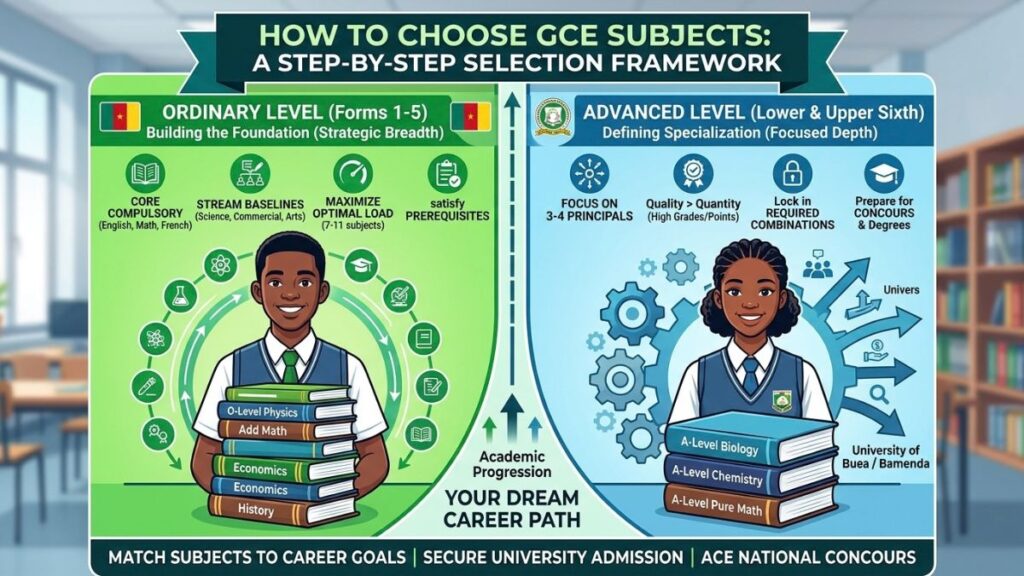
At the Ordinary Level (Forms 1–5), your objective is strategic breadth.
While Form 5 students typically write between 6 and 11 subjects, the goal isn’t just to accumulate passes—it’s to build a broad academic foundation that keeps your options open for Sixth Form (Lower Sixth & Upper Sixth) and satisfies all pre-requisite requirements.
1. The Minimum vs. Optimal Subject Load
- Minimum Passing Threshold: The Cameroon GCE Board requires a candidate to pass in at least 4 subjects to earn an Ordinary Level certificate.
- University-Bound Baseline: To transition smoothly into a strong Sixth Form science, commercial, or arts stream, aim for 7 to 11 subjects, ensuring high grades (A or B) in your target specialization areas.
2. Stream-Specific O-Level Baselines
When organizing your O-Level subjects in Form 3 and Form 4, structure your choices around these core stream templates:
A. Science & Technology Stream Baseline
Designed for future medical, engineering, software, and pure science students:
- Core Compulsory: English Language, Mathematics, French Language.
- Primary Sciences: Physics, Chemistry, Biology.
- Mathematical Extension: Additional Mathematics (strongly recommended for future engineers and computer scientists).
- Broadening Electives: Computer Studies/ICT, Geography, Economics, Literature in English.
B. Commercial & Business Stream Baseline
Designed for future accountants, economists, marketers, and business managers:
- Core Compulsory: English Language, Mathematics, French Language.
- Primary Commercials: Economics, Principles of Accounts, Commerce.
- Analytical & Supporting Subjects: Geography, Computer Studies/ICT, Additional Mathematics.
- Broadening Electives: History, Religious Studies, Literature in English.
C. Arts & Humanities Stream Baseline
Designed for future lawyers, journalists, diplomats, administrators, and linguists:
- Core Compulsory: English Language, Mathematics, French Language.
- Primary Arts Core: Literature in English, History, Geography.
- Humanities & Languages: Religious Studies, Special Bilingual Education French (SBEF), Logic.
- Broadening Electives: Economics, Computer Studies, Human Biology.
GCE Advanced Level Principal Combinations (The Specialization Engine)
When you enter Sixth Form (Lower and Upper Sixth), the educational philosophy shifts from broad exploration to deep specialization.
At the Advanced Level, you will focus almost exclusively on 3 to 4 principal subjects. These principal subjects determine your total GCE points and form the foundation for all university degree admissions and national Concours.
1. The Quality vs. Quantity Rule: 3 Principals vs. 4 Principals
A common pitfall for Sixth Form students is attempting to write 4 or 5 principal subjects to look “more brilliant.”
In the Cameroon GCE system, depth and high grades always beat high subject volume.
- The standard maximum score: A student sitting 3 principal subjects can score up to 15 points (Grade A in each subject = 5 points).
- Admission reality: Most competitive state university faculties and Concours evaluate candidates based on their best 3 principal subjects. Scoring A, A, B (14 points across 3 subjects) is significantly more powerful than scoring C, C, C, D (9 points across 4 subjects).
- When to take 4 subjects: Take a 4th principal subject only if you are an exceptional student aiming for specific competitive scholarships or engineering faculties that explicitly reward Further Mathematics as a standalone 4th subject.
2. High-Impact Science Principal Triads
A. The Pre-Medical & Health Sciences Triad
- Core Subjects:Biology + Chemistry + Physics (or Pure Mathematics)
- Target Degrees: Medicine (MD), Pharmacy, Nursing Sciences, Medical Laboratory Sciences, Dentistry, Veterinary Medicine.
- Why it works: Chemistry and Biology are non-negotiable mandatory prerequisites for the Faculty of Health Sciences (FHS) Concours. Physics or Mathematics provides the quantitative analytical foundation required for pharmacology and biophysics.
B. The Engineering & Physical Sciences Triad
- Core Subjects:Pure Mathematics + Physics + Chemistry
- Target Degrees: Civil, Mechanical, Electrical, Chemical, and Agricultural Engineering.
- Why it works: This is the universal pre-engineering baseline required for the National Advanced School of Engineering (Polytechnique) and faculties of engineering across the globe.
C. The Technology & Computer Science Triad
- Core Subjects:Pure Mathematics + Physics + Computer Science (or ICT)
- Target Degrees: Software Engineering, Cybersecurity, Data Science, Information Technology, Robotics.
- Why it works: Pure Mathematics provides the logical algorithm foundation, Physics builds hardware principles, and Computer Science introduces direct programming theory.
3. High-Impact Commercial Principal Triads
A. The Finance, Accounting & Banking Triad
- Core Subjects:Economics + Principles of Accounts + Pure Mathematics (or Management)
- Target Degrees: Accounting, Corporate Finance, Banking, Auditing, Financial Engineering.
- Why it works: Combines quantitative rigor (Pure Math) with technical accounting and macro-microeconomic theory.
B. The Business Management & Economics Triad
- Core Subjects:Economics + Management + Geography (or Pure Mathematics)
- Target Degrees: Business Administration, International Business, Supply Chain Management, Economic Policy.
4. High-Impact Arts & Social Science Principal Triads
A. The Law & Political Science Triad
- Core Subjects:Literature in English + History + Economics (or Religious Studies / French)
- Target Degrees: Law (LL.B.), Public Administration, Political Science, International Relations.
- Why it works: Literature in English builds essential critical analysis and legal writing capabilities, History develops case study evaluation, and Economics introduces policy context.
B. The Media, Communications & Diplomacy Triad
- Core Subjects:Literature in English + History + Geography (or French / Foreign Languages)
- Target Degrees: Journalism & Mass Communication, Public Relations, International Diplomacy, Translation & Interpretation.
Aligning Subjects with Cameroonian University Entrance Exams (Concours)
In Cameroon’s higher education system, passing your GCE A-Levels with high points is only half the battle. Entry into top-tier professional schools and specialized faculties requires sitting for national competitive entrance examinations (Concours).
These entrance exams do not test general knowledge; they test specific subject mastery directly tied to the field of study. If your A-Level principal combination does not align with the exam syllabus, you will be automatically disqualified or unable to clear the written papers.
1. Faculty of Health Sciences (FHS / CUSS)
For medical, pharmaceutical, and nursing entrance examinations across state universities (such as UB, UBa, University of Yaoundé I, and University of Douala), subject requirements are strict and mandatory:
- Mandatory Subjects:Biology + Chemistry
- Supporting Principal:Physics or Pure Mathematics
- Examination Focus: The Concours paper tests deep conceptual knowledge in Biology/Cellular Biology, General & Organic Chemistry, and basic Physics/Biophysics logic.
- Critical Note: You cannot sit for medical Concours without Chemistry and Biology at Advanced Level.
2. National Advanced School of Engineering (Polytechnique / ENSP)
Engineering entrance exams assess higher-level mathematical derivation, problem-solving speed, and physical principles:
- Mandatory Subjects:Pure Mathematics + Physics
- Supporting Principal:Chemistry or Further Mathematics
- Examination Focus: Applied Mathematics, Mechanics, Electromagnetism, Physics, and Technical Logic.
- Pro Tip: While Chemistry is acceptable as a third principal, candidates taking Further Mathematics often perform significantly higher in the mathematical reasoning sections of the Polytechnique exam.
3. Higher Teacher Training Colleges (HTTC / ENS & HTTTC / ENSET)
Entrance into ENS (for general secondary education teaching) or ENSET (for technical education teaching) requires direct subject-matching based on the department you apply to:
- Departmental Subject Matching:
- Department of English: Must hold A-Level Literature in English.
- Department of History: Must hold A-Level History.
- Department of Mathematics: Must hold A-Level Pure Mathematics (and preferably Further Math).
- Department of Science: Must hold corresponding principal subjects (Physics, Chemistry, or Biology).
- Examination Focus: Advanced undergraduate-level foundational questions in the chosen discipline, alongside general knowledge and bilingualism tests.
4. Advanced School of Mass Communication (ASMAC / ESSTIC) & IRIC
For professional schools in journalism, public relations, diplomacy, and international relations:
- Mandatory / Preferred Subjects:Literature in English, History, Geography, Economics, and French.
- Examination Focus: Essay writing, contemporary socio-political analysis, history of international relations, general culture, and English/French language proficiency.
Summary Reference Table: Career Goals vs. Mandatory GCE Subjects
To streamline your planning, this reference table maps top career choices in Cameroon directly to their required GCE Ordinary Level prerequisites and Advanced Level principal subject combinations:
| Target Career / Profession | Required O-Level Prerequisites | Required A-Level Principal Combination | Target Higher Institutions / Concours |
| Medicine, Pharmacy & Dentistry | Math, Physics, Chemistry, Biology, English | Biology + Chemistry + Physics / Pure Math | FHS (UB, UBa), CUSS (Yaoundé I) |
| Engineering (Civil, Mech, Elec) | Math, Physics, Chemistry, Add. Math, English | Pure Math + Physics + Chemistry / Further Math | Polytechnique (ENSP), FET (UB), NAHPI (UBa) |
| Software Engineering & Computer Science | Math, Physics, Computer Studies, Add. Math, English | Pure Math + Physics + Computer Science / ICT | COLTECH (UBa), Faculty of Science (UB, UBa) |
| Accounting, Finance & Auditing | Math, Economics, Principles of Accounts, English | Economics + Principles of Accounts + Pure Math / Management | ASTI, HND Institutes, Faculty of Management (UB) |
| Law & Legal Practice | English, Literature in English, History, Math | Literature in English + History + Economics / Religious Studies | Faculty of Laws & Political Science (UB, UBa) |
| Journalism, Media & Communications | English, Literature in English, History, French | Literature in English + History + Geography / French | ASMAC / ESSTIC, Mass Communication (UB) |
| Diplomacy & International Relations | English, History, Geography, French, Math | History + Literature in English + Economics / French | IRIC, Faculty of Political Science |
| Secondary School Teaching (General) | English, Math, and core department subjects | Direct subject match for target department (e.g., Physics + Chem) | HTTC / ENS (Bambili, Yaoundé, Maroua) |
Frequently Asked Questions (FAQs)
Can I take the national entrance exam (Concours) for Medicine without Physics at GCE Advanced Level?
Yes, provided you take Pure Mathematics alongside Biology and Chemistry. While the official prerequisite for medical faculties (like FHS in Buea or Bamenda) requires Biology and Chemistry, the entrance exam includes a dedicated physical sciences section testing basic Physics and Biophysics concepts. Taking Biology, Chemistry, and Pure Mathematics is fully acceptable for registration, but you will need to self-study fundamental Physics topics to score high marks on the Concours paper.
Is Additional Mathematics mandatory at O-Level to study Sciences or Engineering at A-Level?
No, Additional Mathematics is not legally mandatory to register for GCE A-Level Pure Mathematics or Physics. However, it is strongly recommended. Students who take Additional Mathematics at Ordinary Level gain early exposure to calculus, trigonometry, and coordinate geometry, making the steep transition to A-Level Pure Mathematics significantly easier and improving performance in engineering Concours like Polytechnique.
What happens if I pass my principal subjects at A-Level but fail English Language at Ordinary Level?
Failing O-Level English Language creates a major academic bottleneck. While the Cameroon GCE Board allows you to sit for A-Levels with an O-Level pass profile, state universities (UB, UBa) and professional faculties generally require a pass in O-Level English Language as a baseline matriculation condition. Candidates in this position are usually forced to re-sit O-Level English Language as a private candidate or sit for a university-organized English Language Proficiency Test before full admission is granted.
Strategic Conclusion
Selecting your GCE subjects is the single most consequential academic decision you will make in secondary school. Rather than relying on trial and error, treating subject selection as a strategic, top-down process ensures that every class you take directly serves your ultimate career ambitions.
Here are the essential rules to keep in mind as you map out your academic journey:
- Reverse-Engineer Your Future: Never pick subjects from the bottom up based on convenience. Identify your desired degree or professional Concours first, verify the required principal prerequisites, and build your A-Level and O-Level load around those criteria.
- Protect Your Core Baselines: Maintain strong passes in non-negotiable core subjects—especially English Language and Mathematics at Ordinary Level—to prevent administrative bottlenecks during university matriculation and scholarship evaluations.
- Prioritize Grade Quality Over Subject Quantity: At the Advanced Level, dynamic academic performance across 3 well-chosen principal subjects (scoring high points like A, A, B) holds significantly more value for competitive entry than spreading yourself thin across 4 or 5 subjects.
By treating your GCE subject registration form as a career roadmap rather than a simple checklist, you position yourself for high academic performance, seamless university transitions, and long-term professional success in Cameroon and beyond.