Here is a fact most people get wrong:
The Cameroon Secondary School Education System is not a single, one-size-fits-all model.
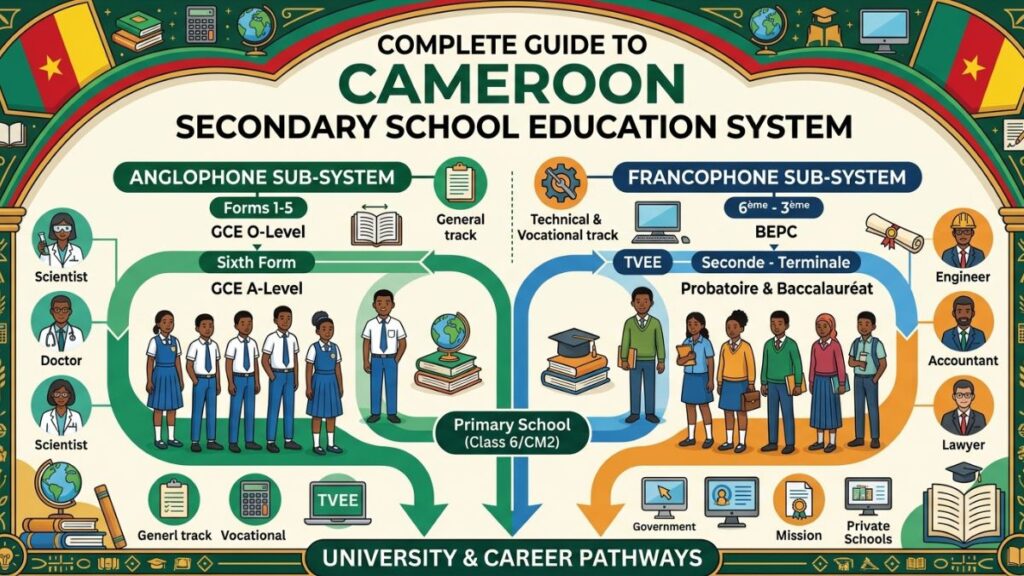
It’s actually a unique dual-system network where two completely distinct educational models run side-by-side:
- The Anglophone Sub-System (rooted in the British Anglo-Saxon tradition).
- The Francophone Sub-System (built on the French national curriculum).
Both tracks operate under the direction of the Ministry of Secondary Education (MINESEC). Both span seven full years of study.
And both produce some of the most competitive secondary school graduates in Central Africa.
However, navigating these two tracks—with their distinct qualification titles, examination bodies, stream choices, and grading scales—can quickly turn confusing.
Whether you are a parent choosing the right school pathway, a student planning your academic career, or an international admissions officer evaluating Cameroonian credentials, this complete guide breaks down exactly how the system works from top to bottom.
The Dual Sub-System Structure: Anglophone vs. Francophone
If you want to understand the Cameroon Secondary School Education System, you need to grasp one fundamental concept:
The system splits into two distinct tracks immediately after primary school.
While both sub-systems take 7 years to complete, their internal structures, milestone exams, and teaching philosophies are completely different.
Here is how each sub-system breaks down step-by-step.
1. The Anglophone Sub-System (7-Year Track)
The Anglophone track follows a traditional 5+2 structure modeled on the classic British education framework.
First Cycle: Forms 1 to 5 (5 Years)
- Focus: Broad general education covering science, arts, commercial subjects, and languages.
- Key Milestone: At the end of Form 5, students sit for the Cameroon GCE Ordinary Level (O-Level) examination administered by the Cameroon GCE Board. Candidates typically present between 6 and 11 subjects.
Second Cycle: High School / Sixth Form (2 Years)
- Structure: Consists of Lower Sixth and Upper Sixth.
- Focus: Deep specialization. Students drop general studies and choose 3 to 4 principal subjects grouped into defined streams (Arts, Sciences, or Commercial).
- Key Milestone: At the end of Upper Sixth, students write the Cameroon GCE Advanced Level (A-Level) examination.
2. The Francophone Sub-System (7-Year Track)
The Francophone track follows a 4+3 structure derived directly from the French national curriculum.
Premier Cycle: 6ème to 3ème (4 Years)
- Progression: .
- Focus: Comprehensive general knowledge across literature, mathematics, history-geography, natural sciences, and physical education.
- Key Milestone: At the end of 3ème, students sit for the Brevet d’Etudes du Premier Cycle (BEPC).
Second Cycle: Lycée / Second Cycle (3 Years)
- Progression: .
- Specialization Streams: Students pick specific academic series:
- Série A: Literature, Philosophy, and Languages.
- Série C: Mathematics and Physical Sciences.
- Série D: Life Sciences, Earth Sciences, and Chemistry.
- Série TI: Information Technology.
- Key Milestones:
- End of Première: Students take the Probatoire examination—a mandatory national prerequisite exam required to enter Terminale.
- End of Terminale: Students sit for the Baccalauréat (BAC) diploma examination.
Side-by-Side Comparison
To summarize how both sub-systems compare at a glance:
| Feature | Anglophone Sub-System | Francophone Sub-System |
| Duration | 7 Years (5 + 2) | 7 Years (4 + 3) |
| Intermediate Exam | GCE Ordinary Level (Form 5) | BEPC (3ème) & Probatoire (Première) |
| Terminal Qualification | GCE Advanced Level (Upper Sixth) | Baccalauréat (Terminale) |
| Specialization Point | Form 3 (Streams) & Lower Sixth (3–4 Subjects) | Seconde / Première (Series A, C, D, etc.) |
| Exam Board | Cameroon GCE Board | Office du Baccalauréat du Cameroun (OBC) |
Academic & Technical Tracks (General vs. Technical/Vocational)
Here’s something crucial to understand:
The Cameroon Secondary School Education System doesn’t just split by language. It also splits by learning pathway.
Every student entering secondary school chooses between two primary paths:
- General Secondary Education (Academic/Theoretical)
- Technical and Vocational Education and Training (TVEE / ESTP) (Practical/Trade-oriented)
Both pathways operate in both the Anglophone and Francophone sub-systems.
1. General Secondary Education Track
The general track is designed for students targeting traditional academic and professional university degrees (such as Law, Medicine, Humanities, or Pure Sciences).
- Anglophone General Track: Students study broad subjects up to Form 5 (GCE O-Level), then narrow down to 3–4 principal subjects in Sixth Form (GCE A-Level).
- Francophone General Track: Students complete general studies up to 3ème (BEPC), then enter specialized streams (Séries A, C, D, TI) in Seconde, Première, and Terminale leading to the Baccalauréat Général.
2. Technical and Vocational Education Track (TVEE / ESTP)
The technical track is engineered for students who want direct career skills in fields like Electrical Engineering, Building Construction, Home Economics, Automobile Mechanics, Accounting, and Secretarial Administration.
Rather than focusing purely on abstract theory, technical secondary schools feature heavy laboratory work, workshop practice, and industrial internships.
Here is how technical secondary education breaks down in both sub-systems:
A. Anglophone Technical Track
- First Cycle (5 Years): Students attend Government Technical High Schools (GTHS) or lay-private technical colleges. At the end of Form 5, candidates take the Technical GCE Ordinary Level or the Certificat d’Aptitude Professionnelle (CAP).
- Second Cycle (2 Years): Advanced technical studies in Lower and Upper Sixth lead to the Technical GCE Advanced Level or the Advanced Technical Certificate (ATC) (formerly known as the Baccalauréat Technique in English).
B. Francophone Technical Track (Enseignement Technique)
- Premier Cycle (4 Years): Ends at 4ème Année with the Certificat d’Aptitude Professionnelle (CAP) exam.
- Second Cycle (3 Years): Progression through Seconde, Première, and Terminale Technique leads to two major milestones:
- Probatoire Technique (taken at the end of Première Technique).
- Baccalauréat Technique or Brevet de Technicien (BT) (taken at the end of Terminale Technique).
Bottom Line: Whether a student graduates with a General GCE A-Level, a Technical GCE A-Level, or a Baccalauréat Technique, all paths offer official access points to higher education, professional institutes, or direct workforce entry.
Examination Boards and Key Qualifications
Let’s be honest:
A secondary school system is only as strong as its evaluation standard.
In Cameroon, national examinations are managed by two distinct semi-autonomous examination boards alongside the Ministry of Secondary Education (MINESEC).
These bodies set the questions, enforce exam security, mark paper scripts, and issue official certificates recognized globally.
Here is the exact breakdown of who runs what.
1. The Cameroon GCE Board (CGCEB)
Headquartered in Buea, the Cameroon General Certificate of Education (GCE) Board manages all general and technical examinations for the Anglophone sub-system.
- Primary Mandate: Organizing, marking, and publishing results for Ordinary and Advanced Level GCE examinations.
- Key Qualifications Issued:
- GCE Ordinary Level (General & Technical): Evaluates broad subject competency after Form 5.
- GCE Advanced Level (General & Technical) / ATC: Tests deep subject mastery across 3–4 principal subjects at the end of Upper Sixth.
- Grading Framework:
- O-Level: Grades range from A (highest) down to E (lowest passing grade), with F indicating a fail.
- A-Level: Grades range from A (5 points) down to E (1 point, principal pass). An O/S grade represents a Subsidiary pass.
2. Office du Baccalauréat du Cameroun (OBC)
Headquartered in Yaoundé, the Office du Baccalauréat du Cameroun oversees high-stakes terminal examinations for the Francophone general and technical sub-systems.
- Primary Mandate: Managing the rigorous Probatoire and Baccalauréat national exam sessions.
- Key Qualifications Issued:
- Probatoire (Général & Technique): Taken at Première. Passing this exam is an absolute, non-negotiable legal requirement to enter Terminale.
- Baccalauréat (Général & Technique): The flagship secondary exit diploma written at Terminale, qualifying students directly for university admission.
- Grading Framework:
- Evaluated on a 20-point scale. A student must achieve an overall average score of 10/20 or higher to pass. Mention distinctions include Passable (10–11.99), Assez Bien (12–13.99), Bien (14–15.99), and Très Bien (16+).
3. MINESEC Intermediate Certifications
While CGCEB and OBC handle upper-level national exams, the Ministry of Secondary Education directly supervises intermediate lower-cycle vocational and general certifications.
- BEPC (Brevet d’Etudes du Premier Cycle): Written at 3ème in the Francophone general track.
- CAP (Certificat d’Aptitude Professionnelle): Written at 4ème Année (Francophone) or Form 5 (Anglophone) for practical vocational trades.
School Categories and Learning Environments
Not all secondary schools in Cameroon offer the same environment, resources, or academic culture.
Across both the Anglophone and Francophone sub-systems, secondary institutions fall into three primary categories:
1. Public / Government Secondary Schools
State-funded institutions represent the largest share of secondary schools across the national territory. They operate directly under MINESEC administration.
- Anglophone Naming: Government High Schools (GHS), Government Bilingual High Schools (GBHS), Government Technical High Schools (GTHS), and Government Secondary Schools (GSS).
- Francophone Naming:Lycée Classique, Lycée Bilingue, Lycée Technique, and Collège d’Enseignement Général (CES).
- Key Features: Low, state-regulated tuition fees, standardized government-assigned teachers, and large campus sizes. Class sizes can be large, making student self-discipline critical.
2. Confessional / Mission Schools
Operated by recognized religious bodies—primarily Roman Catholic, Presbyterian (PCC/UEBC), Baptist (CBC), and Islamic educational secretariats—mission colleges are famous for academic rigor and strict behavioral discipline.
- Famous Examples: Sacred Heart College Mankon, Collège Libermann Douala, St. Joseph’s College Sasse, Collège François-Xavier Vogt Yaoundé, and PSS Mankon.
- Key Features: Highly structured boarding and day facilities, excellent teacher retention, strict codes of conduct, and a strong history of sweeping top positions on CGCEB and OBC national merit lists.
3. Lay-Private Institutions (Etablissements Laïcs)
Lay-private secondary schools are privately owned, non-denominational institutions authorized by MINESEC.
- Key Features: They fill important capacity gaps in fast-growing urban centers, offering flexible day-school arrangements, small class sizes in elite setups, and targeted exam prep.
- Important Check: Quality varies widely. Parents must confirm that a lay-private school holds an official MINESEC operating authorization and is a recognized examination center for the GCE Board or OBC.
Transition to Higher Education and International Recognition
Graduating from the Cameroon Secondary School Education System opens clear, well-established pathways—whether a student plans to continue their studies within Cameroon or apply to international universities abroad.
Here is how Cameroonian secondary qualifications translate into higher education opportunities.
1. Domestic Progression to Cameroonian Universities
In Cameroon, secondary school graduates transition into tertiary education through two primary routes: state/private universities or professional higher institutes.
- State Universities (UB, UBa, Yaoundé I & II, Douala, Dschang, Maroua, Ngaoundéré, Bertoua, Ebolowa, Garoua):
- Direct Entry: Admission into general faculty degree programs (such as Arts, Law, Pure Sciences, or Economics) requires a completed GCE Advanced Level (minimum 2 Principal Passes) or a full Baccalauréat.
- Professional Faculties & Concours: Entry into high-demand professional schools—such as the Faculty of Health Sciences (FHS), National Advanced School of Engineering (Polytechnique), and Higher Teacher Training Colleges (HTTC/HTTTC)—requires passing competitive written entrance examinations (Concours). Candidates must hold relevant subject backgrounds at A-Level or specialized Baccalauréat series (e.g., Series C, D, or Technical equivalents).
- Higher National Diploma (HND) & BTS Tracks:
- Technical and general graduates can enroll directly into 2-year professional programs leading to the Higher National Diploma (HND) in the Anglophone subsystem or the Brevet de Technicien Supérieur (BTS) in the Francophone subsystem, supervised directly by MINESUP.
2. Global Equivalence and International Recognition
Both the Cameroon GCE Board certificates and the Office du Baccalauréat du Cameroun diplomas enjoy strong international recognition due to their rigorous assessment standards.
- North American Credential Evaluation (WES, ICAS, ECE):
- Agencies like World Education Services (WES) evaluate the Cameroon GCE A-Level and Baccalauréat as equivalent to high school completion and pre-university credentials in the United States and Canada.
- Verification Rule: WES and similar bodies strictly require official transcripts and statements of results to be sent directly from the CGCEB in Buea or OBC in Yaoundé. Hand-delivered certificates from students are not accepted.
- European and Commonwealth Admissions:
- Universities across the UK, Europe, Asia, and Africa directly accept the Cameroon GCE A-Level and Baccalauréat for undergraduate admissions.
- Strong A-Level results (such as A, B, C profiles in 3 principal subjects) or high Baccalauréat averages generally qualify candidates for direct entry into 3-year or 4-year degree programs without requiring a foundation year.
- Language Proficiency Waivers:
- Because instruction in the Anglophone track is delivered entirely in English, many foreign universities waive TOEFL/IELTS requirements for students who achieve a passing grade () in GCE O-Level English Language. Similarly, Francophone graduates meet language prerequisites for French-speaking universities worldwide.
Frequently Asked Questions (FAQs)
How long does secondary school take in total in Cameroon?
Secondary school takes 7 years in total across both sub-systems. In the Anglophone sub-system, it is split into a 5-year first cycle (Forms 1–5) and a 2-year second cycle (Lower and Upper Sixth). In the Francophone sub-system, it consists of a 4-year premier cycle (6ème to 3ème) and a 3-year second cycle (Seconde, Première, and Terminale).
Can a student switch from the Francophone track to the Anglophone track?
Yes, but transition points matter. The smoothest transition occurs right after completing primary school (entering Form 1) or after earning the BEPC at the end of 3ème to enter Lower Sixth. Switching mid-cycle requires intensive language preparation and bridge programs, though Cameroon’s Bilingual High Schools (GBHS / Lycées Bilingues) are specifically structured to accommodate dual-system mobility.
What is the main difference between the GCE Advanced Level and the Baccalauréat?
The main differences lie in specialization and evaluation structure:
- Cameroon GCE A-Level: Focuses on deep specialization in 3 to 4 principal subjects (e.g., Pure Mathematics, Physics, Chemistry). It uses letter grades (A through E).
- Baccalauréat: Features a broader curriculum where students sit for 8 to 12 subjects within a specific stream (Série C, D, A, etc.), including mandatory general subjects like Philosophy and French. It is evaluated on a 20-point composite scale.
Is the Probatoire still compulsory in Cameroon?
Yes. In the Francophone sub-system, passing the Probatoire examination at the end of Première is a non-negotiable legal prerequisite to advance to Terminale and sit for the Baccalauréat. There is no direct equivalent exam in the Anglophone sub-system’s Lower Sixth year.
Conclusion
The Cameroon Secondary School Education System stands out as one of the most uniquely versatile educational architectures in Africa.
By running two distinct, world-class educational traditions side-by-side, it equips Cameroonian students with rigorous critical thinking skills, practical technical expertise, and natural bilingual adaptability.
Here is the ultimate takeaway for families, students, and educators:
- Understand the Destination First: Whether choosing the deep subject specialization of the Anglophone GCE track or the broad analytical breadth of the Francophone Baccalauréat track, align your child’s secondary pathway with their ultimate higher education and career goals.
- Respect Key Milestones: Success requires staying ahead of critical transition points—from Form 3 stream choices and Form 5 GCE O-Levels to 3ème BEPC, Première Probatoire, and Upper Sixth A-Levels.
- Leverage Global Value: Cameroonian secondary qualifications are recognized internationally. Keeping official academic records organized and tracking CGCEB and OBC verification procedures early will ensure a smooth transition to top universities worldwide.
Navigated with clear foresight, Cameroon’s dual secondary education system serves as a powerful springboard for lifelong personal and professional success.