Cameroon stands out on the African continent for its unique dual educational heritage. Following the post-colonial unification of British Southern Cameroons and French Cameroun, the country preserved two distinct academic traditions: the Anglo-Saxon sub-system and the Francophone sub-system.
At the heart of the English-speaking regions—and increasingly across private and public schools nationwide—lies the Anglophone Education System in Cameroon.
Grounded in British academic principles, this sub-system emphasizes early subject specialization, continuous assessment, and rigorous standardized national examinations. From primary school through high school, students are trained to develop critical thinking, independent analysis, and clear written expression.
Navigating this educational structure can be complex, whether you are a parent choosing a school, a transfer student adapting to new requirements, or an international admissions officer evaluating qualifications.
In this guide, we break down the entire layout of the Anglophone education system in Cameroon—from primary school and secondary cycles (General and Technical) to university pathways and governing examination bodies.
Primary Education: From Nursery to the First School Leaving Certificate (FSLC)
Primary education in the Anglophone sub-system lays the foundational literacy, numeracy, and social development skills necessary for lifelong learning.
Nursery / Kindergarten (Ages 3–5)
Early childhood education spans two years (Nursery 1 and Nursery 2). This phase focuses on:
- Basic phonics, language acquisition, and social interaction.
- Elementary counting and fine motor skills development.
- Preparing children for structured classroom routines.
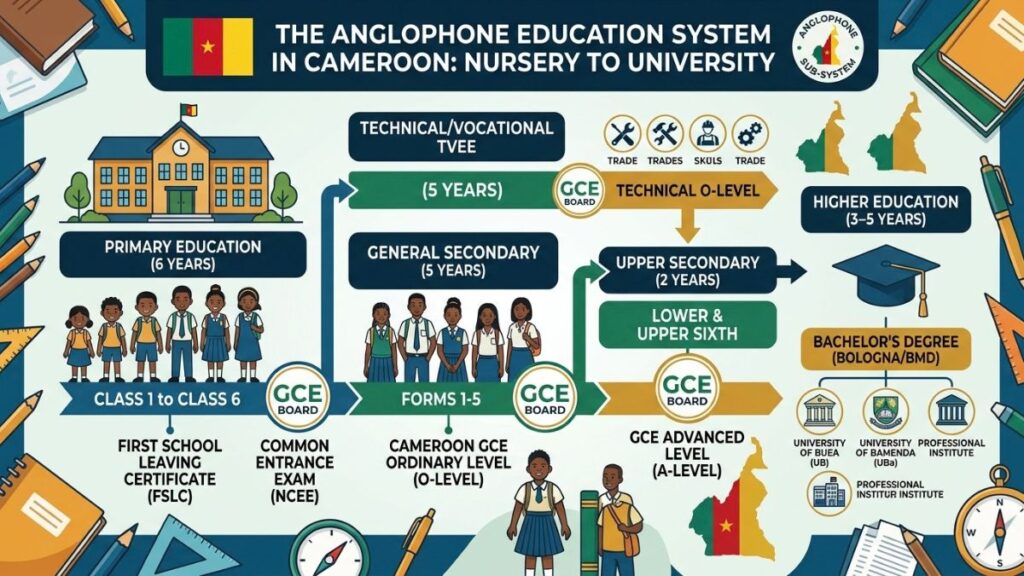
Primary School Cycle (Class 1 to Class 6)
Historically a 7-year program (Class 1 through Class 7), the Anglophone primary sub-system was officially harmonized with national standards to a 6-year structure (Class 1 to Class 6).
- Curriculum Focus: English Language, Mathematics, Science & Technology, Social Studies (History, Geography, Civics), National Languages and Cultures, Arts, and French as a second official language.
- Assessment Structure: Continuous assessment via weekly tests and terminal examinations at the end of each term.
Terminal Qualifications & Transition Exams
At the end of Class 6, pupils sit for two crucial national examinations on which their transition to secondary school depends:
- The First School Leaving Certificate (FSLC): The official terminal qualification certifying successful completion of primary education.
- The National Common Entrance Examination (NCEE): A competitive entrance exam used to determine placement and merit-based admission into government bilingual and general secondary schools (such as GBHS, CKK, or regional colleges).
General Secondary Education: Forms 1 to 5 & Upper Sixth
General secondary education in the Anglophone sub-system spans seven years, divided into two distinct academic cycles: the First Cycle (Ordinary Level) and the Second Cycle (Advanced Level).
The First Cycle: Forms 1 to 5 (5 Years)
The first cycle introduces students to a broad curriculum across the humanities, sciences, and commercial disciplines before gradually narrowing their focus.
- Forms 1 & 2: Students take a wide general curriculum (typically 12 to 14 subjects), including English, French, Mathematics, Physics, Chemistry, Biology, History, Geography, Economics, and Citizenship.
- Forms 3 to 5: Students select specific subject combinations (usually 8 to 11 subjects) tailored toward either an Arts or Science orientation while keeping compulsory core subjects like English Language and Mathematics.
Milestone Examination: GCE Ordinary Level (O-Level)
At the end of Form 5, candidates sit for the Cameroon GCE Ordinary Level examination administered by the GCE Board.
- Grading: Papers are graded on a letter scale from A (highest) to F (fail), where represent passing grades.
- Pass Threshold: Passing at least 4 subjects with Grade C or above earns the candidate an official GCE O-Level Certificate and qualifies them for high school entry.
The Second Cycle: High School / Sixth Form (2 Years)
The second cycle consists of Lower Sixth and Upper Sixth. This phase is highly specialized and mirrors the pre-university Sixth Form model.
- Stream Specialization: Students choose either the Arts Stream (e.g., Literature in English, History, Geography, Economics, Religious Studies) or the Science Stream (e.g., Mathematics, Physics, Chemistry, Biology, Further Mathematics).
- Subject Depth: Unlike the broad lower cycle, high school students specialize in 3 to 5 principal subjects, studying them at an advanced academic depth.
Milestone Examination: GCE Advanced Level (A-Level)
At the end of Upper Sixth, students take the Cameroon GCE Advanced Level examination.
- Grading: Principal subjects are graded from A to E as passing grades (A being the highest), with F indicating a fail.
- Pass Threshold: Securing at least 2 Principal Passes (Grades A-E) earns the candidate the official GCE A-Level Certificate, unlocking direct entry into university degree programs and professional higher institutes.
Technical and Vocational Education and Training (TVEE)
Alongside general academic secondary education, the Anglophone sub-system offers a robust Technical and Vocational Education and Training (TVEE) track. Designed to bridge academic learning with practical trade skills, this pathway equips students for direct entry into specialized technical careers or advanced technical higher education.
Structure of the Technical Track
Like general secondary education, the technical track is divided into two cycles:
- Intermediate Technical Cycle (5 Years): Equivalent to Forms 1 through 5 in general secondary school. Students combine core academic subjects (English, Mathematics, Sciences) with specialized trade modules.
- Advanced Technical Cycle (2 Years): Equivalent to Sixth Form (Lower and Upper Sixth). Students focus deeply on industrial technology, commercial arts, or home economics disciplines.
Specializations & Specialties
Technical colleges and high schools—such as Government Technical High Schools (GTHS) and private technical colleges—offer specialized fields grouped into primary divisions:
- Industrial & Technology Specialties: Civil Engineering, Building Construction, Electrical Technology, Mechanical Manufacturing, Automobile Mechanics, Woodwork, and Electronics.
- Commercial & Business Specialties: Accounting, Secretarial Administration, Marketing, Management, and Information Technology.
- Home Economics & Services: Hotel Management, Catering, Home Economics, and Fashion Design.
Key Technical Qualifications
Students in the technical stream sit for specialized national examinations administered by the GCE Board:
- Intermediate Technical Certificate (ITC): Formerly known as the Technical GCE O-Level, sat at the end of the 5th year.
- Advanced Technical Certificate (ATC): Formerly known as the Technical GCE A-Level, sat at the end of the 7th year. Passing the ATC grants full eligibility for admission into technical universities and Higher National Diploma (HND) programs.
(Note: In some bilingual technical institutions, students may also sit for French-aligned technical credentials like the CAP – Certificat d’Aptitude Professionnelle or Probatoire/Baccalauréat Technique.)
Higher Education & Anglo-Saxon University Model
Higher education in the Anglophone sub-system is grounded in the traditional Anglo-Saxon university structure, characterized by course credit systems, continuous evaluation, individual research, and active student-lecturer engagement.
Since the major university reforms of 1993, this framework has integrated the international BMD (Bachelor, Master, Doctorate) system—known locally as LMD (Licence, Master, Doctorat)—while preserving its core English-language academic culture.
Degree Cycles & Progression Pathways
- Bachelor’s Degree (Undergraduate): Typically completed over 3 years (6 semesters) for general arts, social sciences, and basic sciences, or 4 to 5 years for professional fields like Engineering, Law, and Medicine. Admission requires a minimum of 2 GCE A-Level passes in relevant subjects.
- Master’s Degree (Postgraduate): Spans 2 years (4 semesters) and is split into taught coursework and a compulsory research thesis defense.
- Doctorate / Ph.D.: A 3 to 5-year intensive research degree culminating in original contribution to knowledge and a public dissertation defense.
Premier Anglo-Saxon Institutions in Cameroon
Two state-run institutions serve as the primary pillars of the Anglophone university system:
- The University of Buea (UB): Established in 1993 in the Southwest Region, UB was the first dedicated Anglo-Saxon university in Cameroon. Known as “The Place to Be,” it established standard credit-earning guidelines, faculty boards, and English-only instructional models.
- The University of Bamenda (UBa): Created in 2010 in the Northwest Region, UBa expanded access to Anglo-Saxon higher education through specialized faculties, teachers’ training colleges (HTTC/HTTTC), and professional schools.
Professional & Technical Higher Education
In addition to traditional universities, students holding GCE A-Levels or Advanced Technical Certificates (ATC) can enroll in:
- Higher National Diploma (HND) Programs: 2-year practical degree tracks supervised by the Ministry of Higher Education (MINESUP).
- State & Private University Institutes: Professional institutes offering specialized technical training in nursing, medical laboratory sciences, software engineering, business management, and journalism.
Key Differences: Anglophone vs. Francophone Sub-Systems
While both sub-systems coexist under Cameroon’s national education ministry framework, they operate on fundamental differences in structure, assessment criteria, grading models, and academic philosophy.
Comparative Breakdown
| Feature / Criteria | Anglophone Sub-System | Francophone Sub-System |
| Academic Origin | British System (Anglo-Saxon) | French System (Latin/Continental) |
| Primary Cycle Duration | 6 Years (Class 1 to Class 6) | 6 Years (SIL to CM2) |
| Secondary Cycle Duration | 7 Years (Forms 1–5 + Sixth Form) | 7 Years (6ème to Terminale) |
| Terminal Exams (Secondary) | • GCE O-Level (Form 5) • GCE A-Level (Upper Sixth) | • BEPC (3ème) • Probatoire (Première) • Baccalauréat (Terminale) |
| Primary Grading Scale | Letter grades (A to F) / Percentages | Numerical mark out of 20 (e.g., 12/20) |
| Secondary/GCE Grading | Letter scale: A, B, C, D, E, F (O-Level passes: A–C; A-Level passes: A–E) | Marks out of 20 (Pass mark generally ) |
| Examination Philosophy | • High subject specialization early on • Terminal single-sitting examinations | • Broad subject spectrum through final year • Grouped coefficient-weighted scoring |
| Main Governing Board | Cameroon GCE Board (Buea) | Office du Baccalauréat du Cameroun (OBC) |
Core Pedagogical Contrasts
- Breadth vs. Specialization:
- Anglophone: Encourages early specialization. By High School (Sixth Form), students focus deeply on just 3 or 4 principal subjects tailored directly to their target university career (e.g., Physics-Chemistry-Maths for Engineering).
- Francophone: Maintains a broader subject footprint through the final year (Terminale). Students take up to 9–11 subjects across various series (A, C, D, etc.), weighted by numerical coefficients.
- Exam Passing Mechanics:
- Anglophone: Subject-by-subject evaluation. A candidate receives individual grades for each subject registered and earns credit per subject passed.
- Francophone: Aggregate average system. A candidate must achieve an overall general average of at least 10/20 across all subjects combined (factoring in subject coefficients) to obtain the diploma.
Governance & Regulatory Bodies
The Anglophone education system operates under strict governmental oversight to ensure quality assurance, standard alignment, and national harmony across all learning institutions. Management is structured across three distinct ministries and an autonomous examination body.
1. Ministry of Basic Education (MINEDUB)
MINEDUB (Ministère de l’Éducation de Base) is responsible for formulating and enforcing policy guidelines across early childhood and primary education.
- Oversees curriculum development and implementation for Nursery 1 through Class 6.
- Manages public primary schools and regulates mission, private, and community-owned nursery and primary schools.
- Organizes national assessment frameworks, including the National Common Entrance Examination (NCEE) and the First School Leaving Certificate (FSLC).
2. Ministry of Secondary Education (MINESEC)
MINESEC (Ministère de l’Enseignement Secondaire) controls all middle and high school institutions across the national territory.
- Supervises both General Secondary (Forms 1–5 and Sixth Forms) and Technical & Vocational (TVEE) streams.
- Regulates teacher training colleges (GTTC/GTTTC), school accreditation, staff deployments, and academic calendars.
- Ensures that public high schools (GBHS, GTHS) and private denominational colleges adhere to standardized pedagogical schemes of work.
3. Ministry of Higher Education (MINESUP)
MINESUP (Ministère de l’Enseignement Supérieur) exercises regulatory authority over all university and professional tertiary education.
- Approves degree programs, university faculties, and private higher education institutions (IPES).
- Supervises the Higher National Diploma (HND) national examinations.
- Sets national entrance parameters for professional university faculties (e.g., Medical Sciences, Engineering, and HTTC teacher training schools).
4. The Cameroon GCE Board (Autonomous Examination Body)
Created by Presidential Decree in 1993 following student and parent advocacy for academic autonomy, the Cameroon GCE Board is headquartered in Buea, Southwest Region.
- Core Mandate: Autonomous authority to organize, conduct, and certify all English-language secondary examinations in Cameroon.
- Examinations Managed:
- GCE Ordinary Level (General & Technical/ITC)
- GCE Advanced Level (General & Technical/ATC)
- Serves as the ultimate custodian of examination integrity, syllabus updates, answer-script marking, and official credential verification for the Anglophone sub-system.
Frequently Asked Questions (FAQs)
How many years does it take to complete secondary education in the Anglophone system?
It takes a total of 7 years to complete secondary education in the Anglophone sub-system: 5 years in the first cycle (Forms 1 through 5, leading to the GCE Ordinary Level) and 2 years in the second cycle (Lower and Upper Sixth, leading to the GCE Advanced Level).
Can a student transfer from the Francophone sub-system to the Anglophone sub-system?
Yes, transfers are possible, but they usually require an adaptation period due to structural and language differences. Transfers are most seamless at transition points—such as after completing CM2 (moving into Form 1) or after completing Troisième (moving into Form 4 or 5). Students entering the Anglophone system must demonstrate strong English language proficiency to handle the curriculum.
Is French compulsory in Anglophone schools?
Yes. Under Cameroon’s official policy on national bilingualism, French is taught as a compulsory core subject in all Anglophone primary schools and during the first cycle of secondary school (Forms 1 through 5). Students sit for French at the GCE Ordinary Level, though it becomes optional at the Advanced Level.
What is the minimum requirement to enter university in Cameroon with GCE results?
To qualify for direct entry into a degree program at Cameroonian universities (such as UB or UBa), a candidate must hold at least 2 GCE A-Level Principal Passes (Grades A through E) obtained in a single sitting, alongside a GCE O-Level Certificate with passes in at least 4 subjects (including English Language). Specialized professional faculties (e.g., Medicine or Engineering) often require specific subject combinations and higher grades.
Conclusion
The Anglophone education system in Cameroon stands as a robust, structured, and internationally recognized academic model. By combining early subject specialization with continuous assessment and rigorous national examinations, it equips students with deep critical reasoning, practical problem-solving skills, and versatile communication abilities.
Whether navigating the foundational years from Class 1 to 6, choosing specialized streams in high school, or pursuing higher education at top-tier institutions, understanding this system empowers students, parents, and educators to make informed choices at every academic milestone.
As Cameroon continues to modernize its national curriculum to meet global standards, the Anglophone sub-system remains a key pillar in producing highly competent, bilingual graduates ready to excel in both local and international arenas.