Choosing your Advanced Level subject combination is one of the most decisive milestones in the Cameroonian education system.
When you enter Sixth Form (Lower Sixth and Upper Sixth), the time for broad exploratory learning is over. The Cameroon General Certificate of Education (GCE) Board shifts your curriculum toward high-level specialization. At this stage, your choice of principal subjects will directly determine your total point score, your eligibility for state university admissions (such as the University of Buea and the University of Bamenda), and your ability to register for national competitive entrance examinations (Concours).
Many students make the critical error of selecting subjects at random—mixing unrelated disciplines or choosing subjects based on short-term popularity rather than long-term utility.
Random combinations lead to restricted career options.
To maximize your academic potential and clear entrance criteria for institutions like the Faculty of Health Sciences (FHS), the National Advanced School of Engineering (Polytechnique), or the Advanced School of Mass Communication (ASMAC), you must enroll in proven, synergistic subject triads.
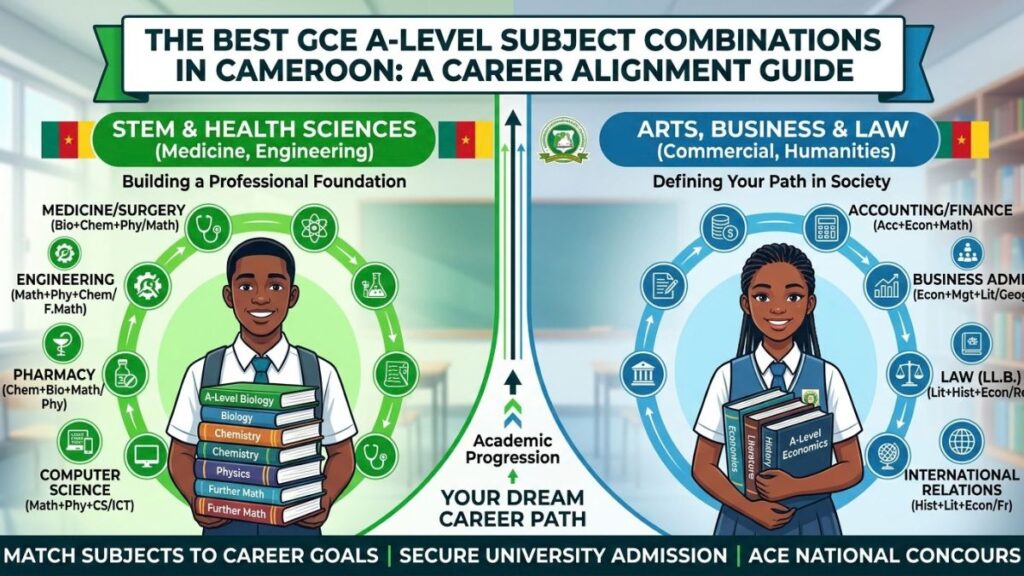
This guide provides a comprehensive directory of the best subject combinations for different careers in Cameroon. Whether your goal lies in medicine, engineering, corporate finance, law, or emerging software technology, this resource breaks down the exact Advanced Level principal combinations required to secure your spot in higher education.
Category 1: Health Sciences & Medical Professions
Healthcare remains one of the most competitive academic tracks in Cameroon. Admission into medical, pharmaceutical, and paramedical faculties relies heavily on specific prerequisite science subjects taken at A-Level.
1. Medicine & Surgery (MBBS / MD) and Dentistry
To sit for the national medical entrance exam (Concours) or apply to faculties like the Faculty of Health Sciences (FHS) at the University of Buea (UB) or the University of Bamenda (UBa), your combination must emphasize life and chemical sciences:
- Optimal Triad: Biology + Chemistry + Physics (or Pure Mathematics)
- Why it works: Biology and Chemistry are compulsory requirements. Chemistry provides the foundation for biochemistry and pharmacology, while Biology covers anatomical and cellular systems. Physics or Pure Mathematics satisfies the quantitative requirement needed for biophysics and clinical calculations.
2. Pharmacy & Pharmaceutical Sciences
Pharmacists focus heavily on chemical synthesis, drug design, and dosage calculations:
- Optimal Triad: Chemistry + Biology + Pure Mathematics (or Physics)
- Why it works: Chemistry is the core driver of pharmacy degrees. Paired with Pure Mathematics, candidates gain the quantitative precision required for pharmaceutical formulations, kinetic calculations, and chemical analysis.
3. Nursing Sciences, Medical Laboratory Sciences & Public Health
For allied health professions, the clinical focus broadens to include environmental and nutritional sciences:
- Optimal Triad: Biology + Chemistry + Food Science (or Geography / Pure Mathematics)
- Why it works: Biology and Chemistry meet the prerequisite baseline for diagnostic lab work and clinical care. Food Science or Geography provides relevant applied knowledge in human nutrition, epidemiology, and public health context.
Category 2: Engineering & Physical Sciences
Engineering and technological disciplines require rigorous mathematical foundation and conceptual mastery of physical laws. Selecting the correct subject combination at Advanced Level dictates your performance in competitive entrance examinations (Concours) for institutions like the National Advanced School of Engineering (Polytechnique / ENSPY in Yaoundé), the Faculty of Engineering and Technology (FET) at the University of Buea, and the National Higher Polytechnic Institute (NAHPI) at the University of Bamenda.
1. Civil, Mechanical, Electrical & Chemical Engineering
These core engineering branches form the backbone of national infrastructure and industrial development. Candidates are expected to master higher-level calculus, mechanics, and physical chemistry:
- Optimal Triad: Pure Mathematics + Physics + Chemistry (and Further Mathematics)
- Why it works: Pure Mathematics and Physics build essential skills in structural mechanics, thermodynamics, electromagnetism, and vector calculus. Adding Chemistry opens up material science and chemical engineering, while replacing Chemistry with Further Mathematics gives students a distinct competitive edge on the mathematical reasoning sections of the Polytechnique (ENSPY) and NAHPI entrance exams.
2. Computer Engineering & Software Development
For students targeting software engineering, embedded systems, hardware design, and network infrastructure:
- Optimal Triad: Pure Mathematics + Physics + Computer Science (or ICT)
- Why it works: Pure Mathematics provides the essential mathematical framework for algorithm design, cryptography, and computational complexity theory. Physics establishes hardware and electronic circuit principles, while Computer Science directly introduces structured programming, databases, and system architecture.
3. Architecture & Urban Planning
Architectural studies require a blend of spatial reasoning, structural engineering concepts, and physical environmental design:
- Optimal Triad: Pure Mathematics + Physics + Geography (or Art)
- Why it works: Pure Mathematics and Physics provide structural calculation capabilities needed for building mechanics and load analysis. Geography introduces environmental planning, spatial analysis, and topography, while Art develops technical drawing, spatial aesthetics, and visual design skills.
Category 3: Business, Finance & Commercial Fields
The commercial sector in Cameroon demands a balance between technical accounting knowledge, economic theory, and quantitative analytical power. Selecting the correct subject combination at Advanced Level prepares candidates for university faculties (such as the Faculty of Social and Management Sciences at UB and UBa), professional HND/BBA programs, and chartered professional certifications (like ACCA and CIMA).
1. Accounting, Auditing & Financial Management
For students targeting careers as chartered accountants, auditors, financial controllers, or tax consultants:
- Optimal Triad: Principles of Accounts + Economics + Pure Mathematics (or Management)
- Why it works: Principles of Accounts lays down fundamental double-entry bookkeeping, financial reporting, and cost accounting mechanics. Economics provides macro-micro financial context, while Pure Mathematics delivers the quantitative rigor required for financial modeling, statistics, and professional accounting examinations.
2. Banking, Corporate Finance & Economics
For future financial analysts, investment bankers, central bank economists, and risk managers:
- Optimal Triad: Economics + Pure Mathematics + Geography (or Management)
- Why it works: Economics and Pure Mathematics form the essential backbone for econometric analysis, monetary theory, and quantitative risk management. Adding Geography or Management broadens the student’s understanding of global market dynamics, commercial trade routes, and enterprise operations.
3. Management, Marketing & Business Administration
For careers in corporate strategy, human resource management, supply chain logistics, and marketing:
- Optimal Triad: Economics + Management + Literature in English (or Geography)
- Why it works: Management equips students with organizational behavior and administrative theory, while Economics supplies commercial acumen. Including Literature in English or Geography enhances critical communication, strategic writing, and environmental analysis skills essential for executive decision-making.
Category 4: Law, Social Sciences & Humanities
Humanities and social sciences focus on legal reasoning, governance, communication, and historical analysis. In Cameroon, these disciplines lead into key state institutions like the National School of Administration and Magistracy (ENAM), the International Relations Institute of Cameroon (IRIC), the Advanced School of Mass Communication (ASMAC / ESSTIC), and faculties of law and political science across public universities (such as UB and UBa).
1. Law (LL.B.) & Judicial Services
For students aiming to become barristers, magistrates, legal advisors, or court registrars entering through ENAM’s Judicial Division:
- Optimal Triad: Literature in English + History + Economics (or French)
- Why it works: Literature in English develops textual analysis, statutory interpretation, and formal argument construction. History instils case evaluation and historical context, while Economics or Religious Studies provides the socio-political and ethical framework necessary for legal systems.
2. Journalism, Mass Communication & Public Relations
For students targeting media management, public relations, broadcasting, and entrance into institutions like ASMAC / ESSTIC or university mass communication departments:
- Optimal Triad: Literature in English + History + Geography (or French/Economics)
- Why it works: High-level media output relies on strong language structure and contextual analysis. Literature in English sharpens writing and critique, History provides essential sociopolitical context, and French supports bilingual reporting in Cameroon’s dual-language environment.
3. International Relations, Public Policy & Diplomacy
For careers in diplomatic services, international NGOs, public administration, and preparation for entrance exams into IRIC or ENAM’s Administrative Division:
- Optimal Triad: History + Literature in English + Economics (or French)
- Why it works: History provides foundational understanding of global geopolitics, treaty evolution, and statecraft. Economics introduces fiscal policy and trade frameworks, while French or Literature in English supplies the advanced bilingual writing skills required for diplomatic drafting and policy analysis.
Category 5: Emerging Tech & Niche Careers
As the Cameroonian economy diversifies, specialized technical and environmental fields are growing rapidly. Fields like data science, precision agriculture, and geological exploration require targeted Advanced Level subject combinations to satisfy entrance criteria for specialized state faculties and polytechnics.
1. Cybersecurity, Data Science & Artificial Intelligence
For students targeting data engineering, machine learning, software security, and admissions into technology-focused faculties like the College of Technology (COLTECH) at UBa or specialized IT institutes:
- Optimal Triad: Pure Mathematics + Computer Science + Physics (or Further Mathematics)
- Why it works: Data science and artificial intelligence rely heavily on linear algebra, discrete mathematics, and probability. Computer Science supplies foundational programming concepts, while Physics or Further Mathematics strengthens abstract problem-solving and systemic algorithmic analysis.
2. Agricultural Engineering, Agronomy & Agribusiness
For careers in food production technology, agricultural economics, farm management, and entry into institutions like the Faculty of Agriculture and Veterinary Medicine (FAVM) at UB or the National Advanced School of Agronomy and Agro-Food Sciences (ENSAI):
- Optimal Triad: Biology + Chemistry + Geology (or Geography)
- Why it works: Biology and Chemistry cover soil biochemistry, plant physiology, and animal biology. Adding Economics or Geography introduces supply chain dynamics, land management, market analysis, and resource allocation vital for agribusiness leadership.
3. Geology, Environmental Science & Mining Engineering
For careers in petroleum exploration, mining geology, environmental impact assessment, and entry into specialized mining faculties or the School of Geology and Mining Engineering (EGEM) at the University of Ngaoundéré:
- Optimal Triad: Geology + Chemistry + Physics (or Pure Mathematics)
- Why it works: Geology establishes foundational mineralogy and structural earth sciences. Chemistry and Physics provide the chemical analysis and geophysics principles required for mineral extraction, petrology, and environmental monitoring.
Summary Matrix: Quick-Reference Subject Combination Directory
To help you quickly locate the precise subject prerequisites for your future ambition, this directory maps key career tracks in Cameroon directly to their required A-Level principal subject combinations, baseline O-Level prerequisites, and principal target university programs or national Concours:
| Target Career / Discipline | Recommended A-Level Principal Combination | Baseline O-Level Prerequisites | Key Cameroonian Institutions / Concours |
| Medicine & Surgery / Dentistry | Biology + Chemistry + Physics (or Pure Math) | Math, Physics, Chemistry, Biology, English | FHS (UB, UBa), CUSS (Yaoundé I) |
| Pharmacy & Drug Development | Chemistry + Biology + Pure Math (or Physics) | Math, Physics, Chemistry, Biology, English | FHS (UB, UBa), Faculty of Science |
| Civil / Mech / Elec Engineering | Pure Math + Physics + Chemistry (or Further Math) | Math, Add. Math, Physics, Chemistry, English | Polytechnique (ENSPY), FET (UB), NAHPI (UBa) |
| Software Engineering & Computer Science | Pure Math + Physics + Computer Science (or ICT) | Math, Add. Math, Computer Studies, Physics, English | COLTECH (UBa), FET (UB), IUT |
| Accounting, Auditing & Taxation | Principles of Accounts + Economics + Pure Math | Math, Economics, Accounting, English | Faculty of Management (UB, UBa), HND Institutes |
| Banking, Finance & Economics | Economics + Pure Math + Geography (or Management) | Math, Economics, Commerce, English | Faculty of Social & Management Sciences |
| Law (LL.B.) & Judicial Services | Literature in English + History + Economics (or French / Rel.) | English, Lit. in English, History, Math | Faculty of Law (UB, UBa), ENAM (Judicial Division) |
| Journalism & Mass Communication | Literature in English + History + Geography (or French) | English, Lit. in English, History, French | ASMAC / ESSTIC, Mass Communication (UB) |
| Diplomacy & Public Policy | History + Literature in English + Economics (or French) | English, History, French, Math | IRIC, ENAM (Administrative Division) |
| Data Science & AI | Pure Math + Computer Science + Physics (or Further Math) | Math, Add. Math, Computer Studies, Physics, English | COLTECH (UBa), Faculty of Science |
| Agronomy & Agribusiness | Biology + Chemistry + Economics (or Geography) | Math, Biology, Chemistry, Economics, English | FAVM (UB), ENSAI, FASA (Dschang) |
| Geology & Mining Engineering | Geology + Chemistry + Physics (or Pure Math) | Math, Physics, Chemistry, Geology, English | EGEM (Ngaoundéré), NAHPI (UBa) |
Frequently Asked Questions (FAQs)
1. What is the best 4th principal subject to take at A-Level to maximize my GCE point total?
Adding a 4th principal subject should only be done if you are an exceptional student who can maintain top grades across all four subjects. If you choose to take four subjects, select a subject that directly reinforces your core triad without adding excessive reading loads.
- For STEM students: Further Mathematics or Computer Science / ICT serves as an ideal 4th subject because it shares deep mathematical overlap with Pure Mathematics and Physics.
- For Commercial students: Management or Geography pairs seamlessly with Economics and Accounting.
- For Arts students: Religious Studies or French complements History and Literature in English.
Crucial Rule: Scoring 14 points across 3 principal subjects (A, A, B) is always more competitive for university admissions and Concours rankings than scoring 8 points across 4 principal subjects (C, D, D, E).
2. Can I study Law at university if I took a Pure Science combination (Physics, Chemistry, Math) at A-Level?
Yes. In the Anglophone Cameroonian university system (such as the Faculty of Laws and Political Science at the University of Buea or University of Bamenda), Law faculties generally evaluate candidates based on their total GCE A-Level points rather than strict subject prerequisites. A student with strong grades in Pure Mathematics, Physics, and Chemistry can successfully enroll in an LL.B. degree program. However, arts students who took Literature in English hold a distinct advantage during early coursework due to their training in textual critique and legal essay composition.
3. What happens if I choose a non-standard or “mixed” combination (e.g., Biology, Economics, History)?
A mixed combination limits your eligibility for specialized technical faculties and national Concours.
- You will be ineligible for medical entrance exams (Concours FHS/CUSS) because you lack A-Level Chemistry.
- You will be ineligible for engineering entrance exams (Polytechnique/ENSPY) because you lack A-Level Physics and Pure Mathematics.
- While a mixed combination allows entry into general social science degree programs, it blocks access to high-impact professional schools that enforce strict prerequisite triads. Sticking to recognized, synergistic triads ensures all higher education doors remain open.
Strategic Conclusion
Selecting the best subject combinations for different careers in Cameroon requires moving away from guesswork and adopting a reverse-engineered strategy. By identifying the prerequisite entry criteria for your target degree programs and national Concours upfront, you eliminate academic bottlenecks early and ensure your Advanced Level combination directly accelerates your long-term career goals.
To maximize your chances of academic and professional success in Cameroon:
- Stick to Recognized Triads: Avoid arbitrary “mixed” combinations (such as pairing isolated arts and sciences) that lock you out of professional faculties like FHS, Polytechnique, and IRIC.
- Master Core Baselines: Protect your O-Level foundations in English Language and Mathematics, as state universities enforce these requirements during matriculation regardless of your A-Level point score.
- Focus on Point Quality: Prioritize high grades across three well-chosen principal subjects rather than diluting your preparation across a fourth subject.
By treating your GCE subject registration as a strategic roadmap rather than a simple administrative step, you set a clear trajectory toward higher education admissions, competitive exam success, and professional achievement.